photography, gelatin-silver-print
#
16_19th-century
#
landscape
#
photography
#
gelatin-silver-print
#
cityscape
#
italian-renaissance
#
realism
Dimensions: height 349 mm, width 457 mm
Copyright: Rijks Museum: Open Domain
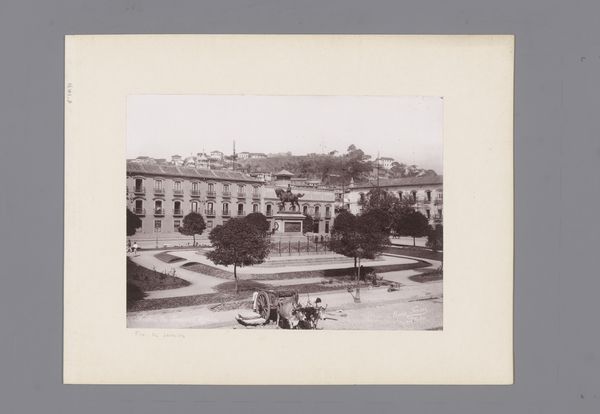
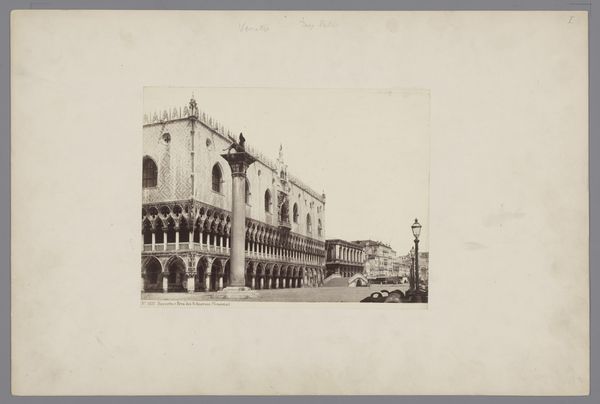
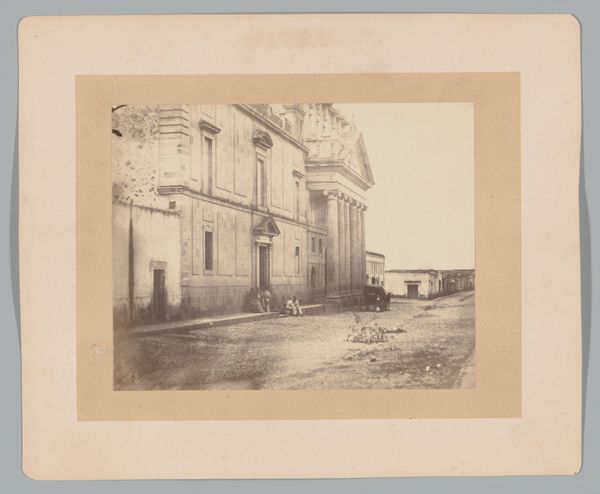
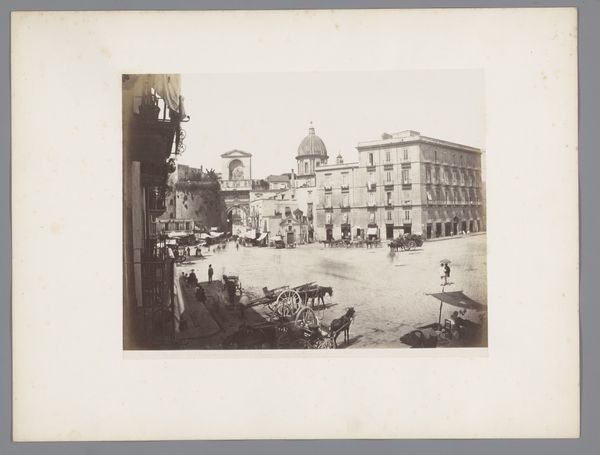
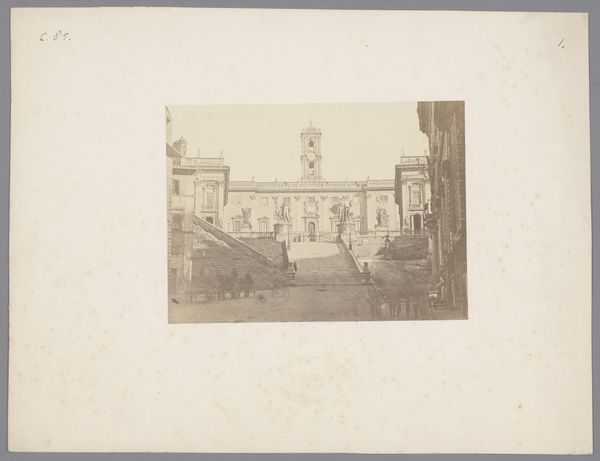
Editor: Here we have Giacomo Brogi's "View of Piazza Cavour in Milan, Italy," a gelatin silver print dating from between 1865 and 1881. The muted tones create a tranquil atmosphere. What compositional elements stand out to you? Curator: The image's success lies in its geometric organization. Note the careful balance achieved between the strong verticality of the statue on the left, mirrored, to a degree, by the repetitive verticals of the building's windows on the right. Editor: That's interesting. I was so focused on the historical aspect, I missed the geometry. Curator: Precisely. Brogi understood the inherent tension created by contrasting forms. The statue’s solidity acts as an anchor, stabilizing the potentially overwhelming detail of the architecture. And notice how the eye is led back into space through linear perspective. Editor: The empty piazza really emphasizes that. It feels less like a bustling city and more like a stage. Curator: An excellent observation. The negative space isolates the elements. One might argue that the architectural forms become objects themselves, existing for their visual presence more than their functional role. The composition, therefore, asks us to analyze form independently of function. Editor: So, in this reading, the photograph becomes less about documenting Milan and more about Brogi’s mastery of photographic composition. Curator: Indeed. The formal choices elevate it beyond mere topographical record, asking the viewer to engage with pure visual structure. It invites analytical decoding. Editor: I never thought about photography this way before, it gives me a new framework. Curator: That’s the beauty of formalist analysis: learning to "see" anew what is plainly visible.
Comments
No comments
Be the first to comment and join the conversation on the ultimate creative platform.
 Collect
 React
React Comment
More like this