About this artwork
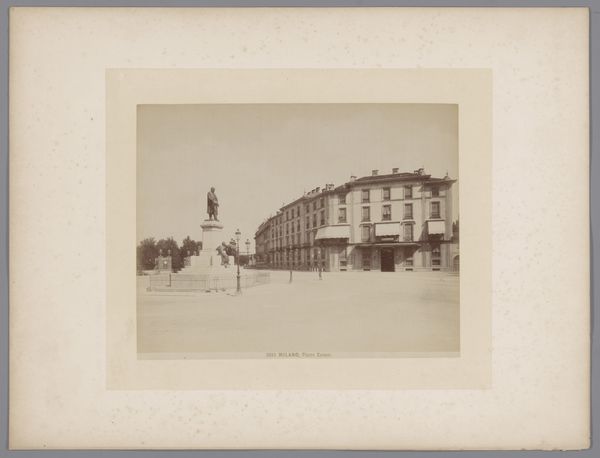
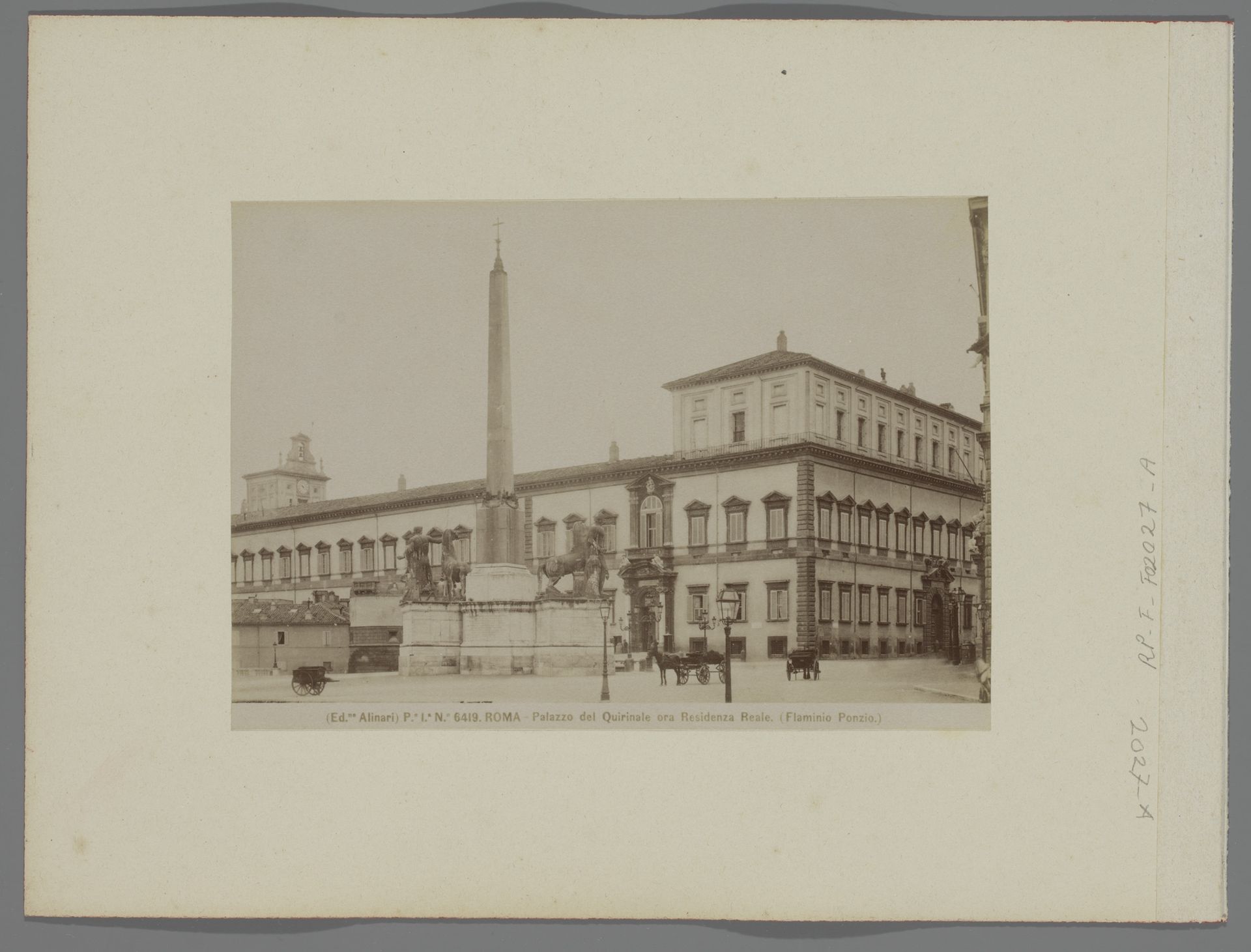
Here we see an early photograph by Fratelli Alinari, documenting the Palazzo Quirinale in Rome. The sepia tones evoke a sense of history, while the sharp lines of the architecture contrast with the soft focus of the street scene. The composition is structured around the vertical thrust of the obelisk, positioned as a central, dominating form. This monument is a clear symbol of power, anchoring the visual field and drawing the eye upwards. The Palazzo itself is rendered with precise attention to its facade. Each window and architectural detail is neatly aligned. Consider how the formal arrangement reflects a broader cultural discourse, perhaps the 19th century's fascination with order and monumentality. Yet, the subtle imperfections of the photographic medium – the slight blur, the uneven tones – introduce an element of chance, destabilizing any fixed interpretation. The photograph becomes a semiotic field, a site where history, power, and representation intersect, inviting us to decode its visual language.
Gezicht op het Palazzo Quirinale te Rome, met obelisk op de voorgrond, Italië
1852 - 1900

Fratelli Alinari
@fratellialinariLocation
RijksmuseumArtwork details
- Dimensions
- height 98 mm, width 140 mm, height 168 mm, width 224 mm
- Location
- Rijksmuseum
- Copyright
- Rijks Museum: Open Domain
Comments
Share your thoughts
About this artwork
Here we see an early photograph by Fratelli Alinari, documenting the Palazzo Quirinale in Rome. The sepia tones evoke a sense of history, while the sharp lines of the architecture contrast with the soft focus of the street scene. The composition is structured around the vertical thrust of the obelisk, positioned as a central, dominating form. This monument is a clear symbol of power, anchoring the visual field and drawing the eye upwards. The Palazzo itself is rendered with precise attention to its facade. Each window and architectural detail is neatly aligned. Consider how the formal arrangement reflects a broader cultural discourse, perhaps the 19th century's fascination with order and monumentality. Yet, the subtle imperfections of the photographic medium – the slight blur, the uneven tones – introduce an element of chance, destabilizing any fixed interpretation. The photograph becomes a semiotic field, a site where history, power, and representation intersect, inviting us to decode its visual language.
Comments
Share your thoughts