drawing, red-chalk, dry-media, ink, pencil, pastel
#
portrait
#
drawing
#
baroque
#
red-chalk
#
figuration
#
dry-media
#
ink
#
pencil drawing
#
pencil
#
pastel
#
rococo
Copyright: Public Domain
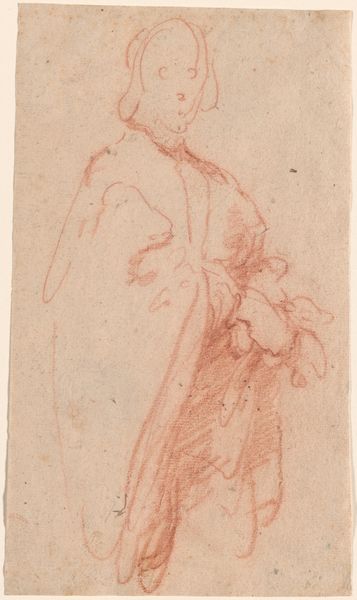
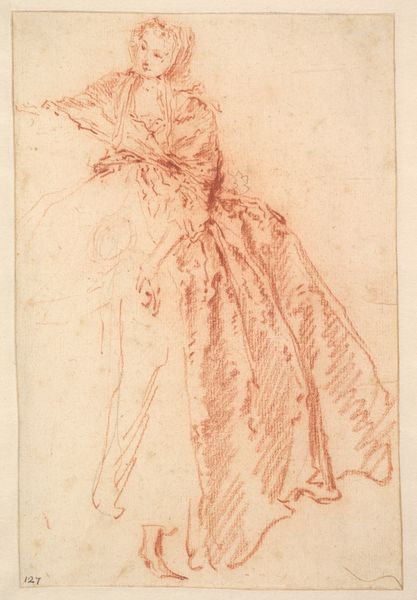
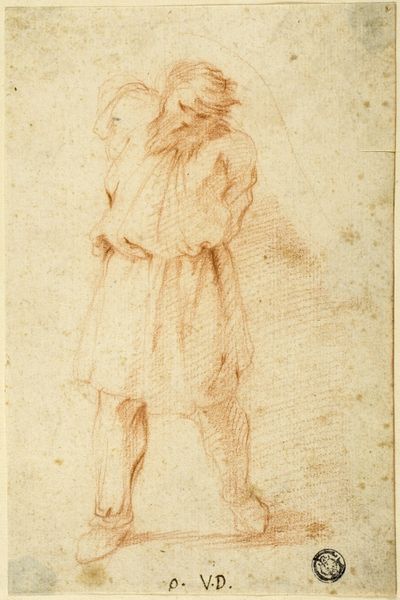
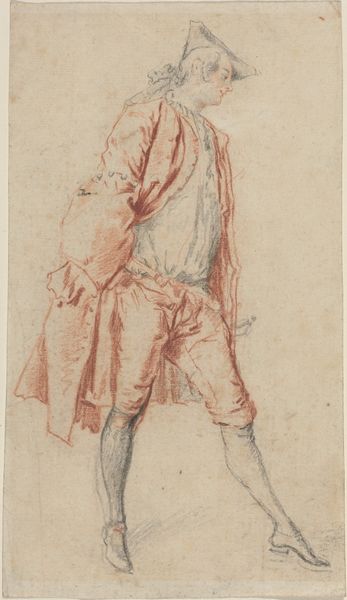
Curator: Jean-Antoine Watteau created this study, "Standing Male Figure," circa 1718-1719. It’s rendered in red chalk. Editor: Immediately striking! There's such a tactile quality despite the flatness of the image. The red chalk seems to capture not just form, but also a sense of warmth—the inherent warmth of the materials themselves. Curator: Absolutely. The red chalk medium was quite fashionable. I think this is not only a study of form, but perhaps reveals broader societal attitudes of Watteau's time, considering what constituted desirable displays of masculine identity and performance. The figure seems burdened with his drape or cloak. Is it simply his posture, or is he symbolic of greater social or political burdens? Editor: The cloak dominates; you are right! It’s like examining the labor embedded within luxury. The cloth probably cost someone an exorbitant sum of hours or labor. The rough quality of the sketch combined with this potential exploitation creates tension. Curator: This tension highlights the nuances of the period. We have the aristocracy and wealth contrasted with its underbelly of social injustices and the laboring class who provided for that opulent, yet performative aristocracy. This study could certainly symbolize that friction. Editor: Looking closer, the softness of the chalk creates a texture that belies its mass production—I would want to examine what kind of chalk was accessible, and what labor went into creating and transporting that tool in itself. What class status did this supply item carry with it? Curator: This invites us to reconsider how the materiality is intrinsically linked to its broader context. It prompts questions about not only who produced the art but what unseen or often ignored infrastructures and labor arrangements facilitated these artistic endeavors, raising profound considerations concerning gender, power and artistic practices within social class hierarchies. Editor: I agree! I initially saw just a quick drawing. Now, I’m seeing the network of hands involved, the potential exploitations, the quiet dialogue between labor and aesthetics right here in this modest red chalk drawing. Curator: Precisely, seeing beyond just the aesthetics of art. Editor: What began as an impression of surface now exposes deeper stories of human interactions, production methods and the materials available to express our collective narratives.
Comments

stadelmuseum over 2 years ago
⋮
The Städel Museum owns a small but important group of drawings by Antoine Watteau. This direct, sensitive medium played a particularly important role for the painter who created the 'fêtes galantes' and recorded attentive encounters and sensitive perceptions. Watteau's preferred drawing technique was chalk: black chalk and especially red chalk, which can create both lines and surfaces, as well as form strong accents and delicate transitions. The interplay with the colour of the paper can produce an effect similar to that of a painting. The 'Standing Male Figure' from circa 1718-19 is a masterly example of all this.The man, who is leaning on an object which is not shown in the picture, is wearing an old-fashioned beret adorned with a feather. Over his shoulder is draped a coat which falls in dark folds. These heavy forms contrast with the delicacy of the slightly inclined face and the nervous hand. The drawing is a model study, and the same figure can be found in the painting 'Les Charmes de la Vie' ('The Attractions of Life') in the Wallace Collection in London. There, he is leaning on the back of a chair and listening to the music. The similarity of the study and the painting that followed leads us to surmise that the drawing was made expressly for this purpose and that Watteau was attempting with this dreamily reflective facial expression to depict the experience of listening. Through the interest in the facial expression, the study becomes a portrait at the same time. There are good reasons for assuming that the gentleman standing and listening is the painter Nicolas Vleughels (1668-1737), who later became the director of the Académie de France in Rome. He was a friend of Watteau's and the two men lived at the same address in Paris in about 1718-19. The study, which may also be a personal and characterising portrait, will have been produced around that time.


Join the conversation
Join millions of artists and users on Artera today and experience the ultimate creative platform.
 Collect
More like this