drawing, print, pencil
#
portrait
#
drawing
# print
#
pencil sketch
#
figuration
#
romanticism
#
pencil
#
genre-painting
Dimensions: Sheet: 14 3/16 × 10 7/16 in. (36 × 26.5 cm)
Copyright: Public Domain
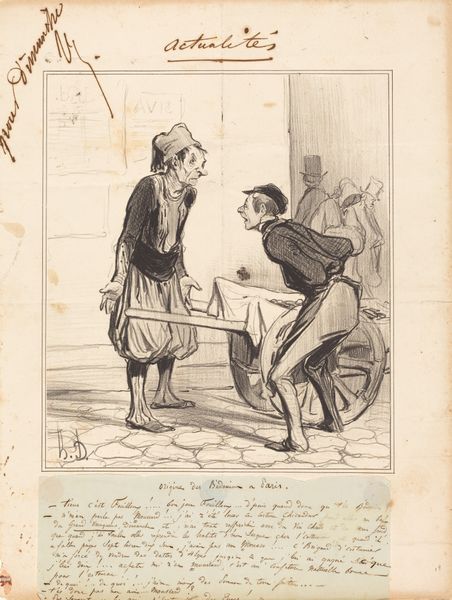
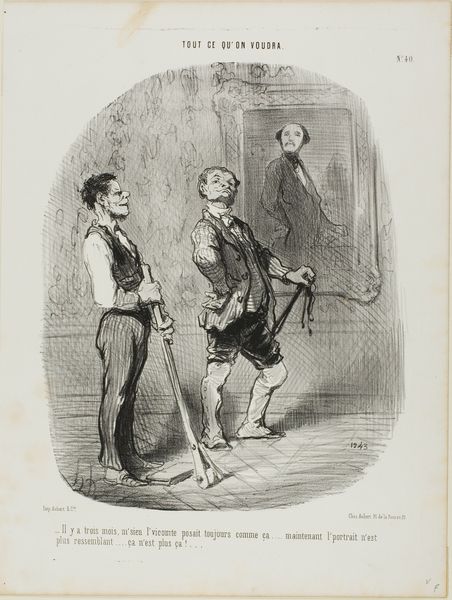
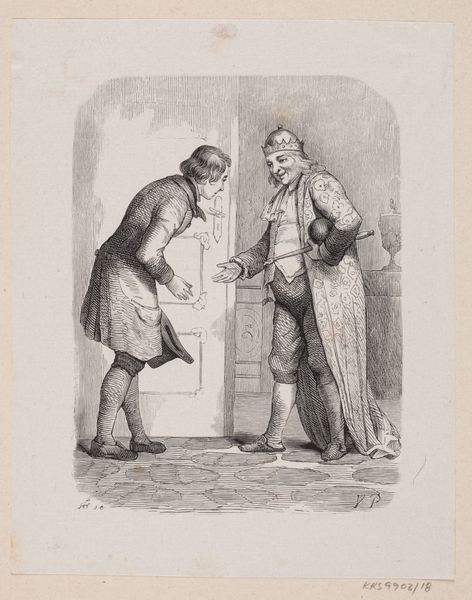
Editor: Here we have "The Godmother's Bouquet" by Baron Dominique Vivant Denon, created sometime between 1795 and 1830. It’s a pencil drawing, perhaps intended as a print. I’m struck by the contrast between the formality of the man presenting the bouquet and the woman's rather casual attire. What's your read on this piece? Curator: For me, the interest lies in understanding this drawing within the social context of its creation. Think about the availability and cost of materials – pencils, paper, and the means of producing prints at that time. Who had access to them? This image isn't just about a charming scene; it reflects the economic realities of artistic production. Editor: So, you're focusing on the physical production of the artwork itself. How does that affect our understanding? Curator: Precisely! Consider the labor involved in producing multiple prints, likely for distribution. This image moves beyond the singular "art object" toward a manufactured item. Moreover, consider the role of "bouquets" as a form of social exchange, manufactured goods themselves that carried symbolic weight. What narratives about labor, gifting, and class might this drawing illuminate? Editor: I see! The flowers aren't just pretty; they’re part of a system. And the drawing, too, is part of a production process, a kind of commodity itself. Curator: Exactly. Looking closely at the medium -- pencil -- allows us to see this piece less as a high art object and more as something closer to craft, a step away from painting, or perhaps the preliminary sketch of something that would be rendered more formally elsewhere. Editor: So, appreciating it requires looking at the social and material circumstances of its making. That's a different perspective than I usually take! Thanks for opening my eyes. Curator: And I'm reminded to look closely at what remains elusive -- What was Denon trying to communicate in a sketch versus the presumed more formal, finished product? The materiality leads me to question the assumed intent.
Comments
No comments
Be the first to comment and join the conversation on the ultimate creative platform.
 Collect
 React
React Comment
More like this