About this artwork
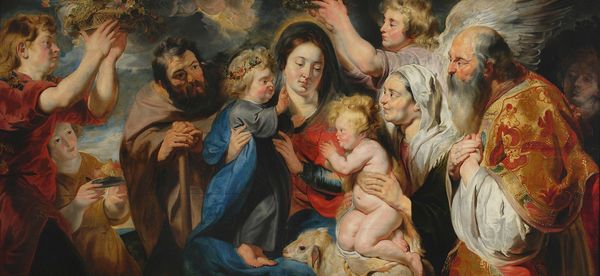
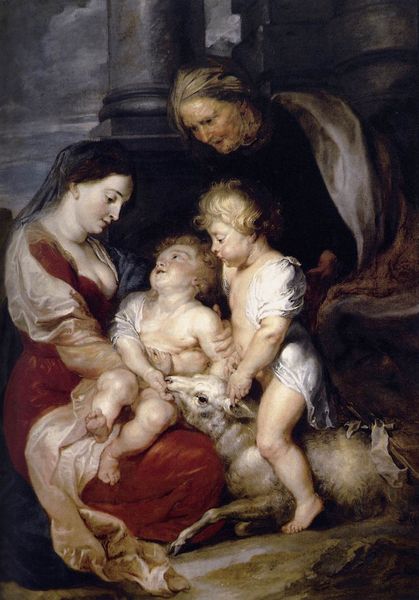
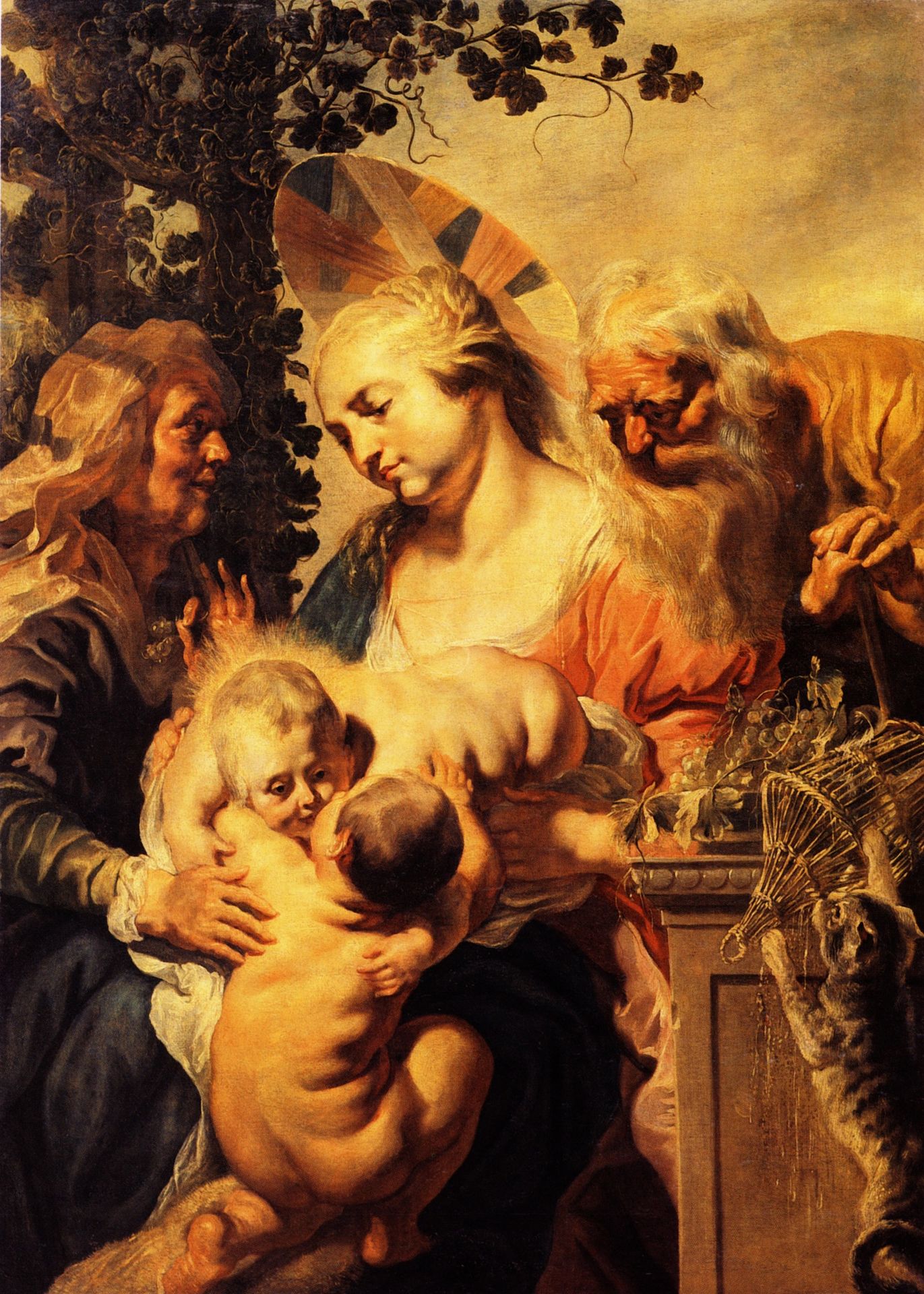
Editor: Here we have Jacob Jordaens' "Holy Family with Elizabeth and Child John the Baptist" from 1615, rendered in oil on canvas. The way the figures are grouped so intimately almost tumbles out of the frame. What do you see in this piece, particularly in how it represents the family dynamic? Curator: This work presents us with an idealized version of familial love, but it's crucial to unpack its historical context. Jordaens painted this during a time of significant religious and social upheaval. How does the inclusion of Elizabeth and John the Baptist complicate the traditional image of the Holy Family, and what commentary might it offer on community and kinship beyond the nuclear family? Editor: That’s interesting! It's almost as if he’s broadening the definition of family, perhaps to suggest a more inclusive understanding. Is that cat symbolic, by the way? Curator: Absolutely, and considering Jordaens’ social position during the Counter-Reformation it is relevant to any art historical study. What societal issues concerning religion were at stake? I would recommend starting there. The cat, and other surrounding details in Jordaens' compositions aren't simply decorative; they often carry moral or symbolic weight. Think about representations of women, in relation to home, motherhood, religion, class… What feelings are conjured and where might those feelings originate? Editor: So, the painting becomes less about simple familial piety and more about the sociopolitical dimensions of faith and family. That changes my perspective completely. Curator: Exactly. By situating the artwork within its historical and cultural framework, we unveil its potential to engage in conversations about identity, gender, power, and faith. Editor: That’s really given me a richer understanding, I feel better equipped now. Thanks so much for expanding my view. Curator: It’s crucial that we continually engage with art critically.
Holy Family with Elizabeth and Child John the Baptist 1615

Jacob Jordaens
1593 - 1678Location
Royal Museums of Fine Arts of Belgium, Brussels, BelgiumArtwork details
- Medium
- painting, oil-paint
- Dimensions
- 155 x 113 cm
- Location
- Royal Museums of Fine Arts of Belgium, Brussels, Belgium
- Copyright
- Public domain
Tags
portrait
baroque
painting
oil-paint
figuration
oil painting
group-portraits
christianity
mythology
animal drawing portrait
history-painting
facial portrait
portrait art
virgin-mary
christ
Comments
No comments
About this artwork
Editor: Here we have Jacob Jordaens' "Holy Family with Elizabeth and Child John the Baptist" from 1615, rendered in oil on canvas. The way the figures are grouped so intimately almost tumbles out of the frame. What do you see in this piece, particularly in how it represents the family dynamic? Curator: This work presents us with an idealized version of familial love, but it's crucial to unpack its historical context. Jordaens painted this during a time of significant religious and social upheaval. How does the inclusion of Elizabeth and John the Baptist complicate the traditional image of the Holy Family, and what commentary might it offer on community and kinship beyond the nuclear family? Editor: That’s interesting! It's almost as if he’s broadening the definition of family, perhaps to suggest a more inclusive understanding. Is that cat symbolic, by the way? Curator: Absolutely, and considering Jordaens’ social position during the Counter-Reformation it is relevant to any art historical study. What societal issues concerning religion were at stake? I would recommend starting there. The cat, and other surrounding details in Jordaens' compositions aren't simply decorative; they often carry moral or symbolic weight. Think about representations of women, in relation to home, motherhood, religion, class… What feelings are conjured and where might those feelings originate? Editor: So, the painting becomes less about simple familial piety and more about the sociopolitical dimensions of faith and family. That changes my perspective completely. Curator: Exactly. By situating the artwork within its historical and cultural framework, we unveil its potential to engage in conversations about identity, gender, power, and faith. Editor: That’s really given me a richer understanding, I feel better equipped now. Thanks so much for expanding my view. Curator: It’s crucial that we continually engage with art critically.
Comments
No comments