painting, acrylic-paint
#
portrait
#
contemporary
#
painting
#
asian-art
#
acrylic-paint
#
figuration
#
social-realism
#
group-portraits
Copyright: Zhang Xiaogang,Fair Use
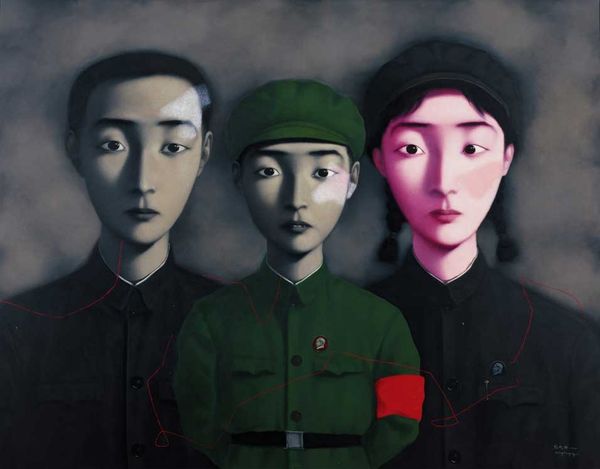
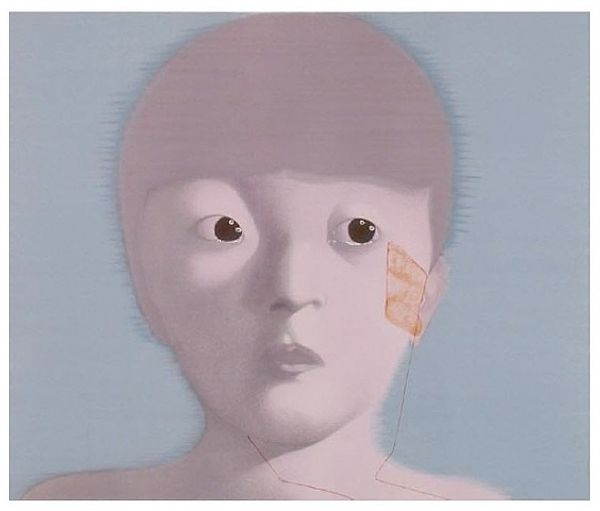
Curator: So, what captures your attention in Zhang Xiaogang’s "A Big Family" from 1995? It’s an acrylic on canvas piece. The palette is quite subdued, except for the centrally-placed child's unnaturally red face. Editor: It’s the material itself; the smoothness of the acrylic makes their skin seem almost like porcelain. Also, it evokes this strange feeling of uniformity and unease simultaneously. What can you tell me about it? Curator: I see a potent commentary on the means of production, particularly concerning identity and its social construction. Notice the uniformity of their attire; they’re painted with an incredible level of detail with fine brushes in this washed out, nearly monochrome world. Then there’s the red in the child's face—it signifies passion, political fervor but also standardization of the subject and the worker in the Mao era and its effect on future generations. The canvas support serves to perpetuate and literally prop up these ideas. What materials did the artist choose to convey these meanings, and why? Editor: The redness draws my eye because it seems deliberately artificial, a kind of "branded" identity perhaps? Curator: Precisely! And consider the recurring red lines, meticulously added, as connections, sutures. Think of those production lines—literal means to produce for the masses. It invites reflection on the individuals shaped by those very systems and networks. How does this specific use of materials relate to the broader context of post-Cultural Revolution China? Editor: I hadn’t thought of the red lines as sutures before! They’re literally “stitching” the family, the ideology together. Curator: And the cool gray washes do an exceptional job of creating distance. Zhang isn’t just painting a family; he’s deconstructing the means by which families and identities are manufactured within specific socio-political systems. I wonder how his artistic decision affects your interpretation now. Editor: I see now that Zhang uses this seemingly straightforward family portrait not only to question ideas surrounding uniformity and collectivism, but he uses acrylic, canvas and thread to offer up that the production of national identity in China left scars. Thanks for the new perspective!
Comments
No comments
Be the first to comment and join the conversation on the ultimate creative platform.
 Collect
 React
React Comment
More like this