About this artwork
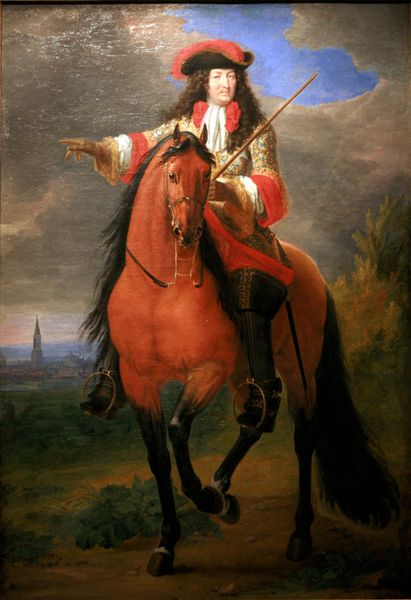
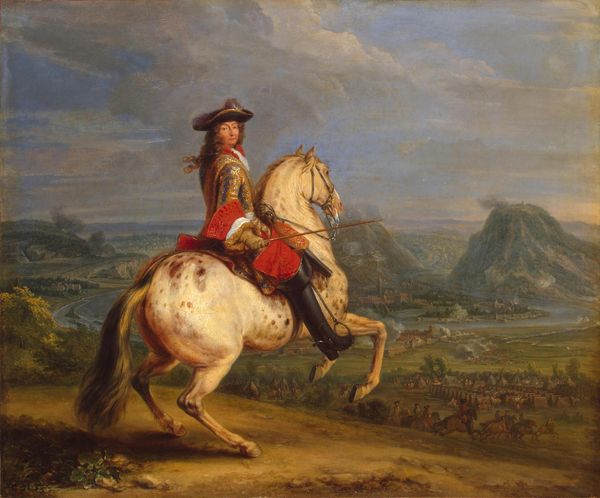
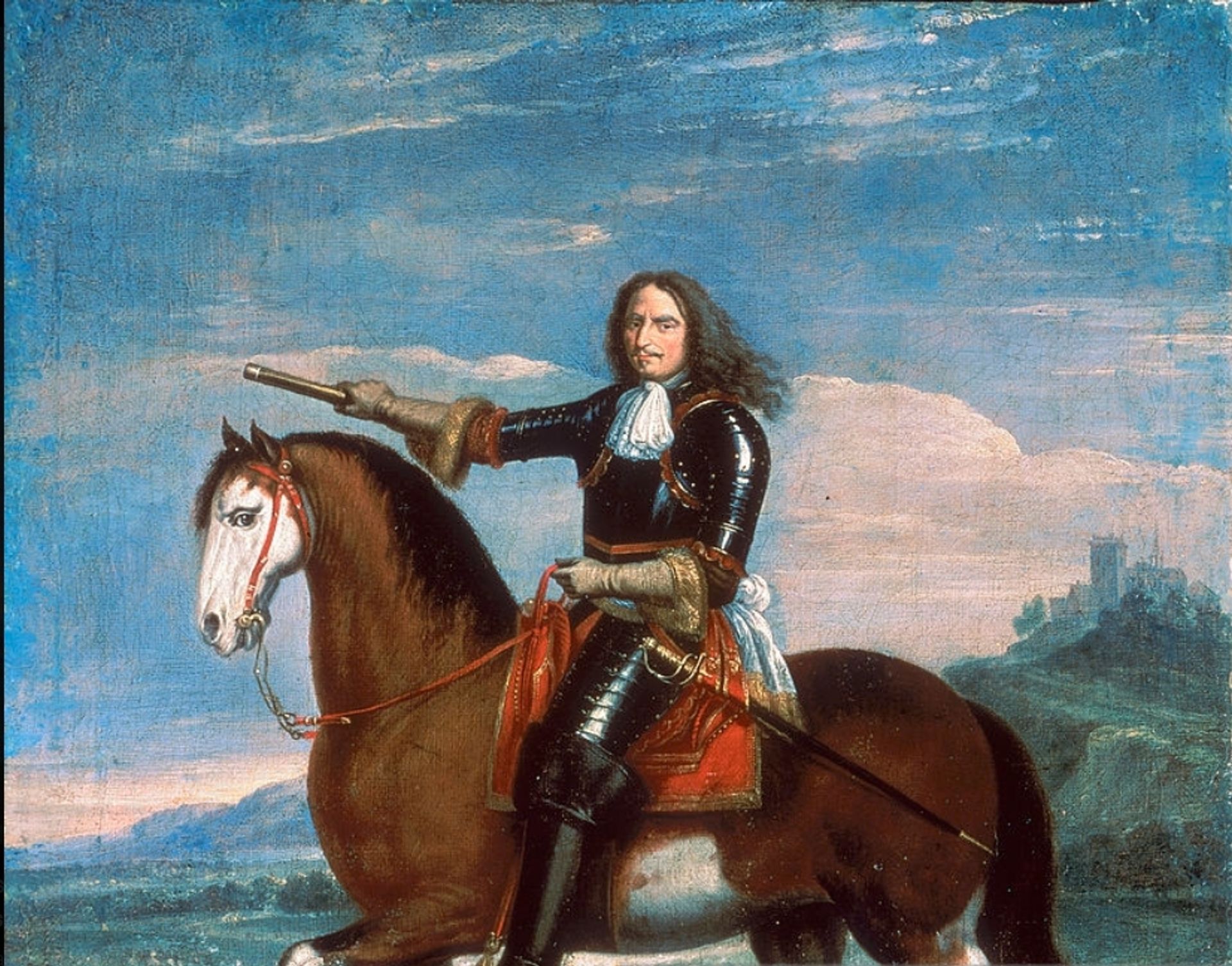
Adam van der Meulen’s canvas captures Henri De La Tour D'auvergne, Vicomte De Turenne, in an equestrian portrait, its date unknown. The composition is immediately striking, dominated by the figure of Turenne on horseback against a dynamic sky. Van der Meulen employs a palette where cool blues of the sky contrast with the warm browns and reds of the horse and landscape. The artist uses the diagonal line of Turenne's arm, pointing with a baton, to disrupt the composition and guide the viewer’s eye. The baton and the horse are not merely representational, but function as signs within a semiotic structure that elevates Turenne to a figure of authority and action. The use of light across the armour creates a play of textures, complicating the surface and hinting at the complexities beneath the subject's martial facade. Consider how the landscape serves not just as backdrop but as an extension of Turenne's domain. The castle in the distance, though small, anchors the composition and speaks to power, territory, and the gaze of command. This interplay between figure and ground, between the textures of paint and the symbols of power, invites us to continuously reinterpret the artwork.
Equestrian Portrait of Henri De La Tour D'auvergne, Vicomte De Turenne


Artwork details
- Location
- Pushkin Museum, Moscow, Russia
- Copyright
- Public domain
Tags
Comments
Share your thoughts
About this artwork
Adam van der Meulen’s canvas captures Henri De La Tour D'auvergne, Vicomte De Turenne, in an equestrian portrait, its date unknown. The composition is immediately striking, dominated by the figure of Turenne on horseback against a dynamic sky. Van der Meulen employs a palette where cool blues of the sky contrast with the warm browns and reds of the horse and landscape. The artist uses the diagonal line of Turenne's arm, pointing with a baton, to disrupt the composition and guide the viewer’s eye. The baton and the horse are not merely representational, but function as signs within a semiotic structure that elevates Turenne to a figure of authority and action. The use of light across the armour creates a play of textures, complicating the surface and hinting at the complexities beneath the subject's martial facade. Consider how the landscape serves not just as backdrop but as an extension of Turenne's domain. The castle in the distance, though small, anchors the composition and speaks to power, territory, and the gaze of command. This interplay between figure and ground, between the textures of paint and the symbols of power, invites us to continuously reinterpret the artwork.
Comments
Share your thoughts