drawing, print, paper, pencil
#
portrait
#
pencil drawn
#
drawing
#
animal
# print
#
pencil sketch
#
paper
#
pencil drawing
#
pencil
Dimensions: image: c. 232 x c. 250 mm paper: 319 x 324 mm
Copyright: National Gallery of Art: CC0 1.0
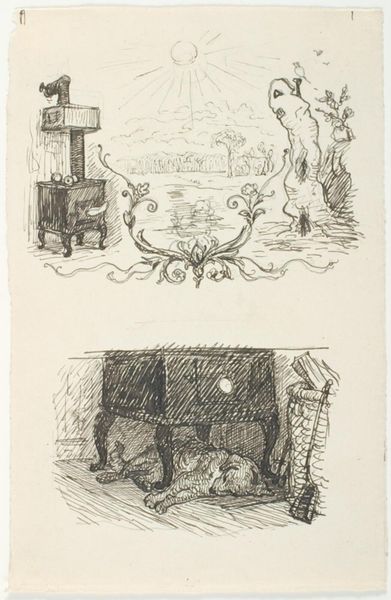
Curator: Here we have Elise Cavanna’s delicate pencil drawing, “Arno and the Cats,” likely created around 1936. It captures a moment of domestic tranquility, a scene with pets lounging amidst furniture. What strikes you most about it? Editor: There's an understated stillness that feels quite palpable, doesn't it? The muted palette focuses my attention on the subjects, specifically the arrangement and relationships among them. Though peaceful, there's something almost surveillant about it, like they’re all performers on a stage. Curator: I completely agree. It has that observed feeling. Cavanna uses light and shadow so well, even in pencil, to create depth and separate planes. There’s a subtle spotlight cast upon the cat draped dramatically across the table. The dog appears statuesque, anchored to the floor, while another cat dissolves under the chair... What a perfectly feline disposition rendered in monochrome. Editor: I'm particularly interested in what this drawing reveals about relationships within the domestic sphere during this time. The positioning of the animals hints at a sort of social hierarchy, mirroring, perhaps, dynamics present in society at large, with clear indications of class and privilege. One is lounging on the table, literally above, while the other crouches vulnerably beneath. And even the dog, larger and supposedly free, is essentially stuck on the floor, a boundary established by the others in the composition. Curator: What a sharp read of these seemingly benign pets, It’s so interesting to see them as representatives in a drama about status. Personally, I wonder who Arno is, whose domesticity is this? This is very unlike any other drawing I know. Cavanna somehow gives everyone space. Editor: Absolutely, it pushes the boundaries of a typical family portrait. I see a commentary on power structures cleverly disguised within a simple composition, offering a nuanced view of domesticity. It prompts me to consider who is being seen and who is hidden, who’s in charge and how this reality extends far beyond this little room and table. Curator: Yes, and at the end of the day, that might be the essence of Cavanna’s beautiful drawing: a portrait that prompts more questions than answers. Editor: A call to further investigation indeed, both into ourselves and society around us.
Comments
No comments
Be the first to comment and join the conversation on the ultimate creative platform.
 Collect
 React
React Comment
More like this