

1548
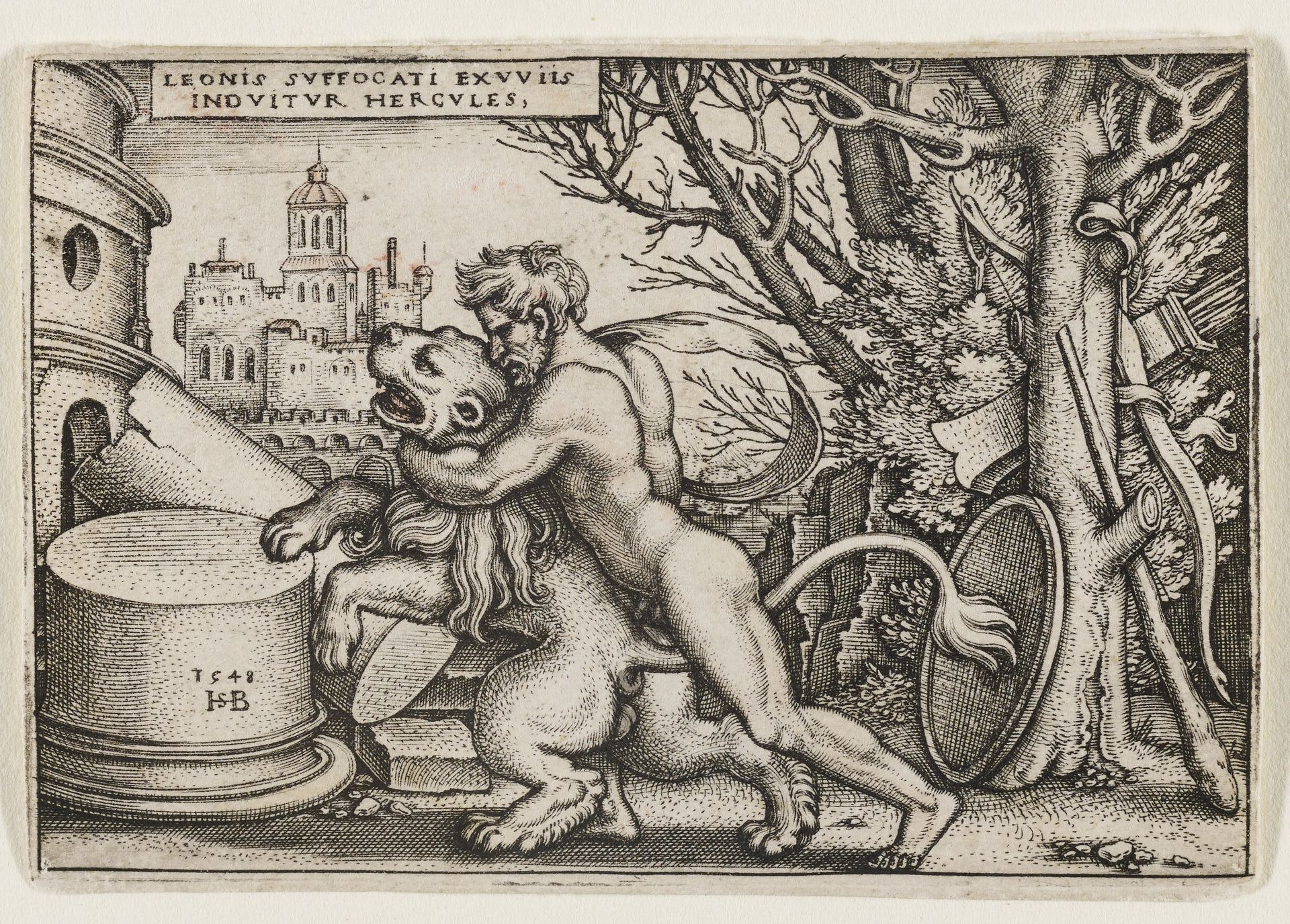
Hercules and the Nemean Lion, from The Labors of Hercules


Listen to curator's interpretation
Curatorial notes
Editor: Here we have Sebald Beham’s “Hercules and the Nemean Lion, from The Labors of Hercules,” created in 1548. It’s an engraving on paper. It strikes me as a very dynamic, almost claustrophobic composition, contrasting with the almost whimsical background elements. What symbols or cultural meanings are embedded in this image? Curator: Absolutely! This print is rich with iconographic references. Consider Hercules himself – a figure synonymous with strength, virtue, and ultimately, deification in Greco-Roman mythology. But Beham was a German artist of the Northern Renaissance, when humanism took on distinct characteristics! Editor: I can see that the style and details in Hercules recall classical art. The human form is definitely idealized here, even in the context of violence. Curator: Precisely! The lion itself, though fearsome, isn't merely a beast to be conquered. It is the embodiment of untamed nature, of primal instincts that Hercules, representing civilized humanity, must overcome. Do you see how this small engraving holds broader tensions, like classical vs. vernacular style, sacred versus secular, the ancient versus contemporary? Editor: That's fascinating! The composition feels like an assertion of man's power over nature, both animalistic and environmental. It appears very consciously staged. Curator: It certainly is! Moreover, it invites us to consider our contemporary moment: what modern-day "lions" are we grappling with, and what symbols do we create to face those beasts? Editor: That’s given me a totally different perspective on how timeless these narratives remain. It’s impressive to see how an artist can encapsulate all these complex ideas into one piece. Curator: It’s rewarding to remember that, even within constraints, visual language possesses cultural continuity through visual symbols, and their psychological impacts on us!
