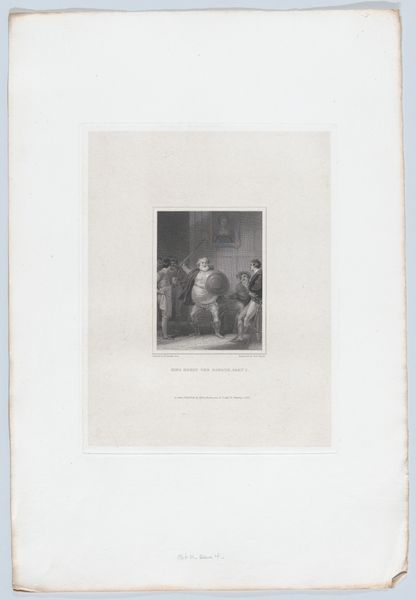
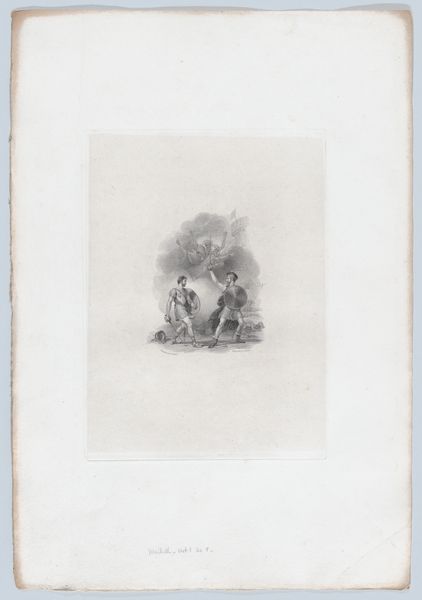
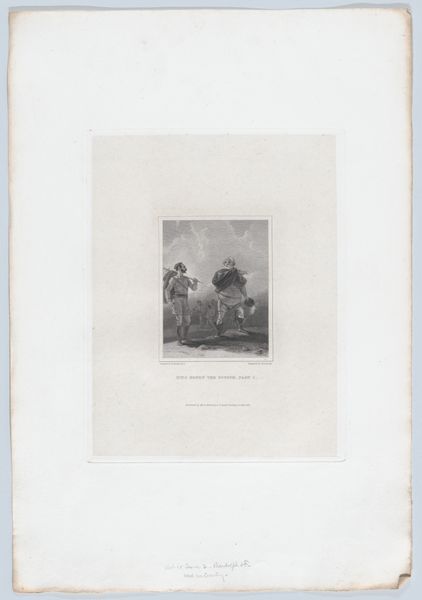
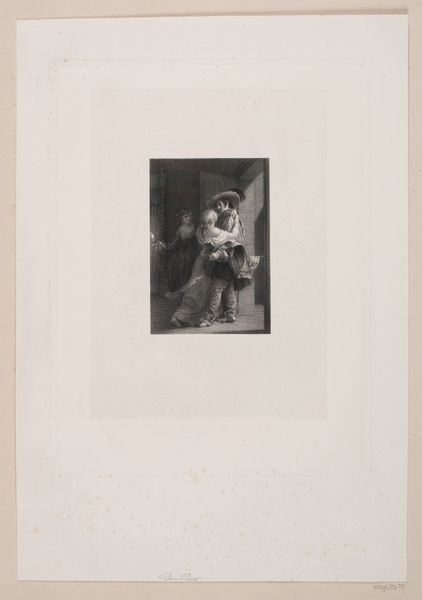
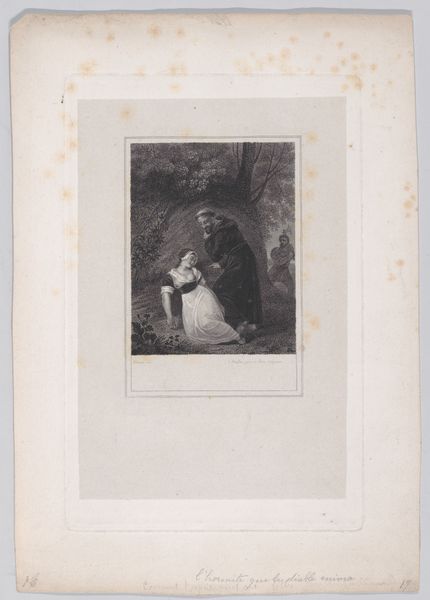
Falstaff on the Battlefield (Shakespeare, King Henry IV, Part I, Act 5, Scene 4) 1825
0:00
0:00


drawing, print, engraving
#
drawing
#
pale colours
# print
#
landscape
#
figuration
#
romanticism
#
men
#
history-painting
#
engraving
Dimensions: Plate: 10 1/16 × 7 13/16 in. (25.5 × 19.8 cm) Sheet: 17 3/16 × 11 5/8 in. (43.7 × 29.5 cm)
Copyright: Public Domain
Charles Heath the elder created this engraving, “Falstaff on the Battlefield”, illustrating a scene from Shakespeare’s *Henry IV, Part I*. Note the character of Falstaff, seemingly embracing a corpse on the battlefield. This embrace, though born of cowardice and deceit in Shakespeare’s play, carries echoes of earlier, more profound gestures. Think of the Pietà, where Mary cradles the body of Christ – a universal symbol of grief, protection, and unconditional love. Here, the motif is twisted, subverted. Falstaff's embrace is not of love, but of self-preservation. He feigns death to avoid danger, using the fallen body as a shield. This grasping for protection, this mirroring of profound sorrow for selfish ends, reminds us of the human capacity to both revere and desecrate the sacred. The image resonates because it taps into our collective memory of grief and sacrifice, even as it presents a parody of these deeply felt emotions. It highlights the cyclical nature of symbols, and how they shift across time, echoing through art, literature, and our subconscious minds.
Comments
No comments
Be the first to comment and join the conversation on the ultimate creative platform.
 Collect
 React
React Comment
More like this