carving, sculpture, wood
#
carving
#
sculpture
#
figuration
#
sculpture
#
wood
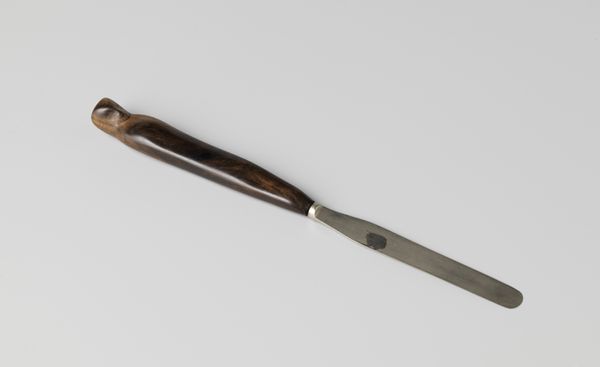
Dimensions: 10 3/4 x 2 1/2 x 1 5/8 in. (27.31 x 6.35 x 4.13 cm)
Copyright: Public Domain
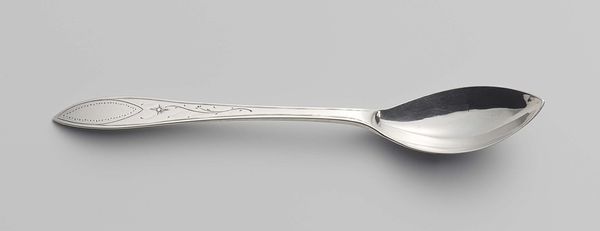
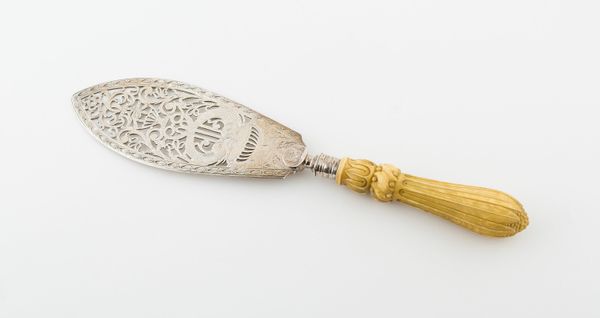
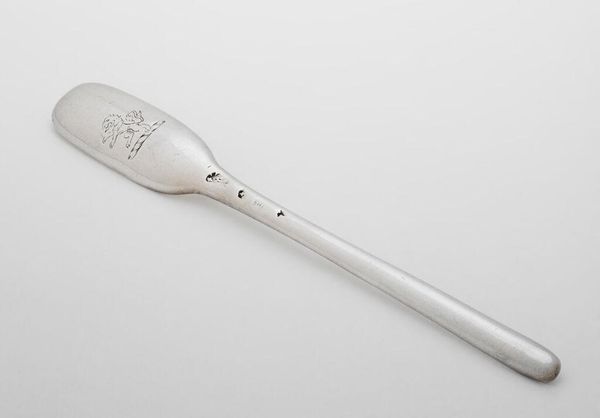
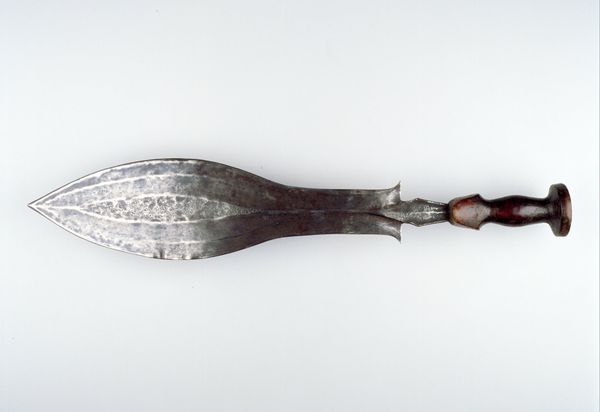
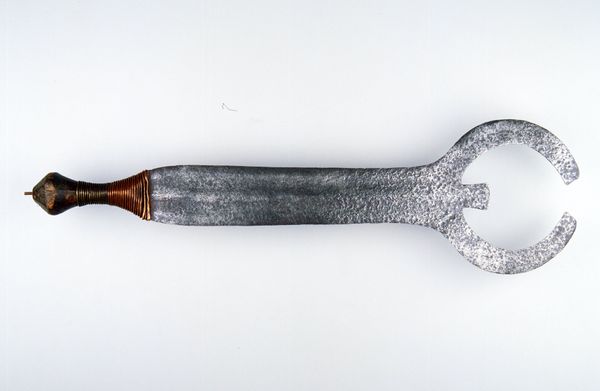
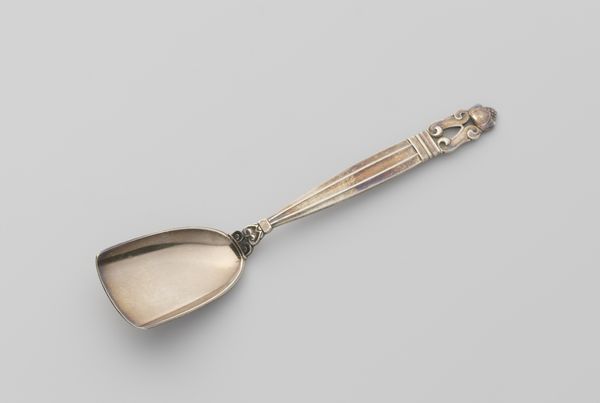
Curator: Let's turn our attention to this curious object titled "Spatula," crafted around the 19th century. It resides here at the Minneapolis Institute of Art. Editor: My first thought is that this spatula’s striking silhouette achieves such elegant minimalism. The figure, carved from what looks like a single piece of dark wood, offers a pronounced contrast of line and void. Curator: Indeed. When we look closer, we discover a fusion of the functional with the deeply symbolic. The incorporation of the human form, particularly, elevates this kitchen utensil. We see this merging of object and image echoing in countless cultural traditions. Are we engaging with ritual or mundane domesticity? Editor: Precisely. The form itself complicates matters: notice the sinuous curves. Consider how the artist has employed decorative piercings outlined in contrasting gold. These serve not only to lighten the weight, but to articulate planes and create a staccato rhythm up through to the oval of the head. Curator: And it’s in this representation of a face where it becomes an emotionally charged figure—that simple arrangement of features conveys humanity—I find my mind reaching for stories of connection and continuity, like ancestors watching over us. Perhaps this wasn't *just* for stirring a pot. Editor: Or perhaps that very observation highlights an ingrained cognitive bias. We project meaning onto the most basic shapes. This reading, informed by Jungian archetypes and your preoccupation with collective memory, does offer a pathway to approach an object with unknown origins or specific context. But to avoid over-interpretation, should we not remain grounded in the object’s empirical qualities, and leave such mythopoetic readings to the listener's discretion? Curator: Fair enough. Although, for me, such a beautifully crafted piece inevitably invokes reflections on humanity’s connection with nature and our perpetual desire to infuse everyday items with spirit. Editor: I can agree to that. It is this tension between form and utility that stimulates interpretation, highlighting our propensity for recognizing abstract features. This analysis helps me understand its possible cultural place. Curator: Ultimately, this spatula, while seemingly simple, holds complexities that can prompt meaningful discussions across generations and cultures. Editor: Yes, the convergence of its constituent properties delivers aesthetic impact regardless of cultural or symbolic understanding, even if that provokes a range of projected associations.
Comments
No comments
Be the first to comment and join the conversation on the ultimate creative platform.
 Collect
 React
React Comment
More like this