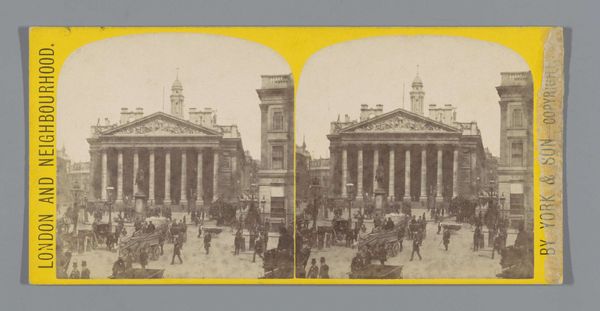
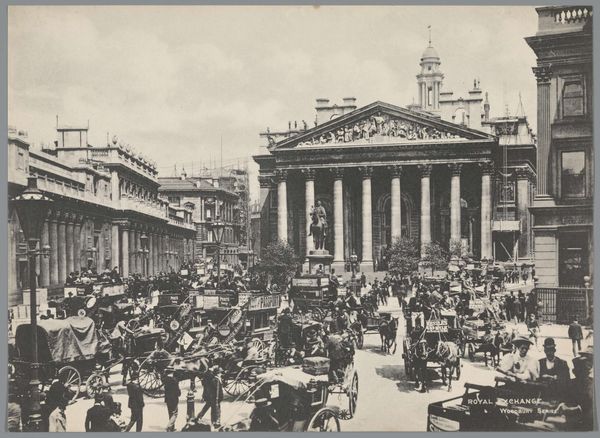
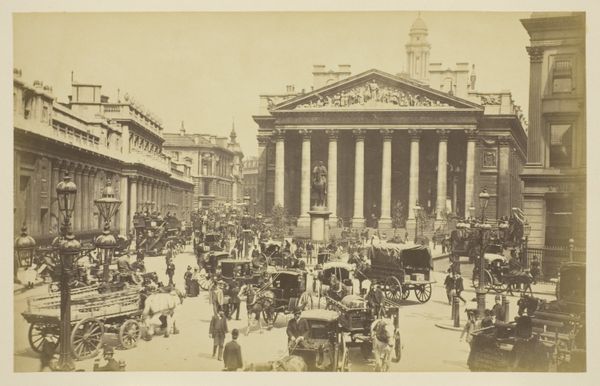
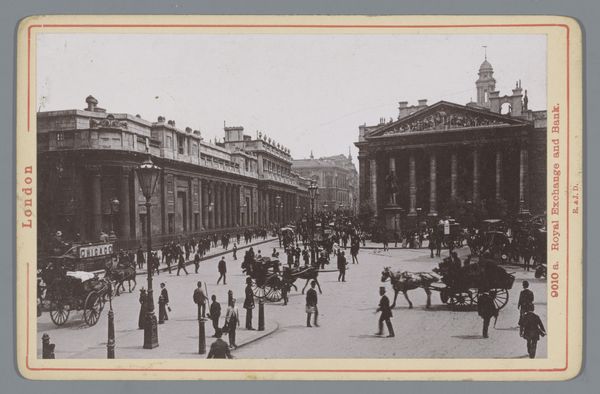
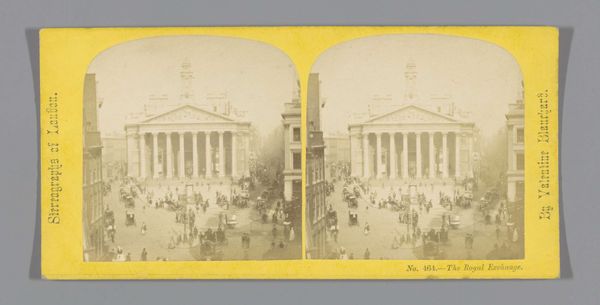
![[Pair of Stereograph Views of the Royal Exchange, London, England] by J. F. Jarvis](https://d2w8kbdekdi1gv.cloudfront.net/eyJidWNrZXQiOiAiYXJ0ZXJhLWltYWdlcy1idWNrZXQiLCAia2V5IjogImFydHdvcmtzL2VjOTFkMDAyLTkwYzItNDVmMS1hODA1LTdiNGJlMGVkNWQ3MS9lYzkxZDAwMi05MGMyLTQ1ZjEtYTgwNS03YjRiZTBlZDVkNzFfZnVsbC5qcGciLCAiZWRpdHMiOiB7InJlc2l6ZSI6IHsid2lkdGgiOiAxOTIwLCAiaGVpZ2h0IjogMTkyMCwgImZpdCI6ICJpbnNpZGUifX19)
1850 - 1919
[Pair of Stereograph Views of the Royal Exchange, London, England]


Listen to curator's interpretation
Curatorial notes
Editor: This is a stereograph, essentially a double image, of the Royal Exchange in London, taken between 1850 and 1919, and printed using the gelatin silver process. The effect is quite striking! I notice the stark contrast and the almost overwhelming geometry of the architecture. How would you interpret the choices made by the photographer here? Curator: Note the carefully framed composition. The building's facade, a dominant grid of columns, acts as the central focus. The foreground bustling with activity creates a contrasting layer. Editor: It’s like a rigid framework against a lively current. Curator: Precisely. The use of gelatin silver printing emphasizes tonal range. Consider the texture of the stone versus the details in the figures and carriages. The two prints create a three-dimensional depth, calling attention to how perspective influences our understanding of space. Do you see how this interplay of line, form, and light shapes our experience of this space? Editor: I do, the sharp lines against the softer textures gives depth. It feels both monumental and teeming with life. It’s about the pure visual language of space. Curator: Indeed. Beyond representation, the composition examines visual order and relationships. Form here dictates content, offering a unique engagement through inherent qualities and how its materiality informs the meaning we extract from the piece. Editor: Thank you! I now understand that the composition highlights how geometry, depth, and light play an important part in the aesthetic feeling evoked from the piece.