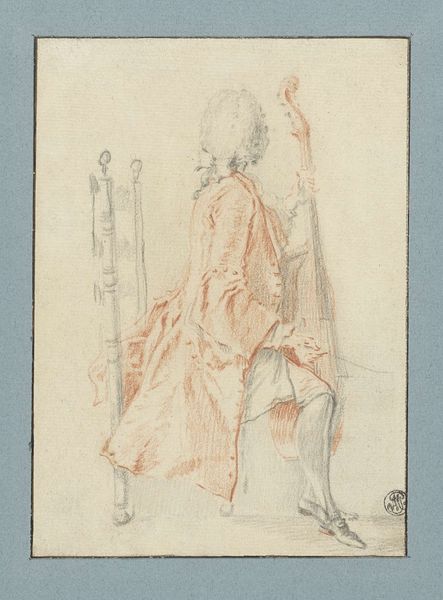
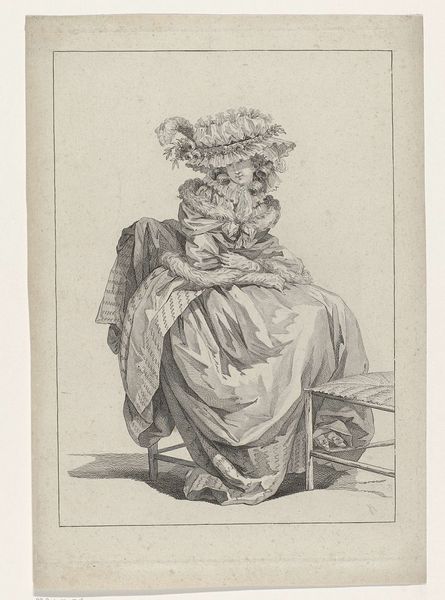
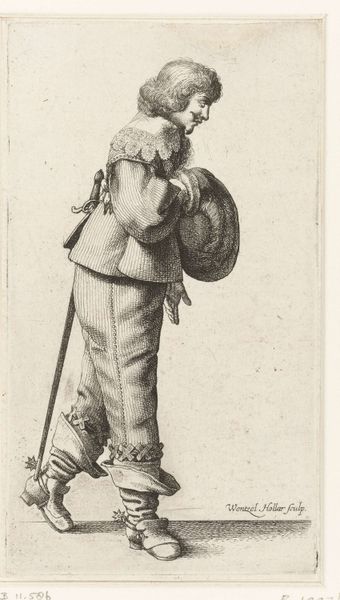
drawing, watercolor
#
portrait
#
drawing
#
pencil sketch
#
caricature
#
watercolor
#
pencil drawing
#
portrait drawing
Dimensions: height 137 mm, width 100 mm
Copyright: Rijks Museum: Open Domain
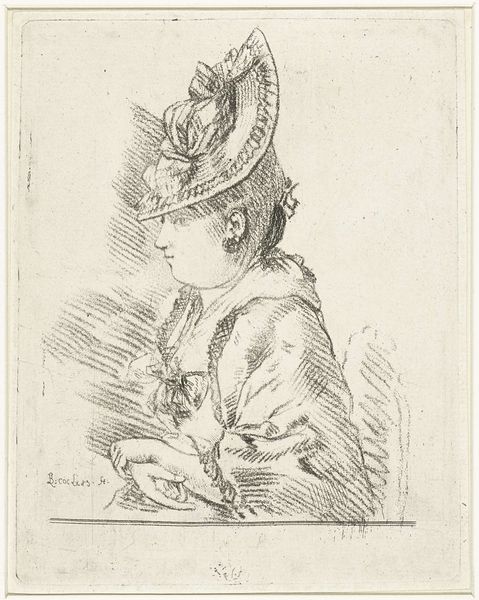
Curator: I'm struck by the domestic intimacy in this work. We’re looking at Louis Bernard Coclers’ “Portrait of Maria Goll van Franckenstein, with knitting,” likely created around 1783, rendered in pencil and watercolor. Editor: It’s immediately melancholic, wouldn’t you say? Her downcast eyes and the muted palette give it such a somber feel, despite the activity of knitting. Curator: Knitting was definitely a signifier, right? Domestic virtue, skill, and female labor all wrapped up. And looking at the means, it's modest – watercolor and pencil. Coclers doesn't seem focused on opulence but perhaps accessibility in portraiture. Was he democratizing representation by working on paper? Editor: I think so. Consider the time period; it's on the cusp of revolution. We have the looming question of who has the right to be represented, and who gets to represent them. We're dealing with a portrait of a woman, by a man—does he fully capture her reality, or is it mediated by societal expectations and gendered power dynamics? Knitting might represent virtuous industry, but what if she's just…bored? Curator: Precisely! Or maybe it's piecework? How does it intersect with the broader systems of labor and the production of textiles during this era? Are we meant to consider the commodification of skill? What exactly will she create with those stitches, for whom, and under what material conditions? Editor: It's vital to look past the surface, especially considering Maria’s social positioning. As part of the Franckenstein family, her life was bound by class and social constraints, but knitting offered agency, didn't it? And also the communal aspect – who did she share skills with? Knitting was and still is, in some cases, a collective activity. The art becomes an invitation for thinking about connection and independence. Curator: Well, the tactile, repetitive act of knitting offers some connection to other skilled handwork. I keep wondering what the conditions of those women would be: materials at hand, repetitive labor done by countless others, mostly forgotten, who have made every knitted piece imaginable. Editor: Absolutely. Looking closely encourages a deeper engagement with the past. Maria isn't merely an image, but a participant in a wider history that touches gender, class, labour, and representation. Curator: Seeing this work really draws attention to both the portrait and its own methods of production. It leaves a lasting impression of domesticity that invites more questions. Editor: Indeed. It also brings to light the stories behind its subjects; it invites conversations that echo throughout our society even today.
Comments
No comments
Be the first to comment and join the conversation on the ultimate creative platform.
 Collect
 React
React Comment
More like this