About this artwork
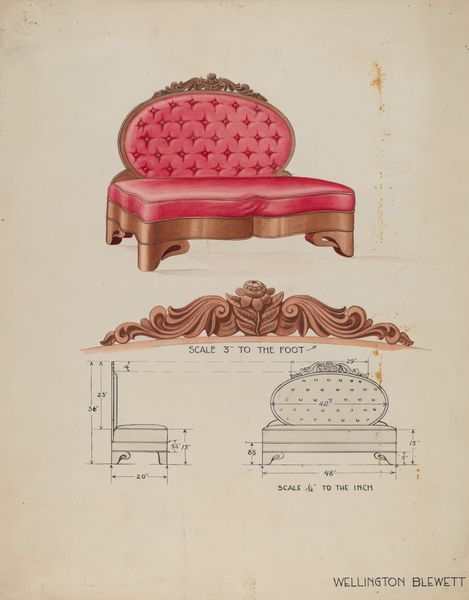
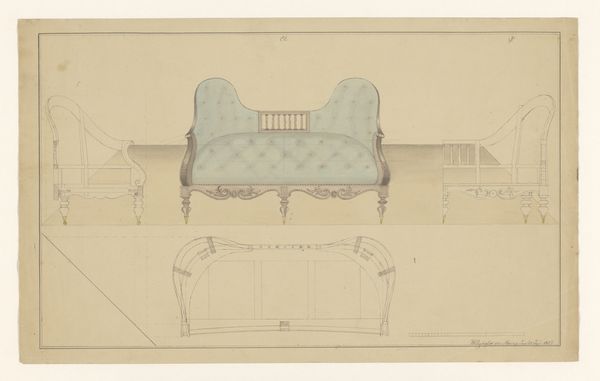
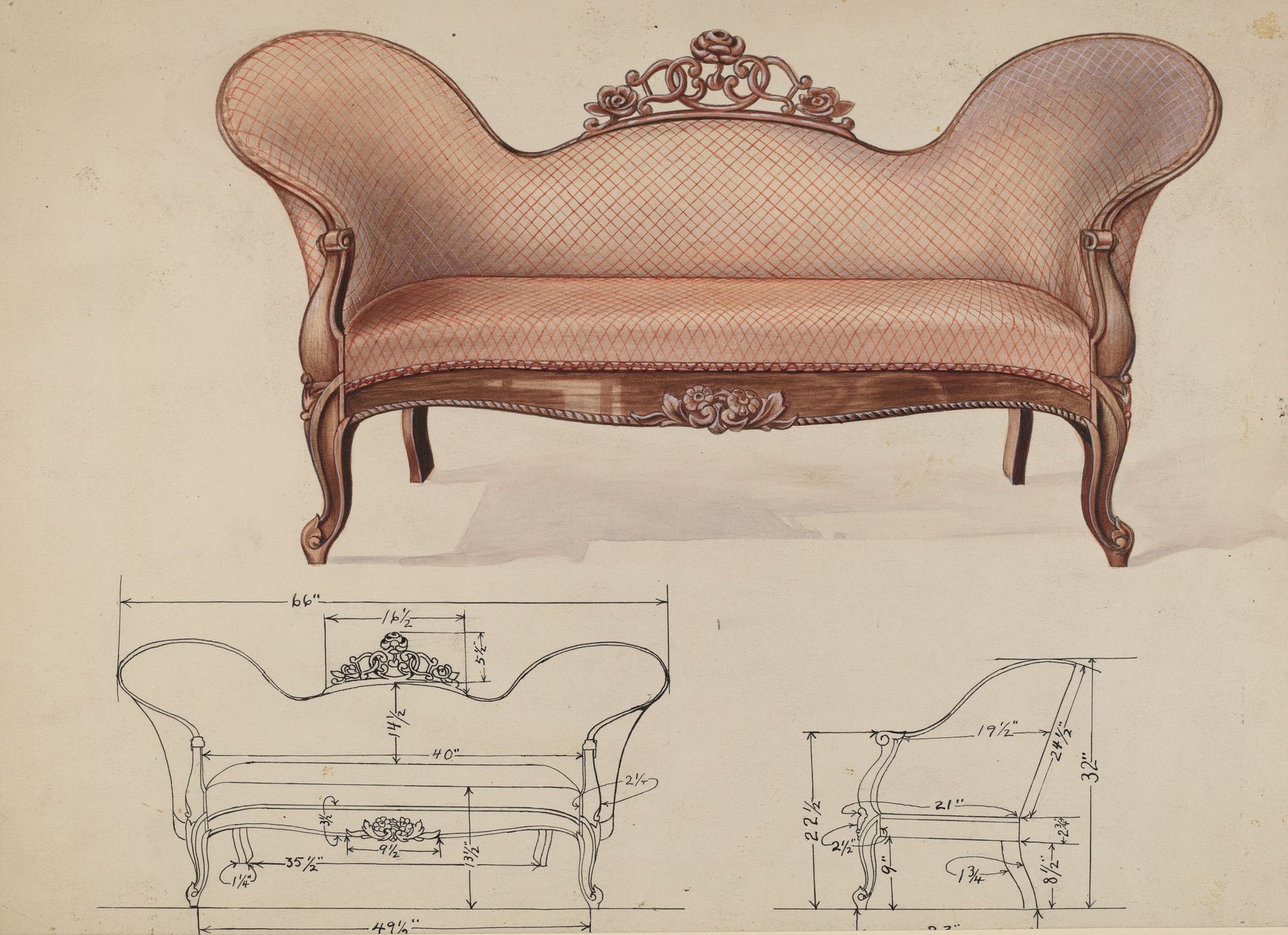
Wellington Blewett rendered this drawing of a Sofa using watercolor and graphite. Note the detailed schematics and the interplay between precise measurements and a more subjective rendering of form. The structure’s symmetry draws our attention, with the ornate headpiece centered above the sofa’s back, flanked by equal curves that descend to form the armrests. Below, three diagrammatic drawings provide specific dimensions, complicating the relationship between art and design. Blewett’s work straddles the line between representation and function. The use of light, particularly on the sofa's upholstery, creates volume and depth, but the flat schematic drawings remind us of the two-dimensional nature of the work. The contrast destabilizes the viewer's perception, underscoring the complex translation of three-dimensional objects into two-dimensional space. The drawing serves not just as a design proposal but as a meditation on perception, representation, and the translation of form.


Artwork details
- Medium
- drawing, watercolor
- Dimensions
- overall: 21.7 x 30.1 cm (8 9/16 x 11 7/8 in.) Original IAD Object: 49 1/2"wide, bottom; 66"wide, top, 28"high overall
- Copyright
- National Gallery of Art: CC0 1.0
Tags
drawing
form
watercolor
geometric
watercolor
Comments
Be the first to share your thoughts about this work.
About this artwork
Wellington Blewett rendered this drawing of a Sofa using watercolor and graphite. Note the detailed schematics and the interplay between precise measurements and a more subjective rendering of form. The structure’s symmetry draws our attention, with the ornate headpiece centered above the sofa’s back, flanked by equal curves that descend to form the armrests. Below, three diagrammatic drawings provide specific dimensions, complicating the relationship between art and design. Blewett’s work straddles the line between representation and function. The use of light, particularly on the sofa's upholstery, creates volume and depth, but the flat schematic drawings remind us of the two-dimensional nature of the work. The contrast destabilizes the viewer's perception, underscoring the complex translation of three-dimensional objects into two-dimensional space. The drawing serves not just as a design proposal but as a meditation on perception, representation, and the translation of form.
Comments
Be the first to share your thoughts about this work.