print, etching, engraving, architecture
#
baroque
#
pen drawing
# print
#
etching
#
form
#
line
#
engraving
#
architecture
Dimensions: height 217 mm, width 135 mm
Copyright: Rijks Museum: Open Domain
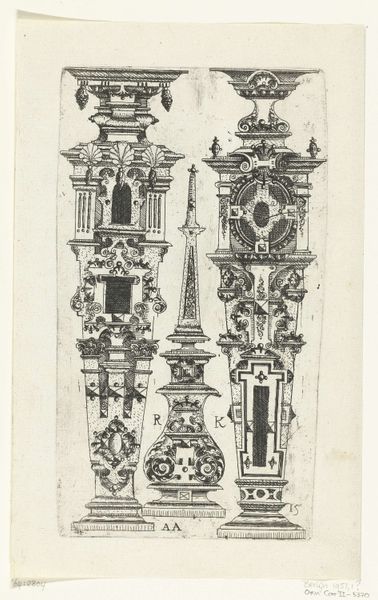
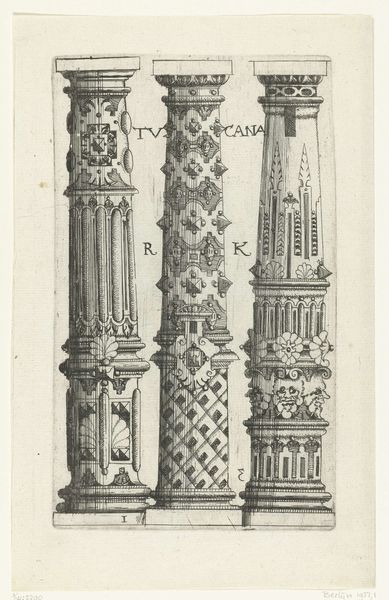
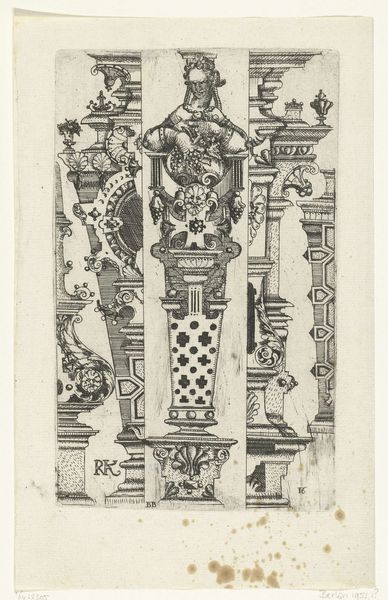
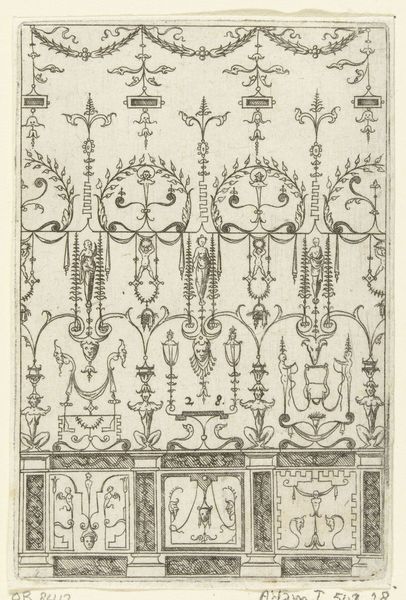
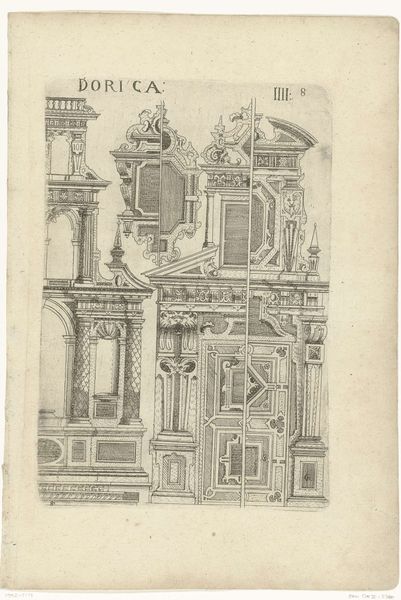
Editor: This is "Drie zuilen," or "Three Columns," an etching from 1622 by an anonymous artist. I'm struck by how detailed the columns are, even though it’s just black ink on paper. There's so much embellishment. How do you interpret the visual structure here? Curator: The tripartite composition immediately establishes a comparative framework, emphasizing the distinct character of each column. Note the variations in texture and line; from the Doric's heavier, more masculine rendering to the ornate, almost florid, Corinthian order. It is an essay in contrast. Editor: So, it's really about the formal qualities and how they differ? Curator: Precisely. Observe the rendering of depth through line weight and density. The engraver meticulously uses these techniques to give each column a sense of three-dimensionality. The architecture, while seemingly representational, functions as a vehicle to explore linear quality. Are you seeing this emphasis? Editor: I see what you mean. It is more about the lines and shapes than the architectural styles themselves. So it's not really about architecture, but about form itself. Curator: Precisely. This engraver uses architecture as pure structure for artistic exploration. Editor: That’s fascinating. I hadn’t thought about it that way before. It is more about the forms, using these shapes to practice technique and line. Curator: Indeed, it is a rigorous and thoughtful practice, one deeply invested in formal analysis. I have to thank you. Editor: No, thank you! I feel like I understand the work, and my approach to other works, more completely now.
Comments
No comments
Be the first to comment and join the conversation on the ultimate creative platform.
 Collect
 React
React Comment
More like this