About this artwork
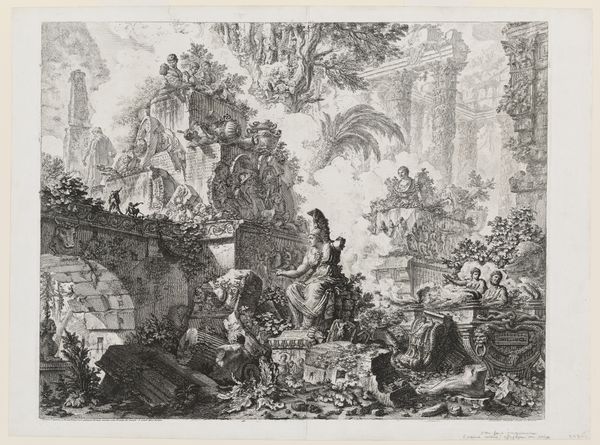
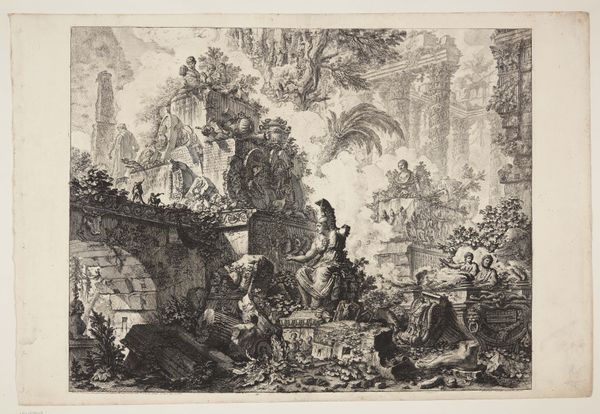
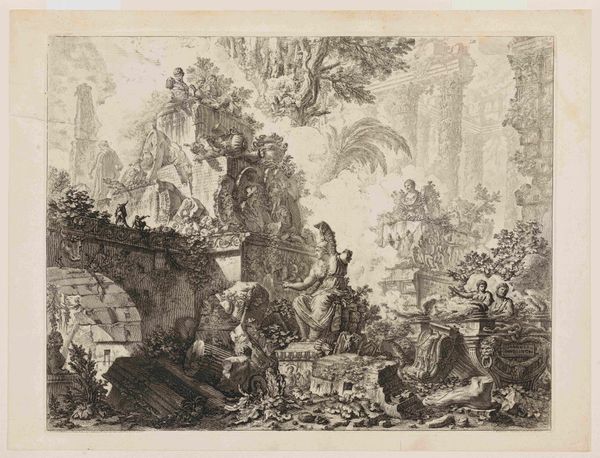
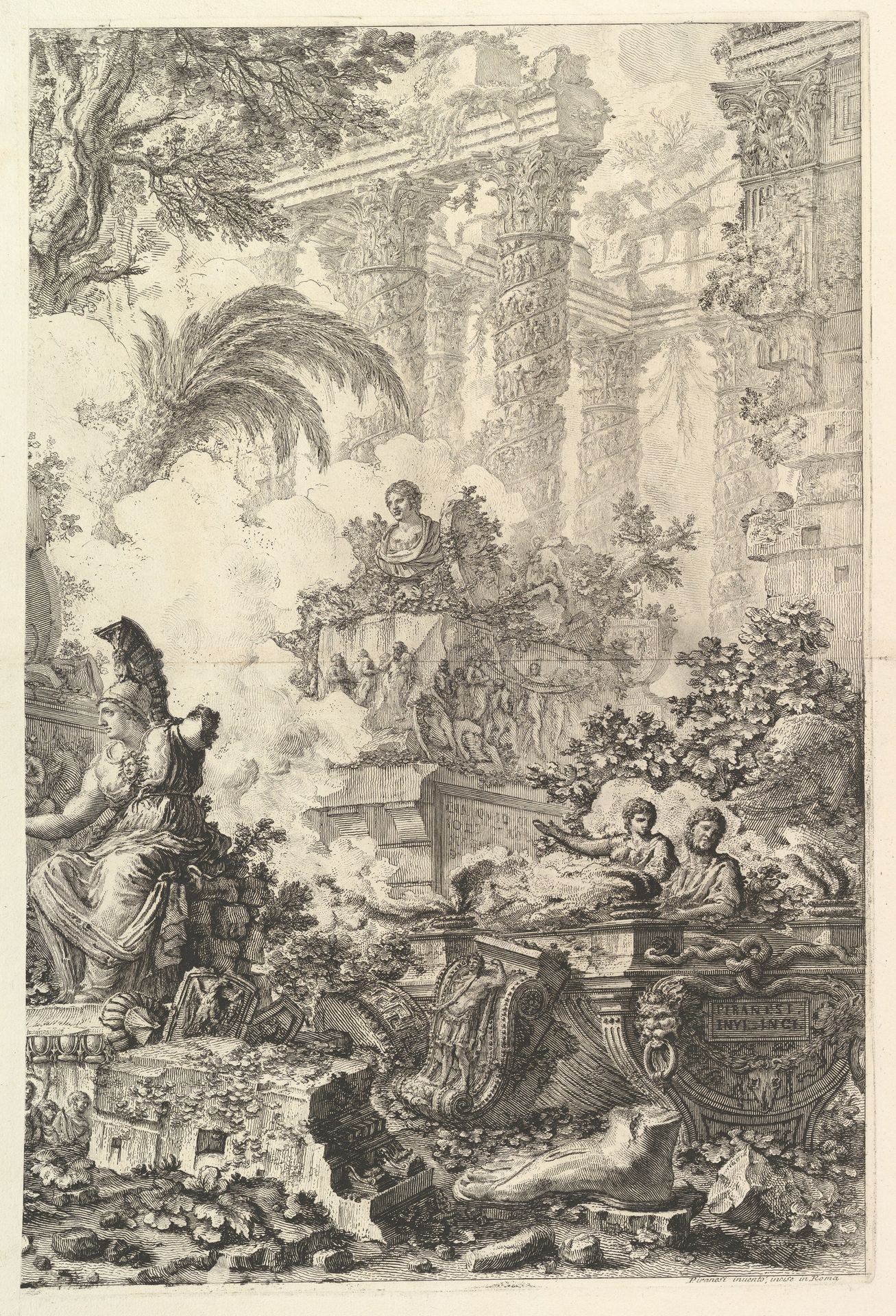
Giovanni Battista Piranesi created this print, Frontispiece, with Statue of Minerva, as the introductory image to his series, "Vedute di Roma". Etched lines densely populate the scene, constructing a complex interplay of ruins, statues, and vegetation that blurs the boundaries between reality and fantasy. The eye struggles to find a stable perspective within the composition. Piranesi masterfully manipulates scale and depth to evoke both grandeur and decay. The statue of Minerva, a symbol of wisdom and strategic warfare, looms large in the foreground, yet is fragmented. This use of fragmentation disrupts conventional notions of classical beauty and order, reflecting the enlightenment interest in the instability of knowledge and historical narratives. The print functions as a semiotic text, inviting us to decode its layers of meaning. Piranesi uses architectural forms to challenge fixed meanings and engage with new ways of thinking about space. The emphasis on the ruin and its destabilized form is not merely an aesthetic choice, but a profound engagement with history, memory, and the very nature of representation.
Frontispiece, with Statue of Minerva, from "Vedute di Roma"
1743 - 1753

Giovanni Battista Piranesi
1720 - 1778
The Metropolitan Museum of Art
Metropolitan Museum of Art, New York, NYArtwork details
- Medium
- drawing, print, etching, engraving, architecture
- Location
- Metropolitan Museum of Art, New York, NY
- Copyright
- Public Domain
Tags
Comments
Share your thoughts
About this artwork
Giovanni Battista Piranesi created this print, Frontispiece, with Statue of Minerva, as the introductory image to his series, "Vedute di Roma". Etched lines densely populate the scene, constructing a complex interplay of ruins, statues, and vegetation that blurs the boundaries between reality and fantasy. The eye struggles to find a stable perspective within the composition. Piranesi masterfully manipulates scale and depth to evoke both grandeur and decay. The statue of Minerva, a symbol of wisdom and strategic warfare, looms large in the foreground, yet is fragmented. This use of fragmentation disrupts conventional notions of classical beauty and order, reflecting the enlightenment interest in the instability of knowledge and historical narratives. The print functions as a semiotic text, inviting us to decode its layers of meaning. Piranesi uses architectural forms to challenge fixed meanings and engage with new ways of thinking about space. The emphasis on the ruin and its destabilized form is not merely an aesthetic choice, but a profound engagement with history, memory, and the very nature of representation.
Comments
Share your thoughts