print, engraving
# print
#
pen illustration
#
pen sketch
#
pencil sketch
#
mannerism
#
figuration
#
form
#
ink drawing experimentation
#
pen-ink sketch
#
history-painting
#
nude
#
engraving
Dimensions: height 172 mm, width 133 mm
Copyright: Rijks Museum: Open Domain
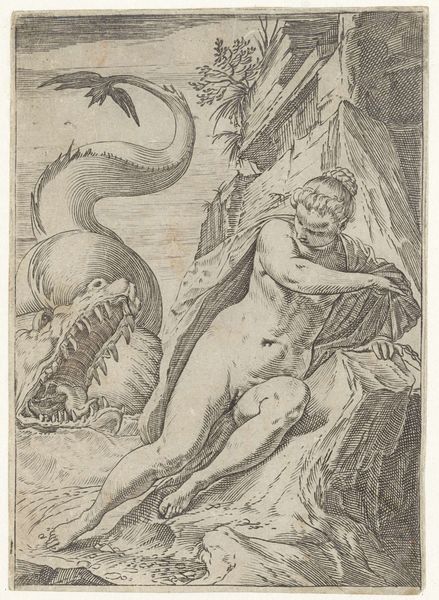
Curator: Right, let's talk about "Jupiter en Aegina," an engraving by Cornelis Bos, dating roughly from 1537 to 1555, currently residing here at the Rijksmuseum. Editor: My first thought? The intensity! It feels incredibly dynamic, that swirl of lines creating such a vivid sense of movement and raw power. Curator: Precisely! Bos captures a key moment from Ovid’s Metamorphoses. Jupiter, disguised as an eagle, abducts the nymph Aegina. There is a palpable drama here, not just in the subject but, as you noted, in the very line work. Consider how Bos uses hatching and cross-hatching to create depth and volume. Editor: The figures are quite muscular and almost theatrical, aren't they? Reminds me of Italian Mannerism—all exaggerated forms and dramatic poses. Though it lacks colour, you still get a feeling of intensity through these incredible linear details! And that eagle! Fierce! Curator: The Mannerist influence is undeniable. Bos was clearly engaged with the stylistic currents of his time. What strikes me is how he manages to convey both the erotic and the violent aspects of the myth within the graphic constraints of printmaking. There is almost a voyeuristic thrill to witnessing this divine abduction. Editor: It does prompt a bit of a double-take, doesn't it? Such detail in the depiction—every feather on the eagle, every curve of Aegina's body. How do you reckon the context might shape our reading of this? Curator: Given its period, this engraving probably circulated among educated elites familiar with classical literature. Prints like this were a form of visual culture that disseminated stories, styles, and ideas. For modern viewers, it prompts a dialogue about power, desire, and the representation of classical narratives. It forces us to consider how visual traditions shape our understanding of myth. Editor: Definitely food for thought. The piece really is quite powerful and unsettling. Curator: Absolutely, Cornelis Bos manages to immortalize the tension of Jupiter’s deed; something that the static and almost calculated process of engraving doesn’t lead you to expect at first sight! Editor: Indeed, it's a compelling work! Thanks for offering a peak beneath its narrative exterior!
Comments
No comments
Be the first to comment and join the conversation on the ultimate creative platform.
 Collect
 React
React Comment
More like this