About this artwork
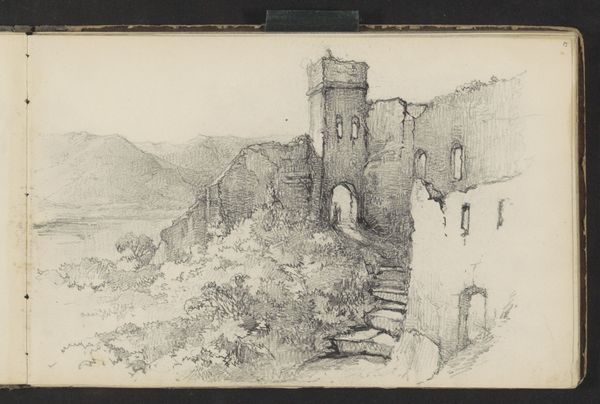
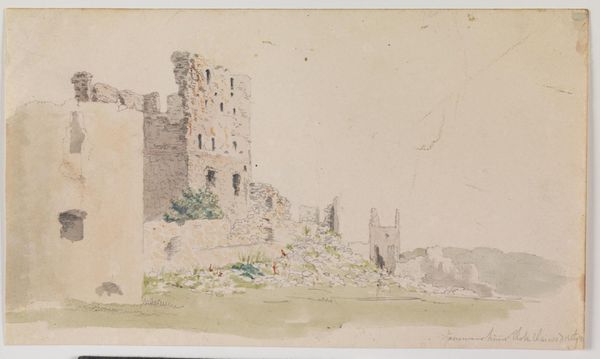
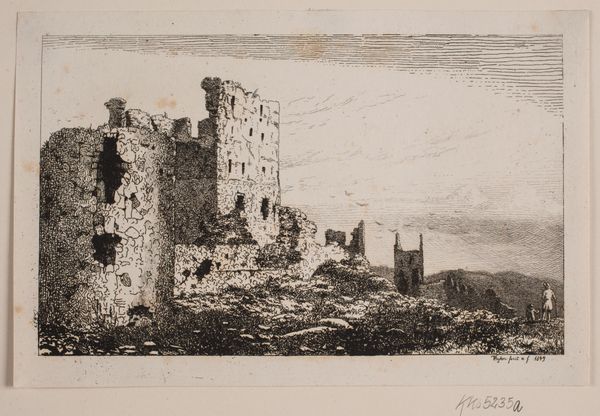
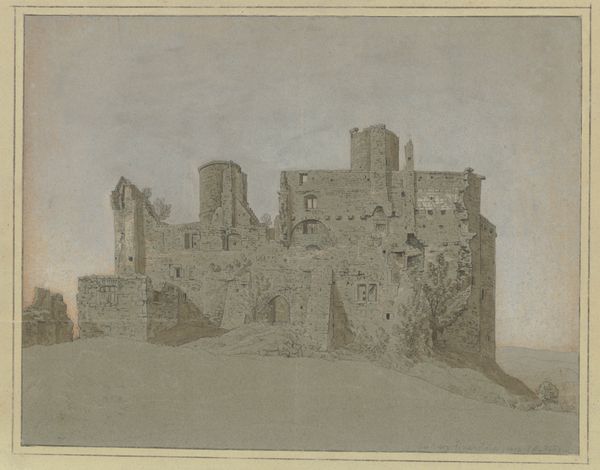
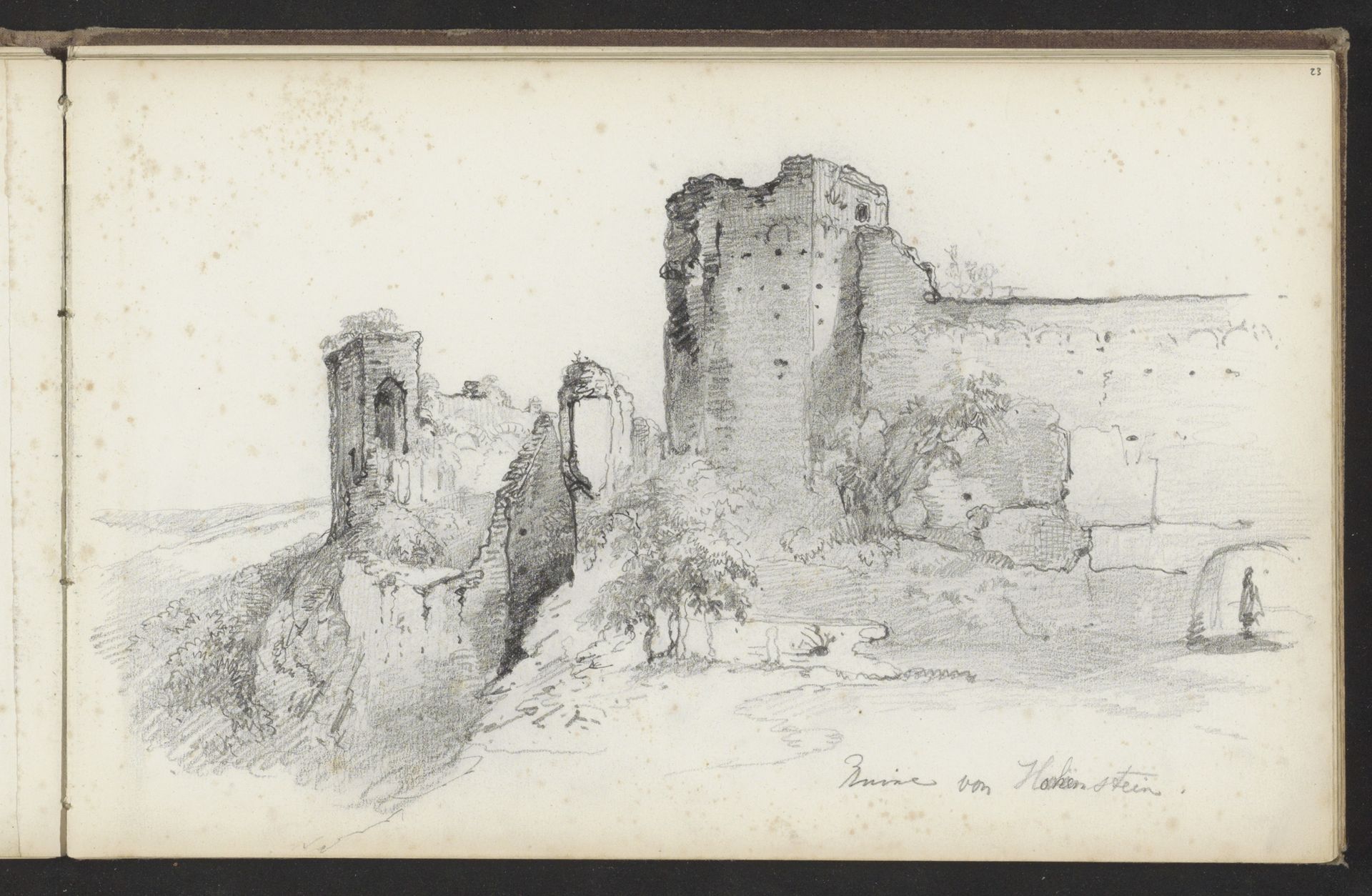
Editor: So, this is *Ruïne van Burcht Hohenstein* by Maria Vos, made sometime between 1860 and 1865. It’s a pencil and colored pencil drawing. It has such a somber mood about it, all that grey and those decaying ruins... Makes you think about the passage of time, doesn’t it? What's your take on this piece? Curator: The passage of time, indeed! I am fascinated by how Vos uses these ruins, rendered with such delicate precision, to almost whisper of a romanticized past. Notice the tiny figure at the base of the wall – almost swallowed by the immensity of the stones. Makes you feel small, doesn’t it? Like history is breathing down your neck. The choice to use coloured pencils in such a subdued way – it avoids sentimentality, wouldn't you agree? It's melancholic rather than overly dramatic. What feelings does the figure evoke for you? Editor: That’s true; they definitely feel dwarfed by it all! Maybe a little lonely, too? The muted colors really reinforce that melancholic feeling… I see that it is tagged as romanticism. How does that fit in with ruins, exactly? Curator: Ah, Romanticism! Think about it as less about roses and more about *feeling*. Ruins became symbols, physical embodiments of lost glory, of the overwhelming power of nature, and the fleeting nature of human achievement. It's not about accuracy; it's about emotion. The drawing is about invoking a specific feeling, a kind of sweet sorrow… It whispers, "even mighty castles crumble." Now, look at how she suggests, rather than dictates. What stories do *you* think it tells? Editor: I hadn’t thought of it like that. It definitely hits differently now, with that context. It's a reminder that even the grandest things don't last forever. I appreciate Maria Vos using simple media to portray very complicated ideas. Curator: Exactly! That subtlety is her strength, I think. These crumbling stones serve as reminders; a gentle whisper urging reflection, and prompting us to contemplate our place within the vast tapestry of time. It has been delightful discussing this with you.

Artwork details
- Location
- Rijksmuseum
- Copyright
- Rijks Museum: Open Domain
Comments
Share your thoughts
About this artwork
Editor: So, this is *Ruïne van Burcht Hohenstein* by Maria Vos, made sometime between 1860 and 1865. It’s a pencil and colored pencil drawing. It has such a somber mood about it, all that grey and those decaying ruins... Makes you think about the passage of time, doesn’t it? What's your take on this piece? Curator: The passage of time, indeed! I am fascinated by how Vos uses these ruins, rendered with such delicate precision, to almost whisper of a romanticized past. Notice the tiny figure at the base of the wall – almost swallowed by the immensity of the stones. Makes you feel small, doesn’t it? Like history is breathing down your neck. The choice to use coloured pencils in such a subdued way – it avoids sentimentality, wouldn't you agree? It's melancholic rather than overly dramatic. What feelings does the figure evoke for you? Editor: That’s true; they definitely feel dwarfed by it all! Maybe a little lonely, too? The muted colors really reinforce that melancholic feeling… I see that it is tagged as romanticism. How does that fit in with ruins, exactly? Curator: Ah, Romanticism! Think about it as less about roses and more about *feeling*. Ruins became symbols, physical embodiments of lost glory, of the overwhelming power of nature, and the fleeting nature of human achievement. It's not about accuracy; it's about emotion. The drawing is about invoking a specific feeling, a kind of sweet sorrow… It whispers, "even mighty castles crumble." Now, look at how she suggests, rather than dictates. What stories do *you* think it tells? Editor: I hadn’t thought of it like that. It definitely hits differently now, with that context. It's a reminder that even the grandest things don't last forever. I appreciate Maria Vos using simple media to portray very complicated ideas. Curator: Exactly! That subtlety is her strength, I think. These crumbling stones serve as reminders; a gentle whisper urging reflection, and prompting us to contemplate our place within the vast tapestry of time. It has been delightful discussing this with you.
Comments
Share your thoughts