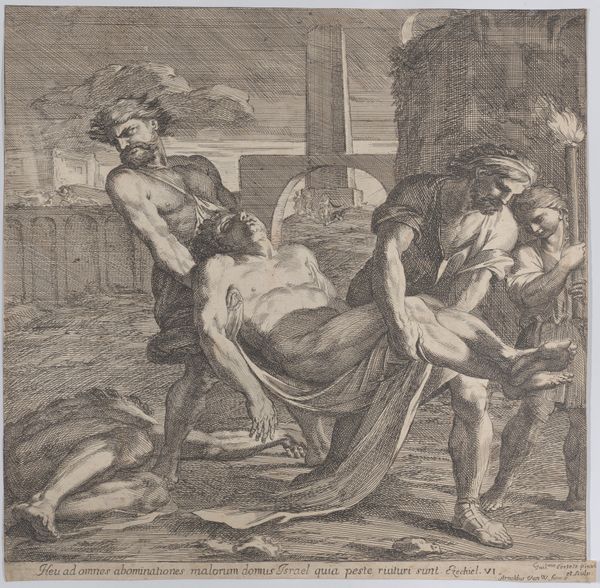
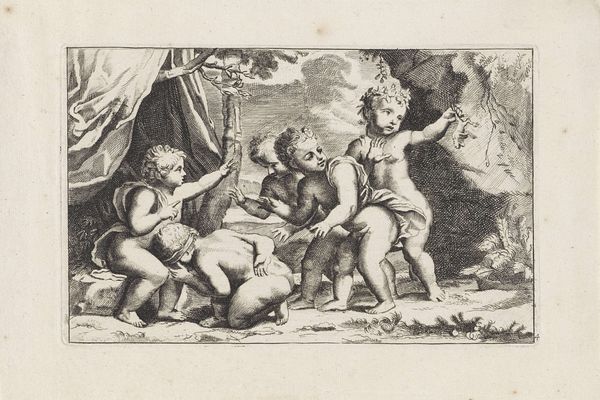
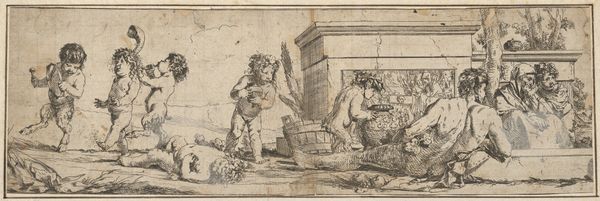
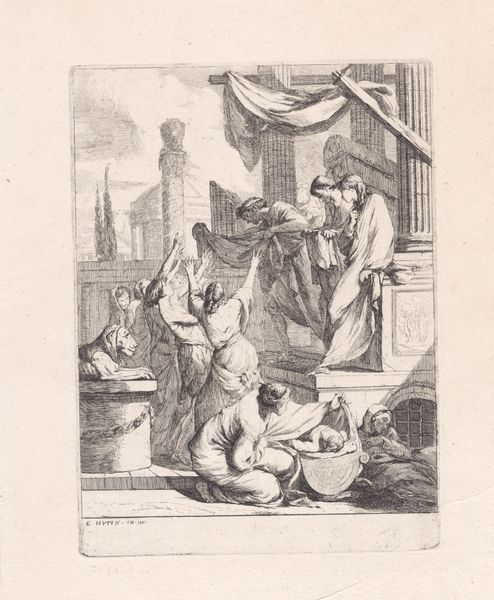
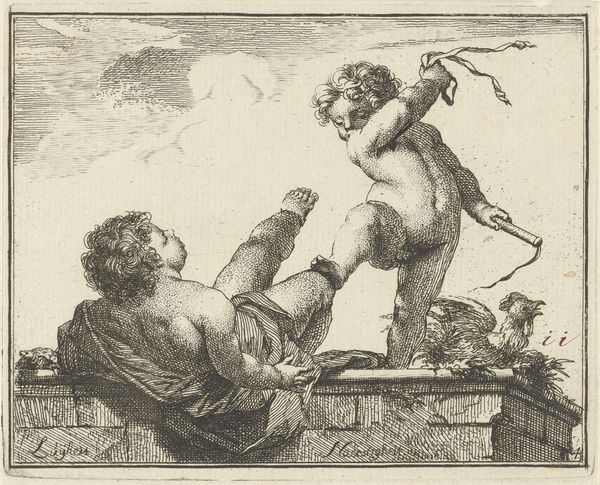
Fire, represented by Venus seated before Vulcan's forge, with armor, a cannon, and cannon balls surrounding her, she turns her head toward Cupid, who stretches his body away from her, from "The Elements" 1640 - 1660


drawing, print
drawing
mechanical pen drawing
pen illustration
pen sketch
personal sketchbook
cupid
sketchwork
pen-ink sketch
men
pen work
sketchbook drawing
storyboard and sketchbook work
sketchbook art
Dimensions: Sheet: 4 1/8 × 6 3/16 in. (10.5 × 15.7 cm)
Copyright: Public Domain
Editor: So, this is Giulio Carpioni's print, "Fire, represented by Venus seated before Vulcan's forge," created sometime between 1640 and 1660. The juxtaposition of Venus and all these armaments is a little unnerving. What do you see here? Curator: What strikes me is the clear connection between production and power represented by Vulcan's forge and the weaponry surrounding Venus. We see the raw materials transformed into instruments of force. How does the context of 17th century Europe, a time marked by conflict, shape the understanding of this work? Consider how readily available resources such as metal become implements of war. Editor: It is interesting to think of materials in the social setting... How might that have affected the role of Cupid? Curator: Good question! Observe Cupid's posture, he's fleeing from the scene. Does that flight suggest a rejection of violence or, perhaps, a commentary on how even love can be a product molded by societal forces? Editor: So, it's not just about mythology, it's about the implications of the creation process. The transformation of raw materials reflecting the culture around the artist... Curator: Precisely. Carpioni uses mythology as a lens to critique the relationship between material, labor, and power. It moves past a simple allegorical illustration and into a more complex commentary on the manufacturing of war itself. Editor: That connection between love, war and manufacture suddenly seems much clearer. Thank you! Curator: My pleasure. Reflecting on the methods behind creation always brings a deeper understanding of the finished art.
Comments
No comments
Be the first to comment and join the conversation on the ultimate creative platform.
 React
React Comment