painting, oil-paint
#
painting
#
oil-paint
#
landscape
#
oil painting
#
cityscape
#
modernism
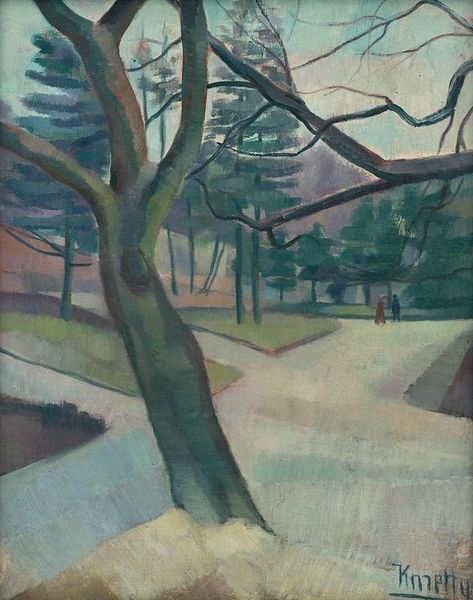
Copyright: Kmetty János,Fair Use
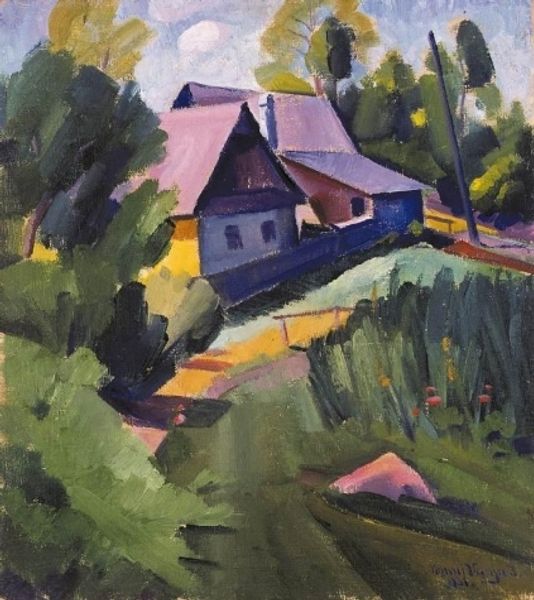
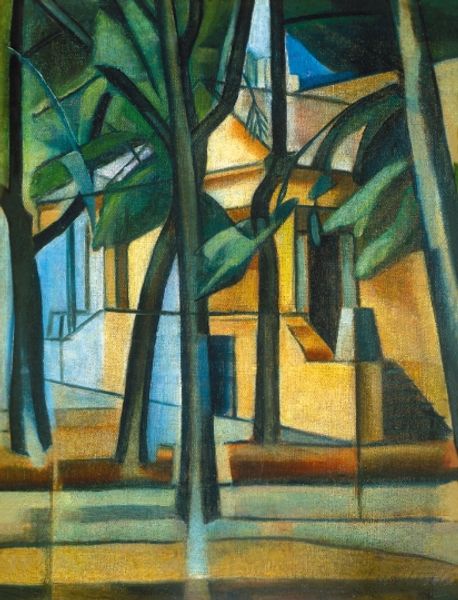
Editor: Here we have János Kmetty’s 1910 oil painting, “City Hall of Kecskemét.” There’s something very still about this scene, the manicured gardens, and the symmetrical facade create a calming effect, even with the modernist style brushstrokes. What do you see in this piece from a formalist point of view? Curator: I observe a careful arrangement of geometric forms. Note the interplay between the hard lines of the building and the soft curves of the foliage. The artist employs a limited palette, predominantly greens and ochres, creating a sense of visual unity. Observe how the formal elements—shape, line, and color—function in the overall composition. Do you perceive how these elements contribute to the aesthetic impact of the work? Editor: I do see that now, how the balance between those colors helps to guide the viewer through the painting. There’s an emphasis on shape through contrasting sharp angles against these almost blob-like rounded shapes. What would you say is most important about the way those things contrast each other? Curator: The contrasting geometries create a dynamic tension. This pushes against traditional landscape painting. It invites us to contemplate the underlying structure and formal relationships within the painted world, wouldn't you agree? The interplay between geometric and organic forms mirrors, on some level, the tension between human construction and the natural world. Editor: That makes perfect sense. It’s fascinating how simply looking at the shapes and colors reveals such complex ideas. I’ll certainly view other landscapes in the gallery with a fresh pair of eyes. Curator: Indeed. Focusing on the formal elements of a work of art, is a fundamental entry point, I hope you have learned a useful perspective.
Comments
No comments
Be the first to comment and join the conversation on the ultimate creative platform.
 Collect
 React
React Comment
More like this