About this artwork
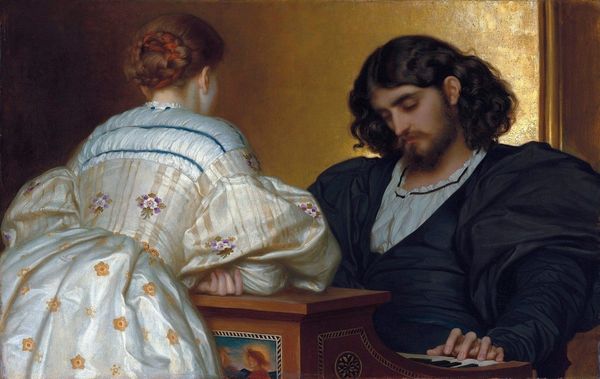
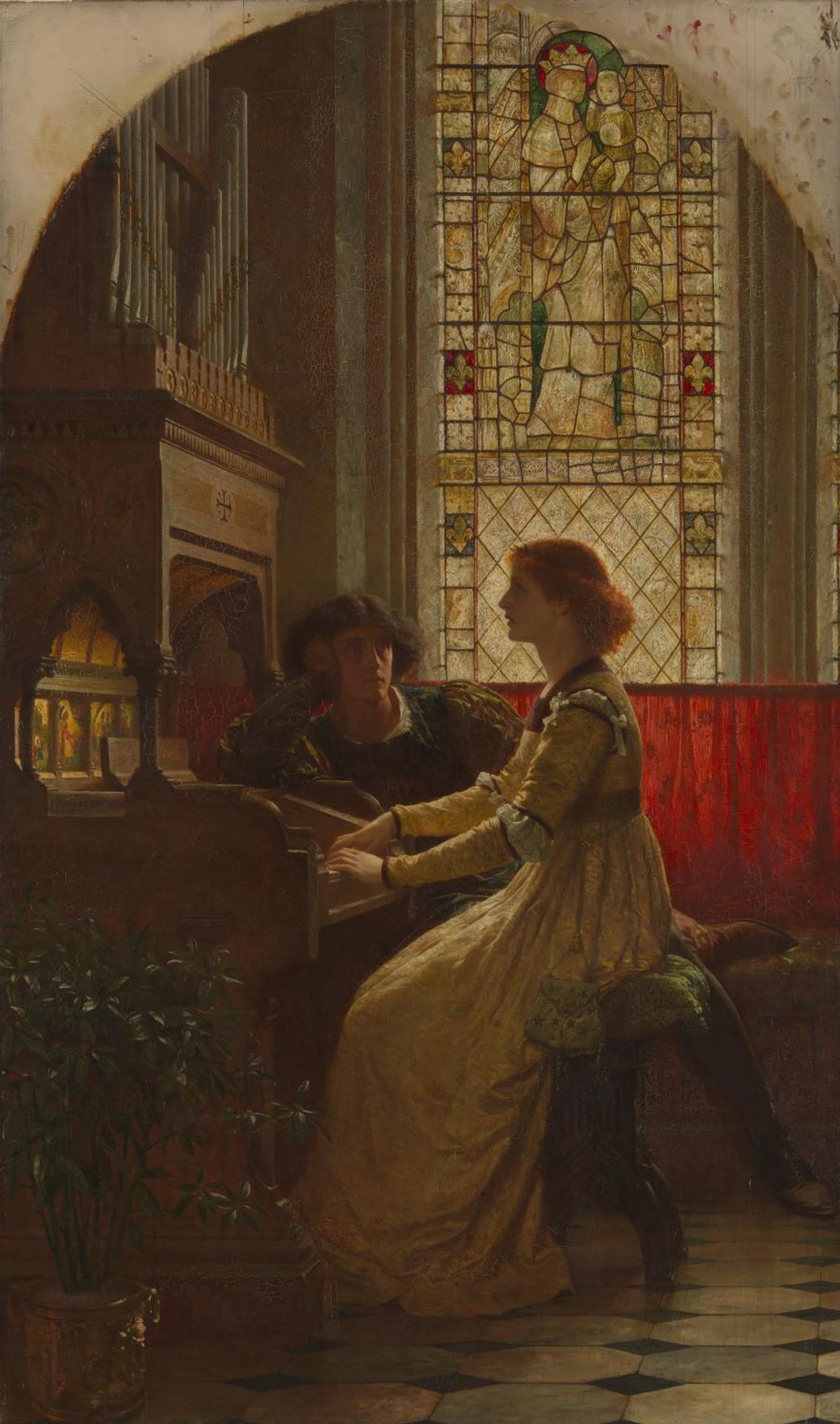
Curator: This is "Harmony" by Sir Frank Dicksee, currently residing in the Tate Collections. The support measures approximately 1575 by 940 millimeters. Editor: It strikes me as a scene steeped in quiet contemplation. The muted palette enhances the intimacy of the setting. Curator: Indeed. Dicksee, who lived from 1853 to 1928, often explored themes of romance and idealized beauty. Here, the harmony extends beyond the musical—notice the mirroring between the figures in the stained glass and the two in the foreground. Editor: The stained glass—it is also quite telling about the socio-political construction of feminine ideals within religious spaces. Curator: Precisely! The angelic Madonna figure echoes the woman playing the organ. The visual association invites a reading of purity and devotion, values historically projected onto women. The man lurking in the shadows, meanwhile, is a study in attentive, perhaps possessive, listening. Editor: It does speak volumes about the gendered expectations prevalent during Dicksee’s time. The composition emphasizes the woman’s active creation and his passive admiration, reinforcing traditional power dynamics. I think that is key to its lasting appeal and critique. Curator: A delicate balance of visual elements and social commentary. Editor: Absolutely, it is both beautiful and unsettling, making it all the more captivating.

Artwork details
- Dimensions
- support: 1575 x 940 mm
- Location
- Tate Collections
- Copyright
- CC-BY-NC-ND 4.0 DEED, Photo: Tate
Comments

http://www.tate.org.uk/art/artworks/dicksee-harmony-n01587
As an art student, Dicksee joined a sketching club that met regularly to make drawings on an agreed theme. One evening, their topic was ‘Music’. Harmony is based on the original sketch Dicksee made that night, and also uses his experience of designing stained glass windows. It was huge success when it was exhibited in 1877. The model for the woman playing the organ was Hilda Spencer, a student at Queens College, where Dicksee taught drawing. Art historians have debated whether Spencer is shown as a passive object of desire, or a powerful figure and accomplished musician in her own right. Gallery label, August 2018
About this artwork
Curator: This is "Harmony" by Sir Frank Dicksee, currently residing in the Tate Collections. The support measures approximately 1575 by 940 millimeters. Editor: It strikes me as a scene steeped in quiet contemplation. The muted palette enhances the intimacy of the setting. Curator: Indeed. Dicksee, who lived from 1853 to 1928, often explored themes of romance and idealized beauty. Here, the harmony extends beyond the musical—notice the mirroring between the figures in the stained glass and the two in the foreground. Editor: The stained glass—it is also quite telling about the socio-political construction of feminine ideals within religious spaces. Curator: Precisely! The angelic Madonna figure echoes the woman playing the organ. The visual association invites a reading of purity and devotion, values historically projected onto women. The man lurking in the shadows, meanwhile, is a study in attentive, perhaps possessive, listening. Editor: It does speak volumes about the gendered expectations prevalent during Dicksee’s time. The composition emphasizes the woman’s active creation and his passive admiration, reinforcing traditional power dynamics. I think that is key to its lasting appeal and critique. Curator: A delicate balance of visual elements and social commentary. Editor: Absolutely, it is both beautiful and unsettling, making it all the more captivating.
Comments
http://www.tate.org.uk/art/artworks/dicksee-harmony-n01587
As an art student, Dicksee joined a sketching club that met regularly to make drawings on an agreed theme. One evening, their topic was ‘Music’. Harmony is based on the original sketch Dicksee made that night, and also uses his experience of designing stained glass windows. It was huge success when it was exhibited in 1877. The model for the woman playing the organ was Hilda Spencer, a student at Queens College, where Dicksee taught drawing. Art historians have debated whether Spencer is shown as a passive object of desire, or a powerful figure and accomplished musician in her own right. Gallery label, August 2018