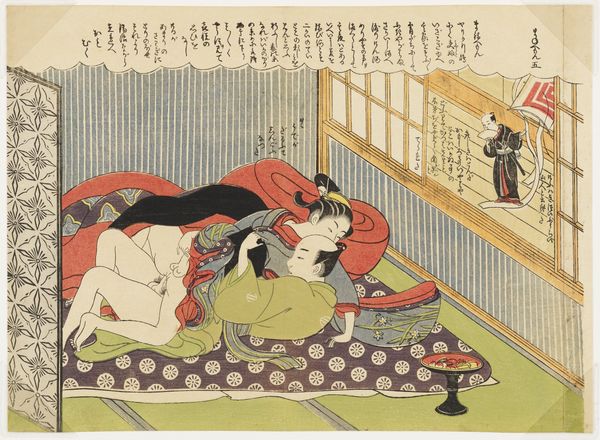
c. 1768 - 1770
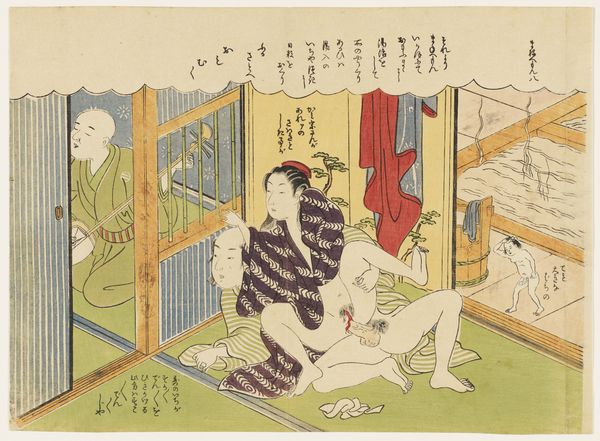
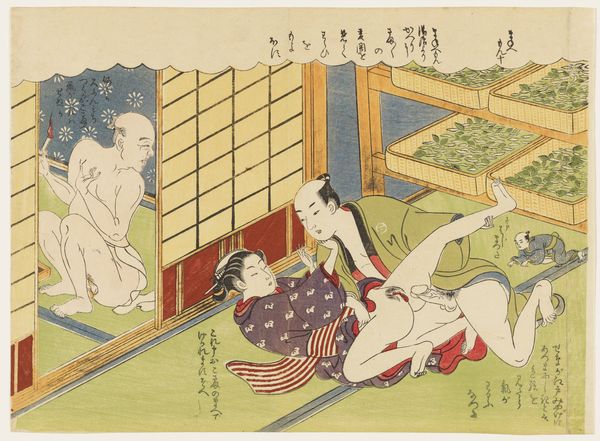
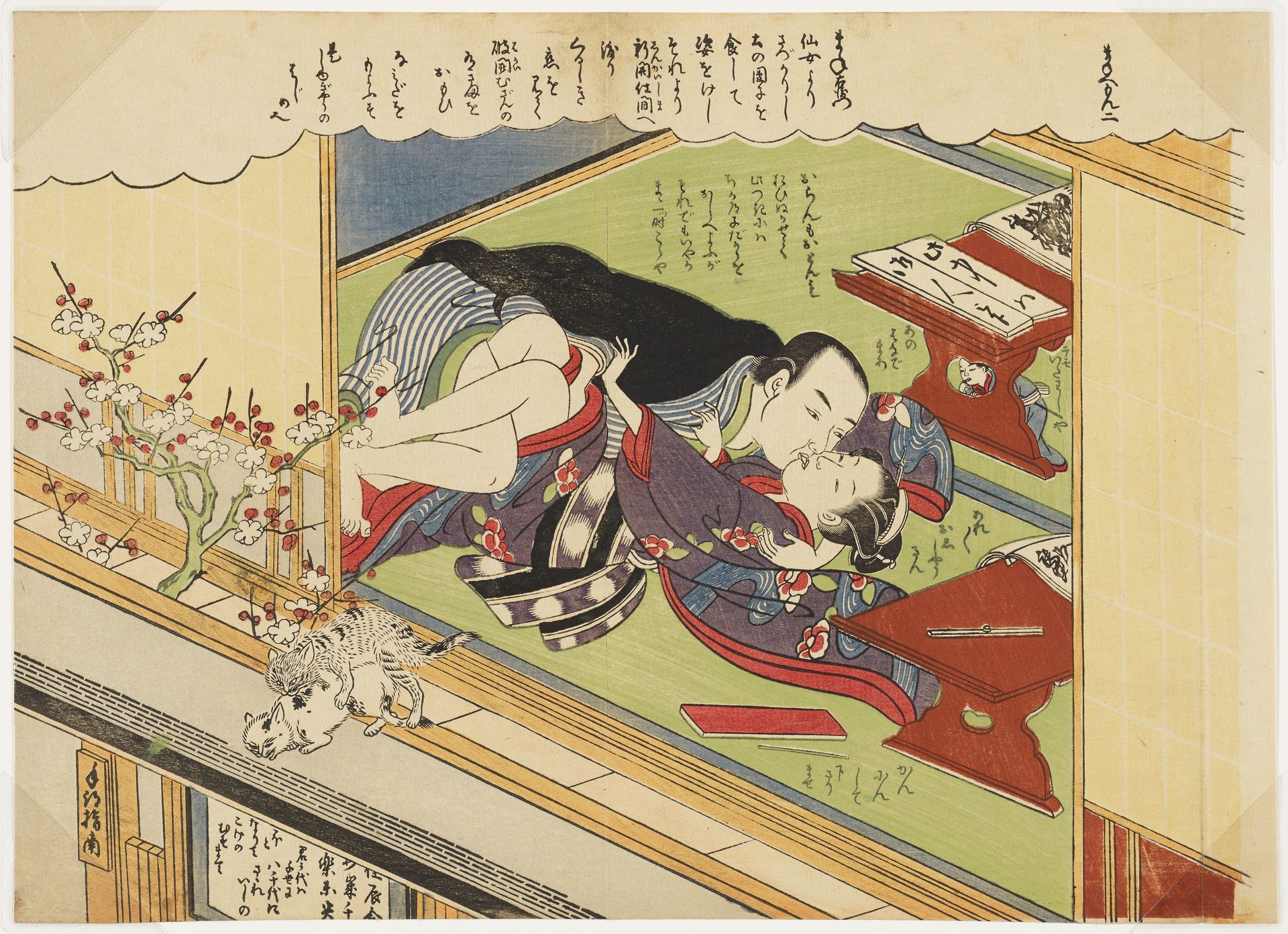
Forced Love


Listen to curator's interpretation
Curatorial notes
Curator: Here we have Suzuki Harunobu’s print, "Forced Love," created around 1768-1770. It’s a color woodblock print, utilizing ink and color on paper, now residing at the Minneapolis Institute of Art. Editor: The first thing that strikes me is the sheer flatness. It's like viewing a stage set, everything deliberately arranged for the eye, with those bold, clear outlines defining each form so precisely. Curator: Yes, Harunobu's work arrived during a really interesting period in Edo society, where consumer culture flourished amongst the merchant class, creating a new demand for art that reflected their lives. Images of courtesans, actors, and everyday scenes became increasingly popular, fueling the ukiyo-e boom. It is a romantic, even erotic interpretation. Editor: The interplay between geometric planes and curvilinear forms is particularly captivating. The sharp angles of the room create a kind of dynamic tension against the rounded figures. Look at how the diagonals intersect, drawing our eyes toward the embracing figures as a compositional focal point. I'm also really interested in his lines that render the texture in a decorative way. Curator: It speaks volumes about the negotiation of desires and the construction of feminine ideals. Harunobu’s prints circulated in a context where print culture shaped perceptions of beauty and desirability, influencing social interactions, and, in fact, even love itself. The title can be off-putting at first. The narrative complexity and suggestive themes would have created a dialogue for viewers at that time. Editor: Precisely, the visual structure of this work echoes broader philosophical ideas as well. There’s the tension between the ideal and the real, a theme found in traditional aesthetic considerations, which this reflects so succinctly in formal, structured, terms. It makes one wonder what kind of critical language would have been used to evaluate such works at that time. Curator: It reminds us that even seemingly innocent imagery can reflect and reinforce deeper cultural narratives. Seeing through that today really helps you view it with fresh eyes. Editor: Agreed. Looking beyond the intimate moment, this work really offers a window into a structured world with an almost theatrical feel.