

About this artwork
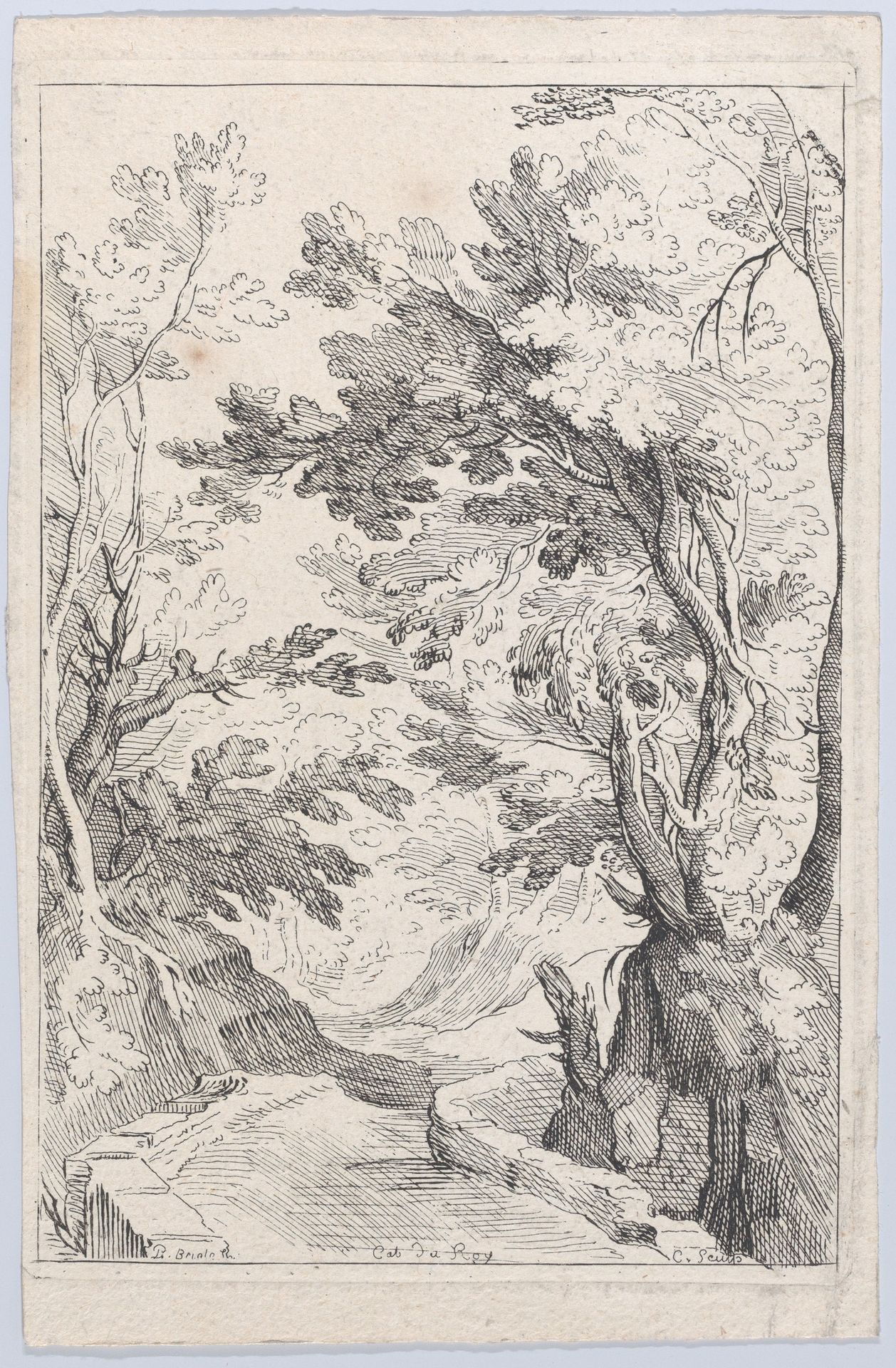
This is “A Pathway with a Parapet in a Forest,” etched by Anne Claude Philippe Caylus. It is an image rendered with a copper plate and mordant, a corrosive substance that bites into the metal. The starkness of the scene is remarkable. Caylus has rendered the forest with closely placed lines; note the remarkable consistency of the engraved line, and the sureness of the artist’s hand. The effect is almost architectural. Caylus no doubt sought to ennoble the experience of walking in nature by comparing it to a stroll through a palace. The act of printing these images was labor-intensive, but it also allowed for the relatively cheap distribution of aesthetics. In this way, printmaking was absolutely critical to the development of modernism. It enabled a widening appreciation of art and design among the middle classes, which in turn transformed social values. It challenges traditional distinctions between the fine arts and design, and suggests a parallel history of creative practices.
A Pathway with a Parapet in a Forest
1712 - 1765

Anne Claude Philippe Caylus
1692 - 1765
The Metropolitan Museum of Art
Metropolitan Museum of Art, New York, NYArtwork details
- Medium
- drawing, print, etching
- Dimensions
- Sheet (trimmed): 8 1/4 × 5 1/2 in. (20.9 × 13.9 cm) Plate: 7 9/16 × 5 1/8 in. (19.2 × 13 cm)
- Location
- Metropolitan Museum of Art, New York, NY
- Copyright
- Public Domain
Tags
Comments
Share your thoughts
About this artwork
This is “A Pathway with a Parapet in a Forest,” etched by Anne Claude Philippe Caylus. It is an image rendered with a copper plate and mordant, a corrosive substance that bites into the metal. The starkness of the scene is remarkable. Caylus has rendered the forest with closely placed lines; note the remarkable consistency of the engraved line, and the sureness of the artist’s hand. The effect is almost architectural. Caylus no doubt sought to ennoble the experience of walking in nature by comparing it to a stroll through a palace. The act of printing these images was labor-intensive, but it also allowed for the relatively cheap distribution of aesthetics. In this way, printmaking was absolutely critical to the development of modernism. It enabled a widening appreciation of art and design among the middle classes, which in turn transformed social values. It challenges traditional distinctions between the fine arts and design, and suggests a parallel history of creative practices.
Comments
Share your thoughts