print, engraving
#
portrait
#
baroque
# print
#
old engraving style
#
pencil drawing
#
history-painting
#
engraving
Dimensions: height 240 mm, width 152 mm
Copyright: Rijks Museum: Open Domain
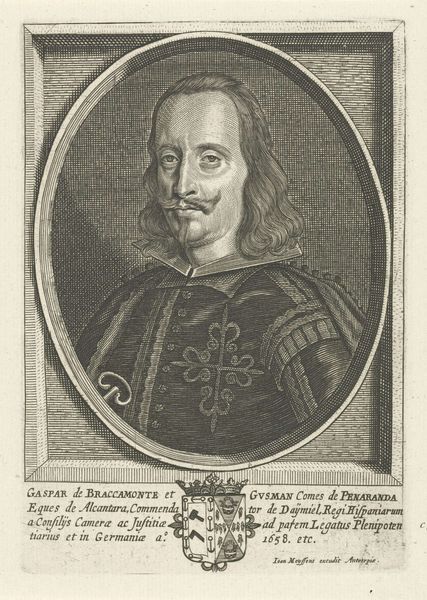
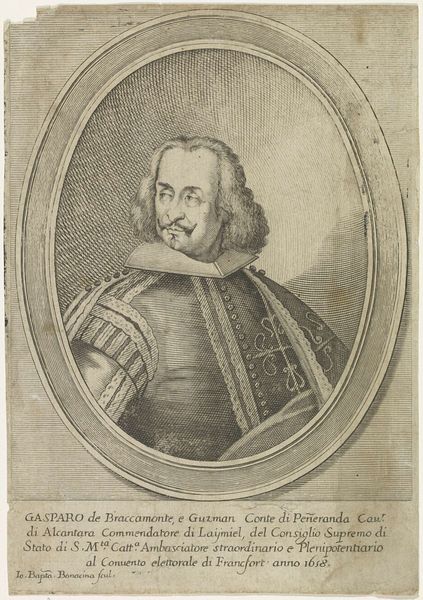
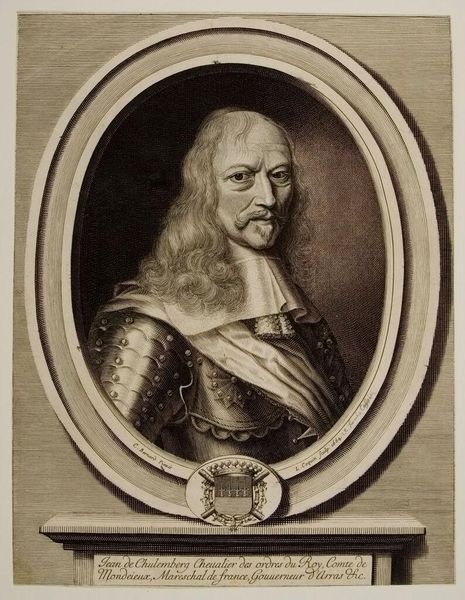
Curator: Look at this intriguing engraving, currently held at the Rijksmuseum. It's entitled "Portret van Luigi de Guzman", dating sometime between 1660 and 1704. Editor: It immediately evokes a sense of austere formality. The fine lines create almost a tapestry-like texture, particularly within the oval frame and drapery, but his gaze is rather direct. Curator: Considering its historical context, portrait engravings like this served an important function. They disseminated images of powerful figures, reinforcing their status and influence throughout society. Guzman's position is also inscribed on the plate beneath the portrait. Editor: Right, the inscription. It speaks volumes! From what I gather, Guzmán was clearly someone of immense importance: "Captain General of the State of Milan," for starters. And I see his armor with its odd key insignia—symbols within symbols. Keys traditionally symbolize access, knowledge, and even authority. Was this an established symbol within his family? Curator: The key motif, especially during this period, can certainly allude to control and governance. Milan's fraught status within the Spanish empire and European politics more broadly cannot be overstated: Spanish governance extracted enormous amounts of wealth from the Italian region even as their neglect and misrule were locally resented. To whom, then, was Guzman offering entry? Editor: Fascinating. The column, half-hidden behind the drapery, suggests a stability, perhaps meant to enforce this same control and dominance you just brought up. It lends a certain weight, a feeling of enduring power. I think he's inviting us to see this legacy. Curator: The artist Cesare Fiori designed the print, and Durello engraved it, so a combined project of legitimization by two artists towards Milan and its representation within broader Spain. By controlling visual access and dissemination, who and what did they aim to represent? Editor: Seeing how this portrait operated within its specific historical context allows one to perceive how such displays could be used to establish social hierarchy through very deliberate manipulation of imagery and symbols. Thank you. Curator: Absolutely; seeing this period through the lens of visual imagery provides valuable insight into 17th century politics and power structures. It provokes critical inquiry!
Comments
No comments
Be the first to comment and join the conversation on the ultimate creative platform.
 Collect
 React
React Comment
More like this