painting, oil-paint
#
cubism
#
abstract painting
#
painting
#
oil-paint
#
abstraction
#
cityscape
#
painting art
#
modernism
Copyright: Public domain US
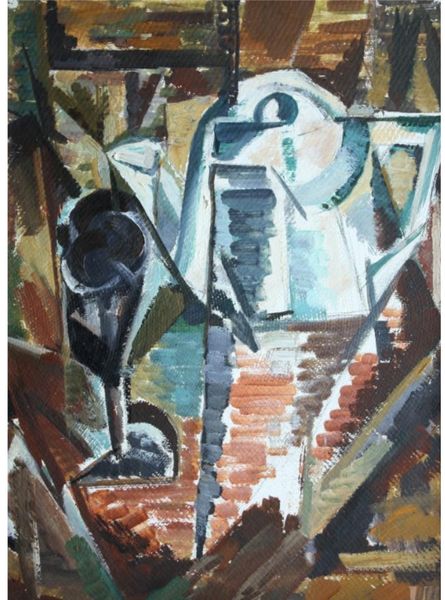
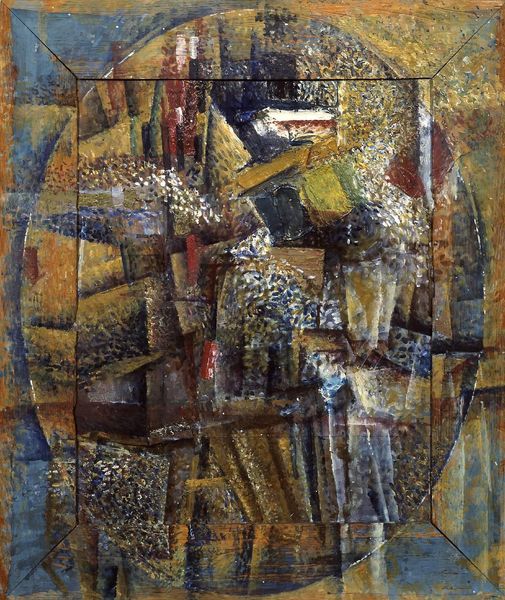
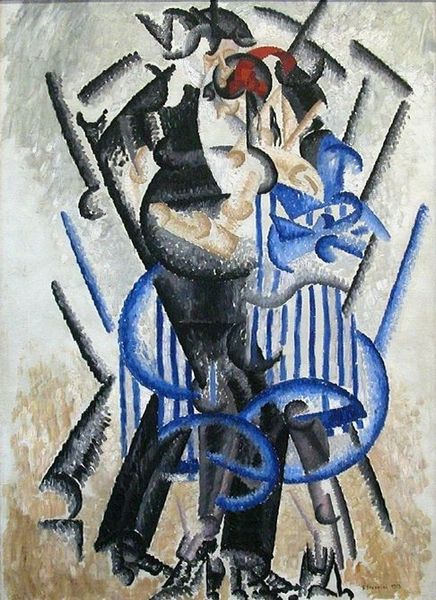
Editor: Here we have Stuart Davis' "Tree and Urn," created in 1921. The medium is oil paint, and its almost monochromatic blue palette gives it such a somber feel. All the shapes are simplified, geometric, almost cubist. I'm intrigued, but also slightly puzzled... What strikes you most when you look at this piece? Curator: Ah, "Tree and Urn". It's like Davis is playing a melancholic jazz tune in shades of blue, isn't it? The urn sits almost like a muted trumpet, while the tree, so abstracted, becomes a stand-in for the ever-changing cityscape, or perhaps the inner landscape of the soul. Davis adored jazz. I imagine him listening to a blues record, deconstructing the sound, and reassembling it as this visual symphony of shape and tone. Does the muted color palette feel restricting, or evocative to you? Editor: I think it definitely evokes a certain mood, but I can see how the limited palette is a clever technique. It's almost like he’s taken a photograph and drained it of its vibrancy, forcing us to focus on the underlying structure. I wouldn't have thought of the jazz influence; that's a revelation! Curator: Exactly! And the cubist leanings – notice how the perspective is skewed, flattened. He’s challenging our conventional ways of seeing, isn’t he? Almost asking, "What *is* a tree, but a collection of forms, textures, feelings?". I see a dialogue, here. Urbanity with Nature, life with Mortality represented by the urn... Editor: That’s so insightful. I was really just seeing an odd still life, but now I see how rich the layers of meaning are. So much to learn, and look at! Curator: Absolutely. Art is a constant unveiling, a dance between what's visible and what lingers beneath the surface. Thanks to Stuart Davis, now off to see what secrets the next art will share!
Comments
No comments
Be the first to comment and join the conversation on the ultimate creative platform.
 Collect
 React
React Comment
More like this