About this artwork
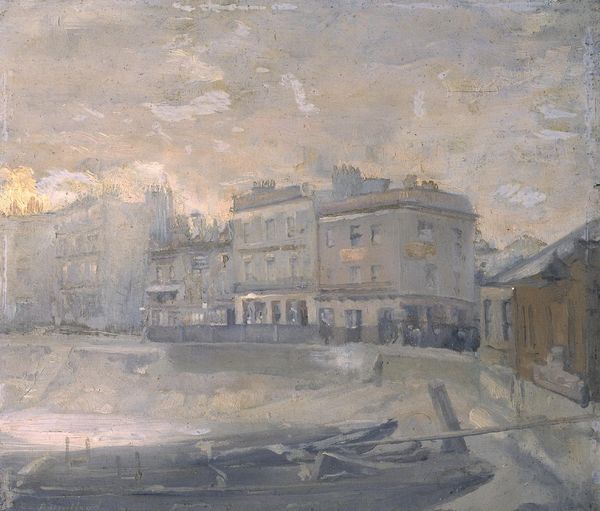
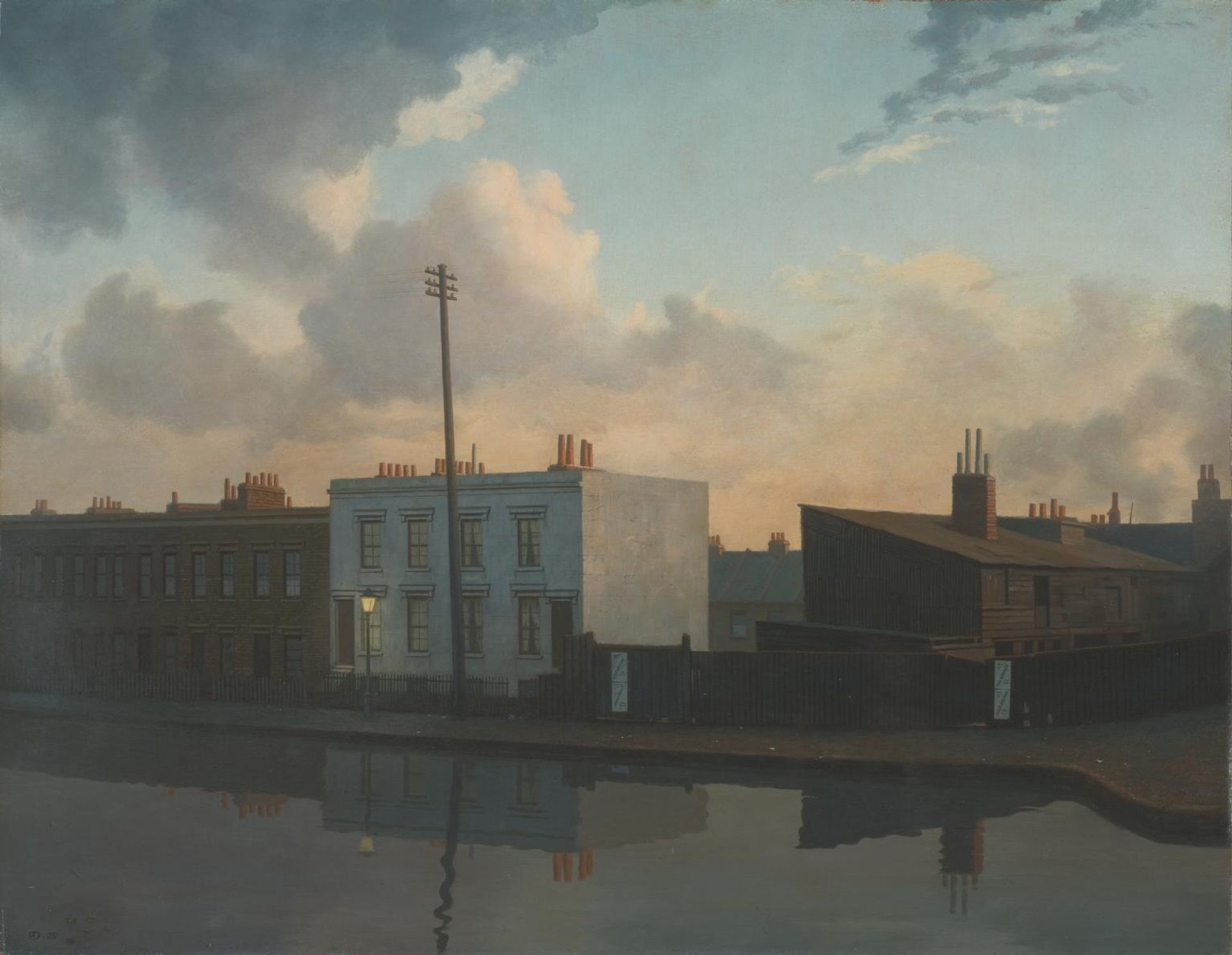
Curator: This is Algernon Newton's "The Surrey Canal, Camberwell," housed here at the Tate. I find its depiction of urban stillness quite striking. Editor: It's undeniably still—almost unsettlingly so. There’s a latent sense of melancholy and solitude, emphasized by the cold palette. Curator: Newton was known for his cityscapes, often depicting overlooked or unglamorous areas of London. The canal itself, now largely filled in, represents a bygone era of industrial transport. Editor: The light feels symbolic too, doesn't it? That single illuminated window amidst the gathering dusk suggests both hope and isolation. Curator: Precisely. Notice also the geometric forms of the buildings, reflecting the social structure, the rhythm of working class life. Editor: And the clouds mirroring the water! A powerful reflection on a city's continuous flux and permanence. Curator: A potent image—speaking volumes about the socio-economic landscape. Editor: Indeed, there's much to contemplate in this quiet corner of London.

Artwork details
- Dimensions
- support: 718 x 914 mm frame: 860 x 1062 x 85 mm
- Location
- Tate Collections
- Copyright
- © Tate | CC-BY-NC-ND 4.0 DEED, Photo: Tate
Comments

http://www.tate.org.uk/art/artworks/newton-the-surrey-canal-camberwell-n05343
Newton began to exhibit regularly at the Royal Academy summer shows in 1923 and he continued to send paintings for several decades. His chosen subjects were views of London, mostly in the St John's Wood, Hampstead, Kentish Town and Paddington areas. He was particularly fond of including a stretch of water in his compositions and often chose back-street views of canals, as here. He liked the slightly forlorn Regency and early Victorian terraces that faced the canals, and gave them a curiously uninhabited look. He once wrote: 'There is beauty to be found in everything, you only have to search for it; a gasometer can make as beautiful a picture as a palace on the Grand Canal, Venice. It simply depends on the artist's vision.' Gallery label, August 2004
About this artwork
Curator: This is Algernon Newton's "The Surrey Canal, Camberwell," housed here at the Tate. I find its depiction of urban stillness quite striking. Editor: It's undeniably still—almost unsettlingly so. There’s a latent sense of melancholy and solitude, emphasized by the cold palette. Curator: Newton was known for his cityscapes, often depicting overlooked or unglamorous areas of London. The canal itself, now largely filled in, represents a bygone era of industrial transport. Editor: The light feels symbolic too, doesn't it? That single illuminated window amidst the gathering dusk suggests both hope and isolation. Curator: Precisely. Notice also the geometric forms of the buildings, reflecting the social structure, the rhythm of working class life. Editor: And the clouds mirroring the water! A powerful reflection on a city's continuous flux and permanence. Curator: A potent image—speaking volumes about the socio-economic landscape. Editor: Indeed, there's much to contemplate in this quiet corner of London.
Comments
http://www.tate.org.uk/art/artworks/newton-the-surrey-canal-camberwell-n05343
Newton began to exhibit regularly at the Royal Academy summer shows in 1923 and he continued to send paintings for several decades. His chosen subjects were views of London, mostly in the St John's Wood, Hampstead, Kentish Town and Paddington areas. He was particularly fond of including a stretch of water in his compositions and often chose back-street views of canals, as here. He liked the slightly forlorn Regency and early Victorian terraces that faced the canals, and gave them a curiously uninhabited look. He once wrote: 'There is beauty to be found in everything, you only have to search for it; a gasometer can make as beautiful a picture as a palace on the Grand Canal, Venice. It simply depends on the artist's vision.' Gallery label, August 2004