print, ink
portrait
caricature
asian-art
caricature
ukiyo-e
ink
Dimensions: 14 1/2 × 10 1/8 in. (36.83 × 25.72 cm) (sheet, vertical ōban)
Copyright: Public Domain
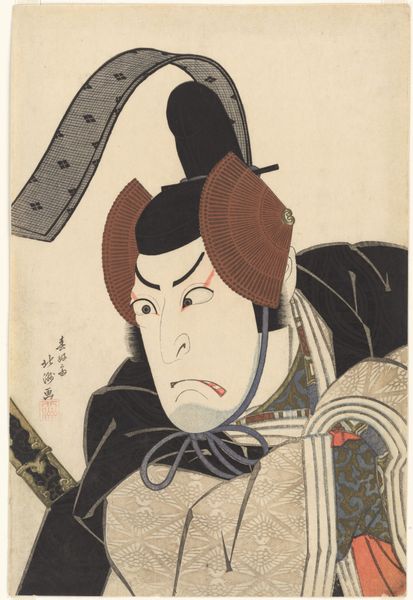
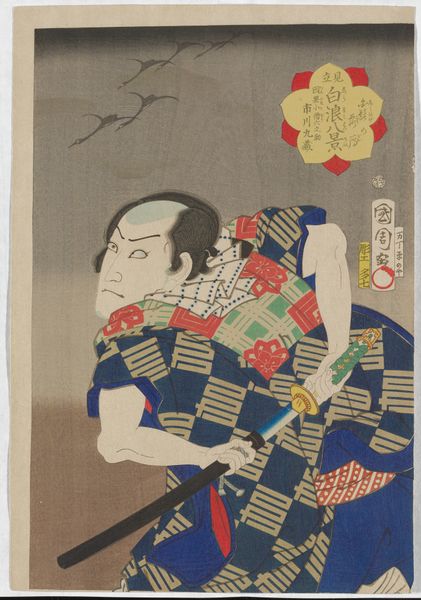
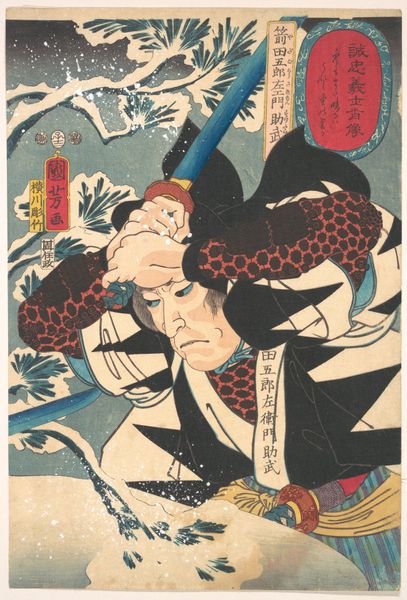
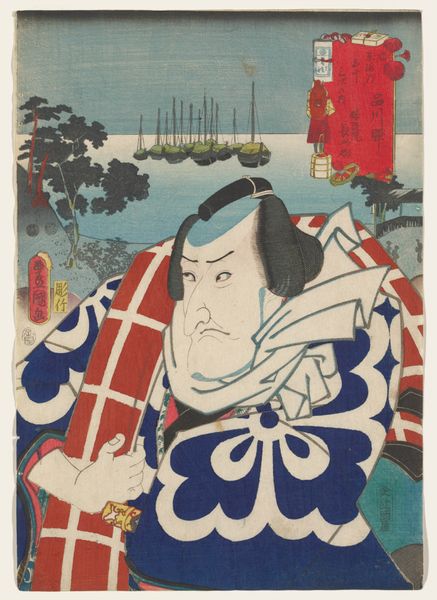
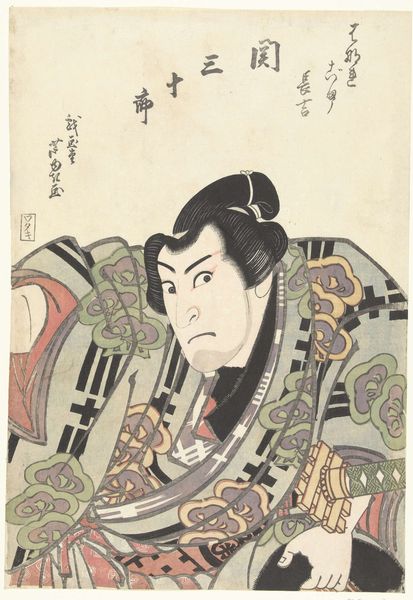
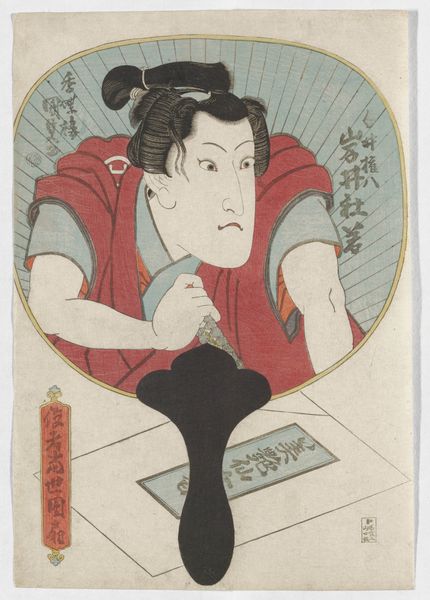
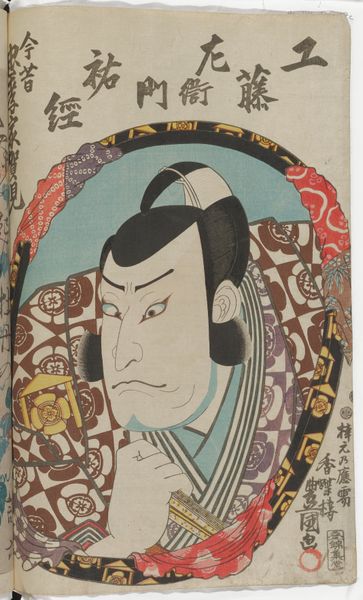
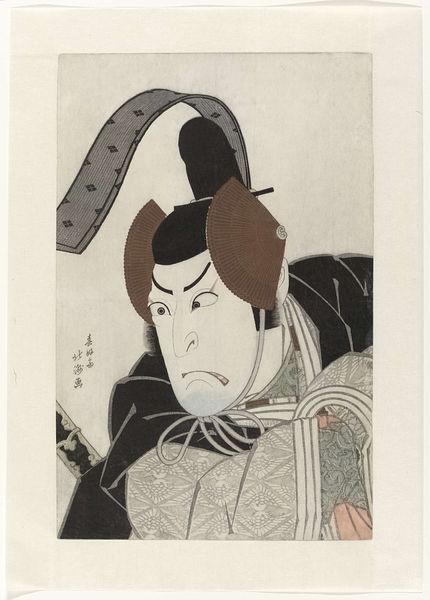
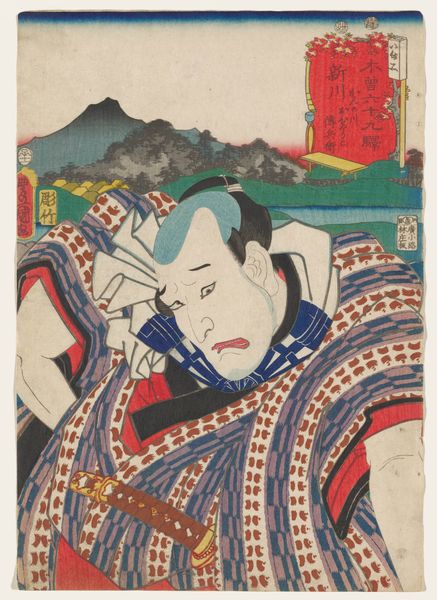
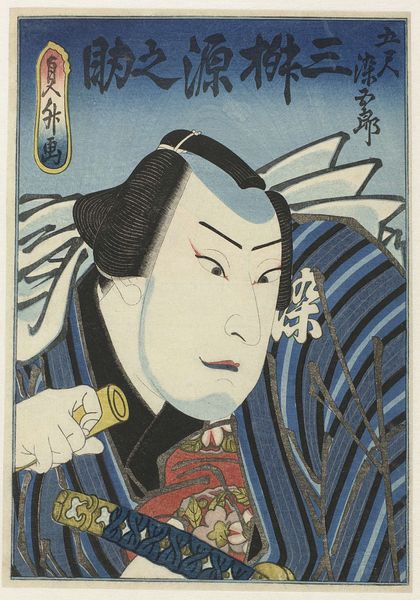
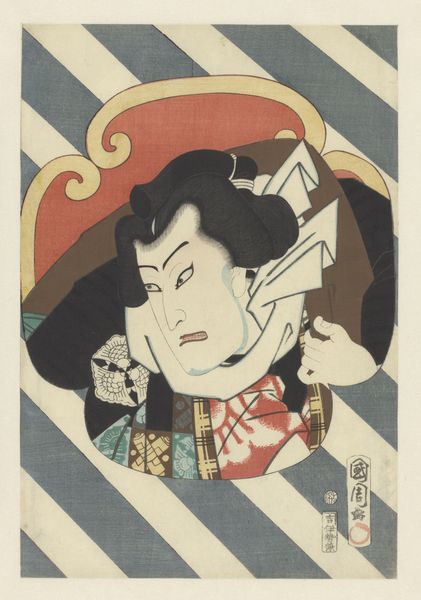
Curator: This striking print is by Utagawa Kunisada, dating back to about 1833. It's titled "Actor Ichikawa Danzō V as Satsuma Gengobei," a woodblock print rendered in ink and color, part of the Ukiyo-e tradition. Editor: Immediately, I get a sense of contained tension. The severe gaze, the way he clutches that sword... It's almost theatrical, larger than life. Curator: Indeed. The composition itself is quite deliberate. Notice how the artist frames the actor's head and upper body within a stylized fan? This not only focuses our attention but also hints at the subject's role and persona. Editor: It’s a fascinating contrast—the rigid lines of the fan against the fluid curves of the robe and the actor's face. The minimal palette too—blacks, whites, the touch of red… it speaks volumes. The blue shaved part of the head just brings a certain strangeness to the image, that almost clashes with the face but strangely works with the cold determination displayed. Curator: Consider the symbolism. The sword represents power and perhaps a threat, while the fan, a common prop in Kabuki theatre, denotes artifice and performance. Editor: I wonder about that mask-like quality. The stark white face, the stylized eyebrows... Is it meant to distance us, to remind us that we're observing a performance? He may even look clown-like in a Western understanding, even with a certain level of anger he displays Curator: Precisely. And if you examine the lines and forms carefully, one sees how Kunisada exaggerates certain features, employing the "caricature" that is a prominent Ukiyo-e element, underscoring the artifice, reinforcing the theatricality of the portrait. Editor: This makes me reflect on the performative aspect of identity itself. We are all, in a way, actors on a stage, aren't we? Kunisada just holds up a mirror—or, in this case, a fan—to that reality. Curator: Ultimately, Kunisada captures not only the likeness of the actor but also the very essence of Kabuki theatre. Editor: Right! Leaving us pondering what is performance, what is "real," and how art blurs these distinctions in such an unforgettable and forceful composition.
Comments

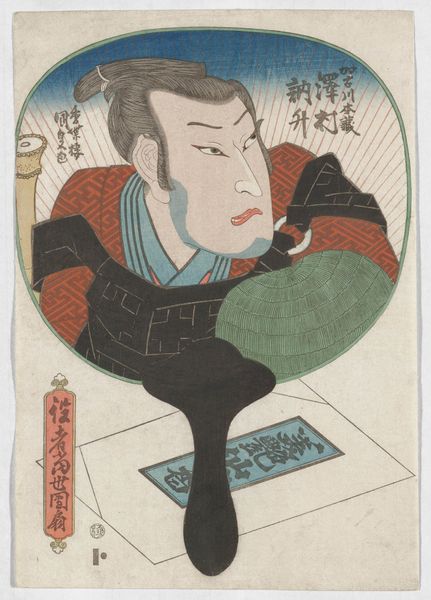
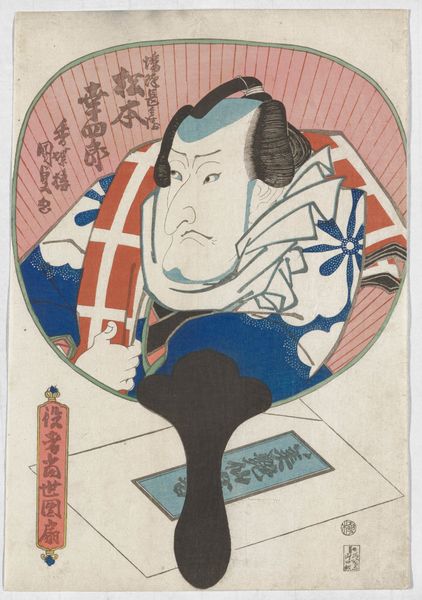
Related to the plav Godairiki koi no fūjime, performed at the Ichimura Theater, 1833, third month. Utagawa Kunisada’s bust portraits from the 1820s and 1830s typically show actors against a plain background accompanied by poems composed by the portrayed actors. Here, the portrait is fan shaped, allowing the image to be cut out and affixed to an actual fan. This series is also an early example of product placement, as a packet of Bien Senjokō face powder appears at the bottom of each print. It seems that the prints were delivered together with the powder or that the producer of the powder paid for some of the production costs of the print.


Join the conversation
Join millions of artists and users on Artera today and experience the ultimate creative platform.