#
figurative
#
oil painting
#
portrait reference
#
acrylic on canvas
#
animal portrait
#
animal drawing portrait
#
portrait drawing
#
facial portrait
#
portrait art
#
fine art portrait
#
digital portrait
Copyright: Public Domain: Artvee
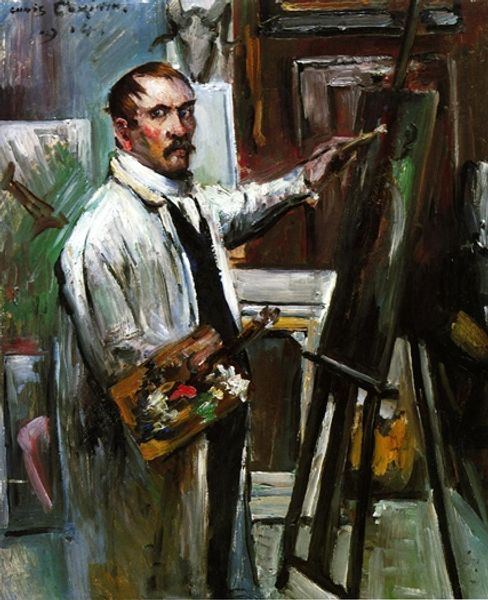
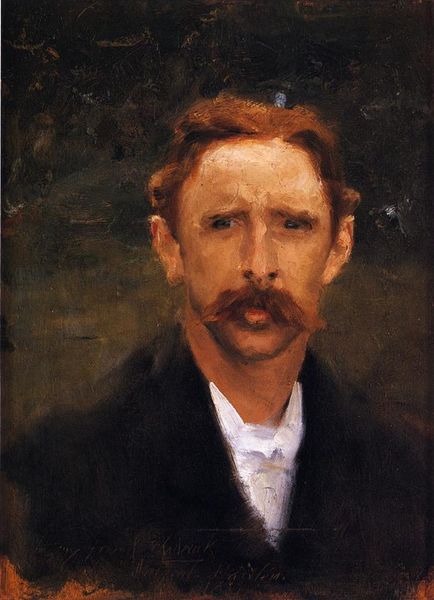
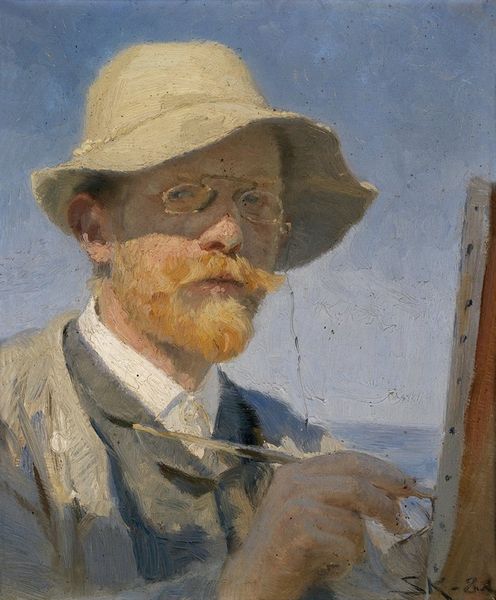
Curator: It has such a tangible feel, almost confrontational! He really looks like he's about to either paint your portrait or tell you off for being late. Editor: I think you're right! We're looking at Filipp Malyavin's "Self-portrait" from 1927. It's an oil painting, capturing the artist with this striking direct gaze. It’s tempting to think about the context of Russia in the late 1920s... Curator: Ooh, go on. Is he hiding dissident thoughts behind that furrowed brow? Editor: Possibly. Think about the changing roles of artists during this time. Artistic expression had to fit into particular modes. This unflinching self-examination could be read as either a defiant assertion of individuality or an acceptance of prescribed roles, right? Curator: I see what you mean. Maybe the blue and green splashes in the background hint at a wilder spirit he's keeping in check. The colours don't quite harmonise, there is something off. What does that make him look like, holding a brush full of… bubble-gum pink paint. Is that an act of rebellion? A way of thumbing his nose at expectation, at Socialist Realism? Editor: I'm fascinated by the gaze here, how Malyavin is presenting himself. Consider the formal aspects – the composition, the use of color. But equally important are the questions the work raises about identity, authenticity, and the artist's role. Are we complicit in constructing a particular narrative of him? Curator: Gosh, you’ve put him on trial! Maybe he just wanted to paint himself on a day he was feeling particularly grumpy, and a bit conflicted. That palette of bubblegum and rouge sitting in tension. Editor: Ha! And perhaps there is beauty in that tension itself. It reminds me how we carry our histories. It asks us what narratives are inherited. Curator: Yes! Beautiful, complicated… and he is wearing an unusual tie! Editor: Exactly. Maybe he's asking us to confront ourselves too, in our own time. What will the history books say?
Comments
No comments
Be the first to comment and join the conversation on the ultimate creative platform.
 Collect
 React
React Comment
More like this