photography
#
landscape
#
photography
#
constructionism
#
modernism
#
realism
Dimensions: height 150 mm, width 229 mm, height 315 mm, width 330 mm
Copyright: Rijks Museum: Open Domain
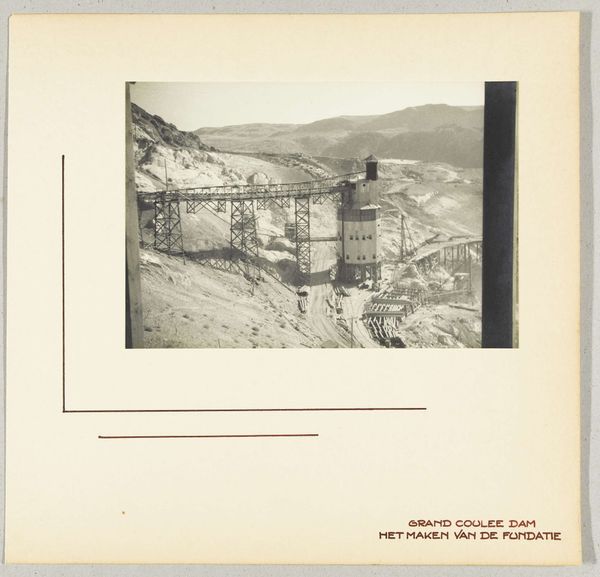
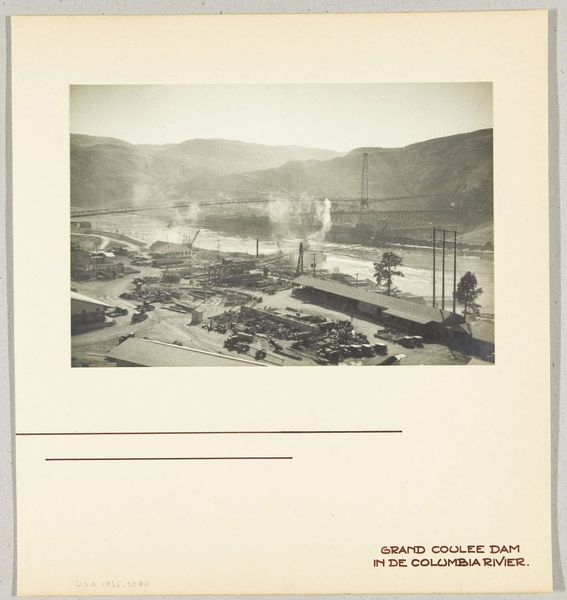
Curator: This is a photograph titled "Grand Coulee Dam, Columbia River, Verenigde Staten: grinttoevoer," created in 1936. Editor: My first impression is of immense scale, paradoxically captured with such flat tonality. It evokes a stark, almost desolate feeling despite the obvious human activity. The linear composition directs the eye powerfully from foreground to the mountainous background. Curator: The photograph resonates with themes of progress and transformation. The dam itself symbolizes humankind’s attempt to harness nature, reflecting a belief in technological advancement. Editor: Indeed. And yet, the image lacks human presence. Instead, we have the formal elements of a linear conveyor juxtaposed against the asymmetrical natural land formations. Curator: Those conveyors certainly dominate. They represent more than just machinery; they embody a shift in societal consciousness, a move toward industrialization that transforms not just landscapes but entire belief systems. Note how 'Safety Pays' is inscribed at the peak. Editor: That slogan disrupts what is almost classical use of the sublime with raw propaganda. Its horizontality acts to reinforce the depth in a calculated flattening effect, playing with how the viewer understands dimension, scale, and even ideological depth. Curator: The desaturated monochromatic palette further contributes to the scene’s serious and monumental aura. The photo seems aware that its industrial and modern outlook may have hidden costs. Editor: The use of photography as the medium is critical too, as it acts both as record and promotion. There's an undeniable attempt to frame the narrative in a specific light. In any event, what might have seemed just descriptive and of-the-moment has taken on complex resonance, nearly a century later. Curator: I find myself contemplating how such images have become iconic representations of human ambition, capturing both our capabilities and our complex relationship with the natural world. Editor: For me, it is ultimately the compositional balance – the angular lines against the amorphous earth – that creates its visual and conceptual tension. It forces us to reflect on that very relationship between geometry, medium, and history.
Comments
No comments
Be the first to comment and join the conversation on the ultimate creative platform.
 Collect
 React
React Comment
More like this