brass, wood
#
brass
#
arts-&-crafts-movement
#
furniture
#
warm toned
#
wooden texture
#
wood
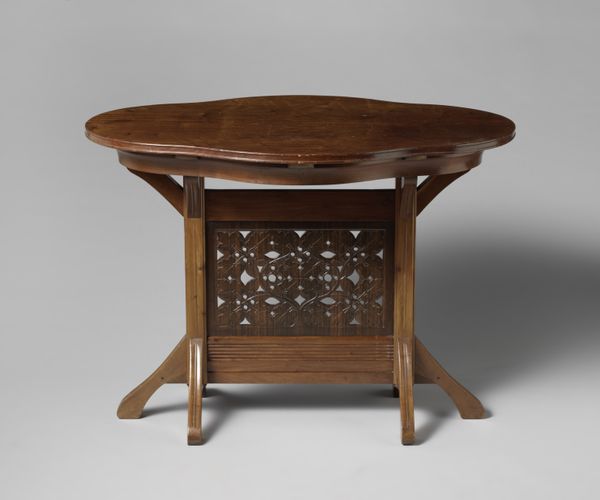
Dimensions: 25 1/4 x 22 1/4 x 22 1/4 in. (64.14 x 56.52 x 56.52 cm) (closed)
Copyright: No Known Copyright
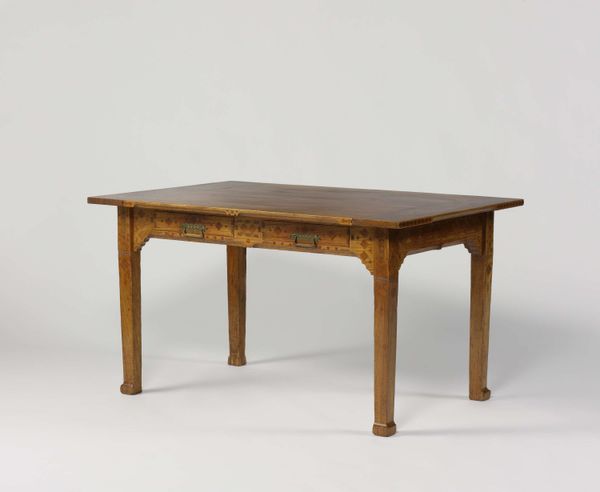
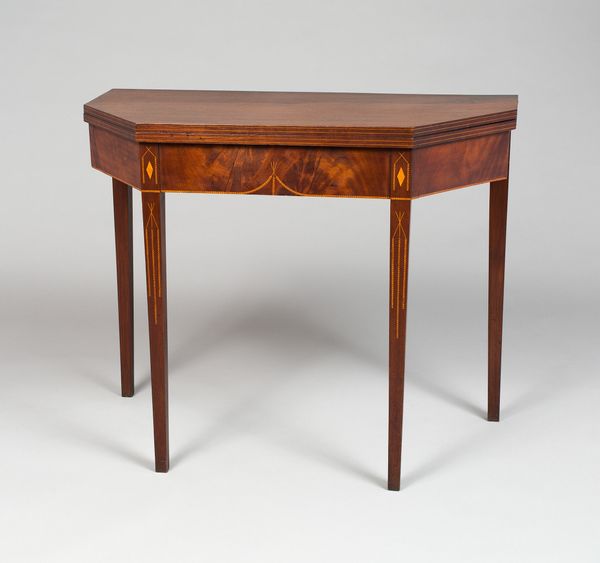
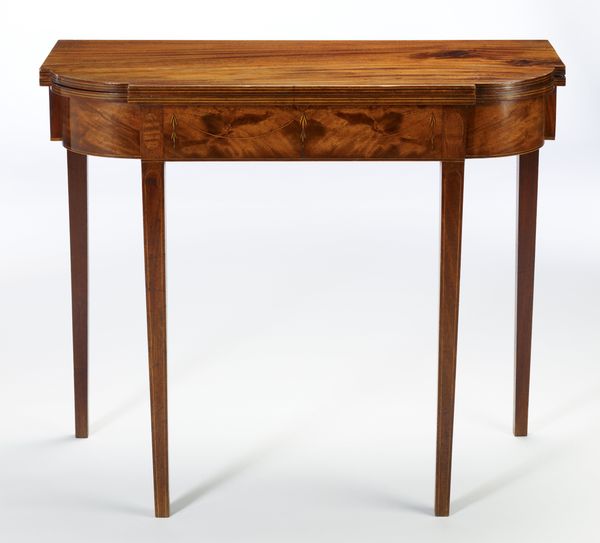
Editor: Here we have Henry van de Velde's "Game Table," crafted around 1906. The piece is primarily wood, accentuated with brass fittings, currently residing at the Minneapolis Institute of Art. It's captivating, and almost anthropomorphic. What meanings do you find embedded within it? Curator: Van de Velde’s table is so fascinating. The wood’s warm tones immediately bring to mind ideas of hearth and home, comfort, maybe friendly competition, but these forms… see how they bow outwards? The tension between support and display is evident, it almost buckles slightly in the middle there. Editor: I notice that now – it’s as though the table itself is animated, not just a static object. Curator: Exactly! Think about games themselves - cycles of chance, moments of heightened tension, anticipation, maybe even the disruption of order and societal roles on a small scale. The "rules" by which the table is built may reference the larger, and somewhat unstable, forces within our world. Does it communicate something about fin-de-siècle anxieties, do you think? Editor: I hadn’t considered it that way. The design seemed purely aesthetic at first. Now it's making me consider larger questions on how design intersects with society at that time. Curator: It’s subtle, but powerful. And notice those brass insets - points of contact, markers of place, even small stages within the game. Editor: Yes! Almost like designated areas of ritual or purpose. Thanks for pointing out so much nuance in what seemed, on the surface, to be such a simple object. Curator: Absolutely! Every object whispers stories if we take the time to listen. And seeing that symbolic resonance is why these objects are far more complex than they appear.
Comments

minneapolisinstituteofart over 1 year ago
⋮
Henry van de Velde was a leading avant garde designer in the Art Nouveau movement in France, and its German counterpart, Jungendstil. His sinuously curving interiors and furniture commissioned in 1895 for Siegfried Bing's Paris shop L'Art Nouveau were a sensation. They demonstrated the harmony of gesamtkunstwerk-a total work of art-in which architecture, furnishings, and fittings were carefully conceived and orchestrated as a whole. This games table, a rare example of the type, exhibits the strong curvilinear elements so important in botanically inspired Art Nouveau designs. Van de Velde's characteristically strong and confident lines animate the form, while providing a sturdy and compact table for gaming. Other beautiful and practical solutions are the small shelves to contain counters or drinks, and the table top, whose four triangular sections fold out to a larger, leather-covered rectangular surface when in use. This delightful object further enriches the MIA's furniture holdings in its prominent collection of Modernist design, by fin-de-siècle architect-designers such as Joseph Olbrich, Otto Wagner, Josef Hoffmann, Peter Behrens, Louis Majorelle, Eugène Gaillard, Charles Rennie Mackintosh, and Frank Lloyd Wright. Van de Velde spent the years from 1899-1917 in Germany, where he directed the Kunstgewerbeschule in Weimar from its inception in 1908 until the outbreak of the First World War (he turned the school over to Walter Gropius, who transformed it into the Bauhaus in 1919). JKO 11/09


Join the conversation
Join millions of artists and users on Artera today and experience the ultimate creative platform.
 Collect
More like this