About this artwork
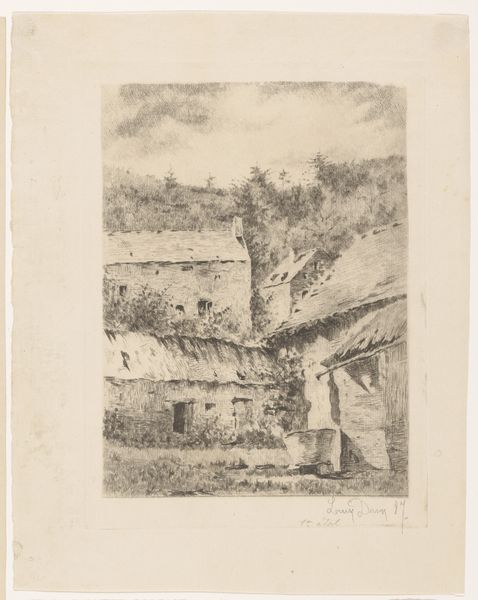
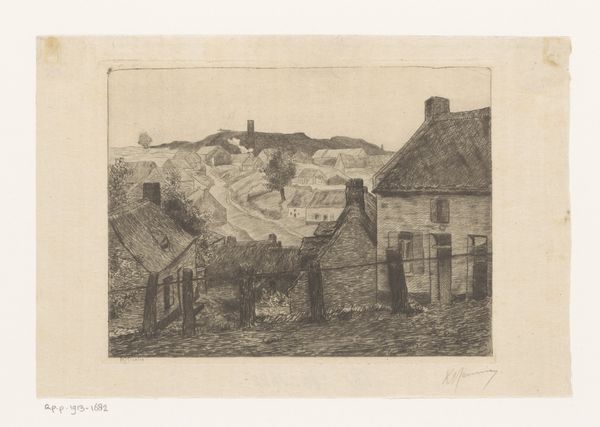
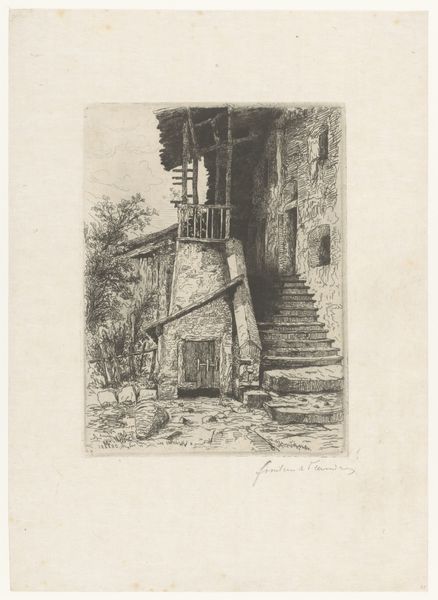
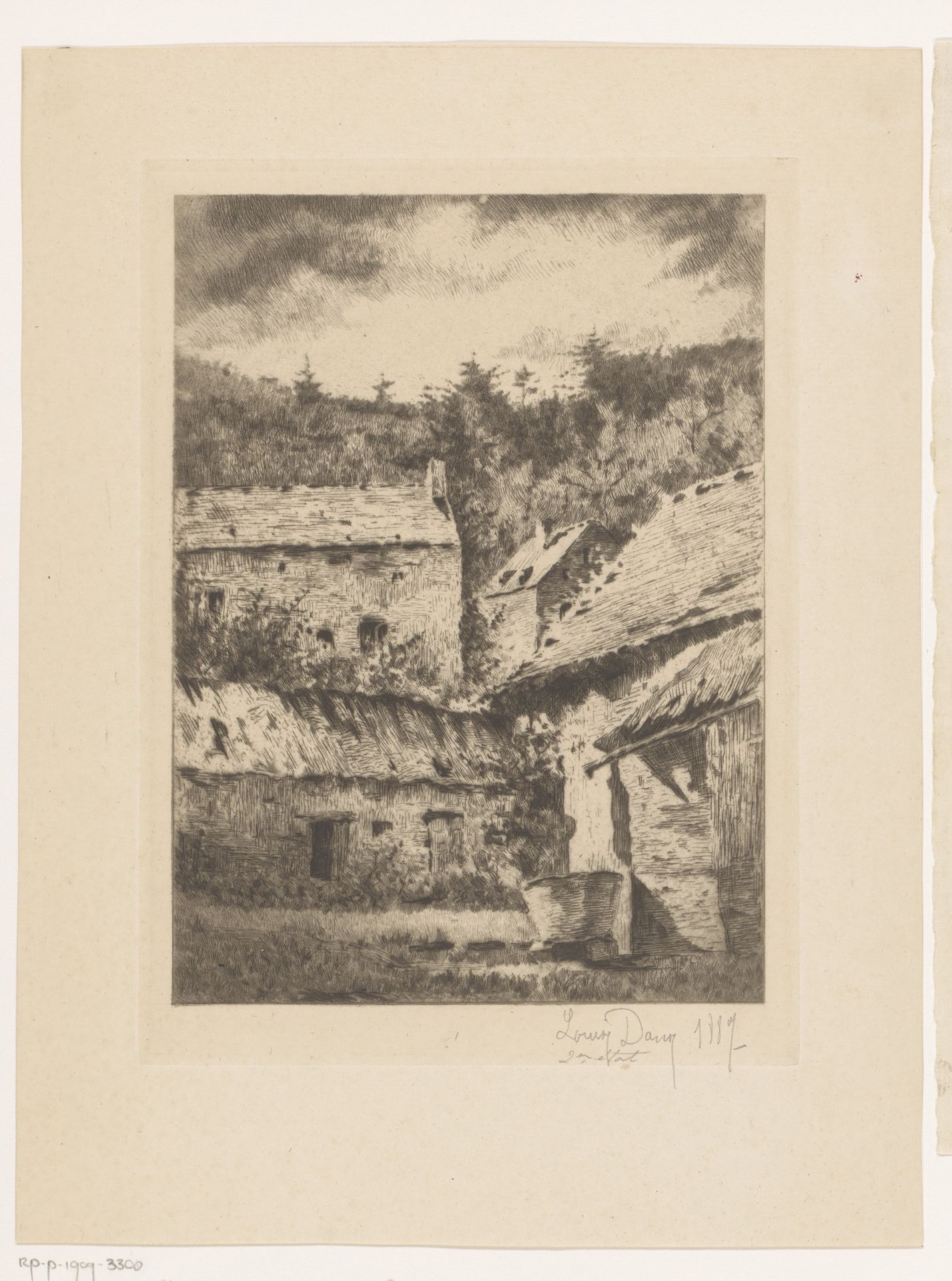
Curator: Looking at Louise Danse’s 1887 etching, "Heuvelachtig landschap met boerenhofstede," now housed at the Rijksmuseum, I'm immediately struck by the way the intricate linework creates a sense of enclosed, intimate space. Editor: It does feel very enclosed, almost oppressive. The looming sky and closely packed buildings create a sense of… entrapment, perhaps? It really gives an impression of how small a rural life might be. Curator: Absolutely. And what's particularly interesting is her choice of etching—a printmaking technique that inherently involves labor. It is an exacting, chemical process that transforms a metal plate. Consider the amount of labour required to produce this image versus its consumption. Editor: You can almost feel the labor within those lines. Speaking of which, do you think there’s commentary here about the socio-economic position of farmers during this period? The etching portrays a simple, rustic dwelling—but also potentially speaks to their working conditions and the physical labour involved in agriculture during that time, if one looks at class structure. Curator: Precisely. This links back to the etching process itself, its demand on time, skill and labour and even class, with printmaking traditionally accessible to many as a portable format. Did this allow images, opinions, ideologies to become easily disseminated among a population beyond painting? What might Louise Danse be trying to transmit through the materiality of etching itself? Editor: That is an interesting point: did Danse choose this medium for its material expression, its reproducibility, or potentially to reach a broader public? This print asks us to confront the realities of 19th-century rural life, which are sometimes sanitized in grander landscape paintings of the era. Curator: True, that’s what Realism does, in a sense. Thank you. Editor: It invites questions about visibility, labour, and the construction of these often underrepresented voices. A fine end note!

Artwork details
- Medium
- print, etching
- Dimensions
- height 220 mm, width 160 mm
- Location
- Rijksmuseum
- Copyright
- Rijks Museum: Open Domain
Tags
etching
old engraving style
landscape
genre-painting
realism
Comments
No comments
About this artwork
Curator: Looking at Louise Danse’s 1887 etching, "Heuvelachtig landschap met boerenhofstede," now housed at the Rijksmuseum, I'm immediately struck by the way the intricate linework creates a sense of enclosed, intimate space. Editor: It does feel very enclosed, almost oppressive. The looming sky and closely packed buildings create a sense of… entrapment, perhaps? It really gives an impression of how small a rural life might be. Curator: Absolutely. And what's particularly interesting is her choice of etching—a printmaking technique that inherently involves labor. It is an exacting, chemical process that transforms a metal plate. Consider the amount of labour required to produce this image versus its consumption. Editor: You can almost feel the labor within those lines. Speaking of which, do you think there’s commentary here about the socio-economic position of farmers during this period? The etching portrays a simple, rustic dwelling—but also potentially speaks to their working conditions and the physical labour involved in agriculture during that time, if one looks at class structure. Curator: Precisely. This links back to the etching process itself, its demand on time, skill and labour and even class, with printmaking traditionally accessible to many as a portable format. Did this allow images, opinions, ideologies to become easily disseminated among a population beyond painting? What might Louise Danse be trying to transmit through the materiality of etching itself? Editor: That is an interesting point: did Danse choose this medium for its material expression, its reproducibility, or potentially to reach a broader public? This print asks us to confront the realities of 19th-century rural life, which are sometimes sanitized in grander landscape paintings of the era. Curator: True, that’s what Realism does, in a sense. Thank you. Editor: It invites questions about visibility, labour, and the construction of these often underrepresented voices. A fine end note!
Comments
No comments