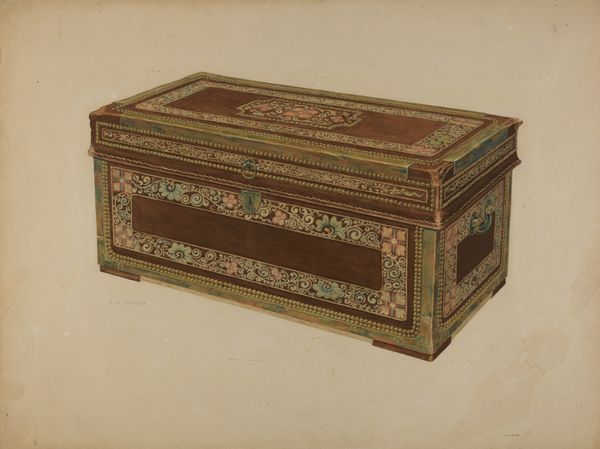
drawing, coloured-pencil, carving, wood
#
drawing
#
coloured-pencil
#
carving
#
pottery
#
coloured pencil
#
wood
#
academic-art
Dimensions: overall: 36.2 x 45.7 cm (14 1/4 x 18 in.)
Copyright: National Gallery of Art: CC0 1.0
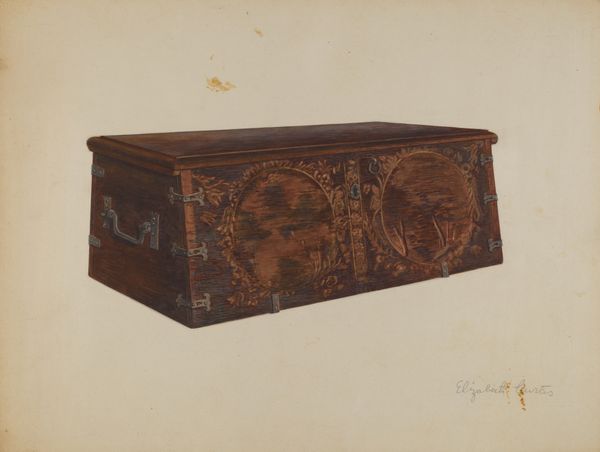
Curator: Here we have "Sea Chest", a mixed media piece from 1935-1942 by Rolland Livingstone, combining drawing, colored pencil, wood and carving. Editor: The carving immediately evokes a sense of Americana, maybe even propaganda. It feels very declarative in its patriotism, quite forceful, doesn't it? Curator: Absolutely. If we consider the historical context, it was created during the Depression era, with war on the horizon, it's impossible to separate it from the fervent nationalistic sentiments that permeated much of American culture. It likely embodies a desire to present a strong, united front. How do you read the nautical symbolism? Editor: Well, anchors traditionally signify hope, steadfastness. But within the broader scheme here – the eagle with the shield, and what appears to be the profile of a soldier – they morph into something else. The visual program screams duty and loyalty to country. The sea, with its many treasures, might become a stage for naval bravery. Also note "Jim McDivit-Gloucester" along the bottom; probably commissioned by or a tribute to him? Curator: That’s a sharp observation. Commissioned or not, this piece acts as a form of memorialization, enshrining an individual within a grand narrative of national identity. The inscription anchors it both to a person and a place. How do you read this intersection? Editor: Interesting how Livingstone fuses together the intimate—Jim McDivit's name, forever engraved on wood—and these potent emblems. A man subsumed into national and historical allegory. Is there room for personal agency when faced with symbols so overpowering? That stern soldier in the circle... it feels as though personal expression had to comply to a common language, for better or for worse. Curator: Yes, and that language continues to evolve even today. I wonder what future generations will take from its iconography? Editor: The life and legacy of those symbols – fascinating, and complex. Always so much more than initially meets the eye, it seems.
Comments
No comments
Be the first to comment and join the conversation on the ultimate creative platform.
 Collect
 React
React Comment
More like this