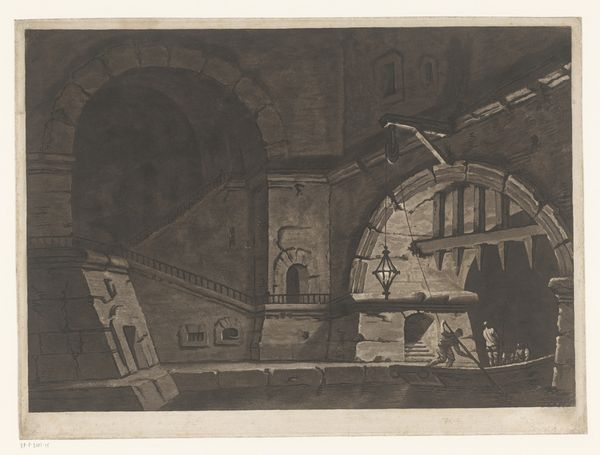
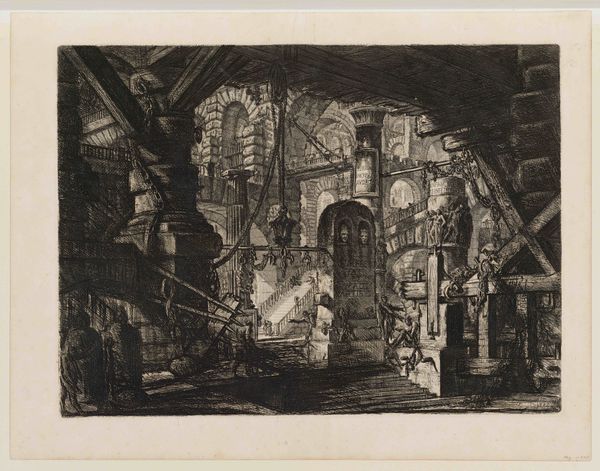
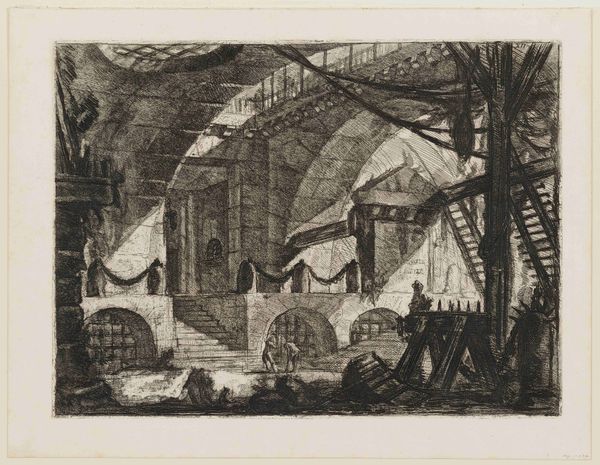
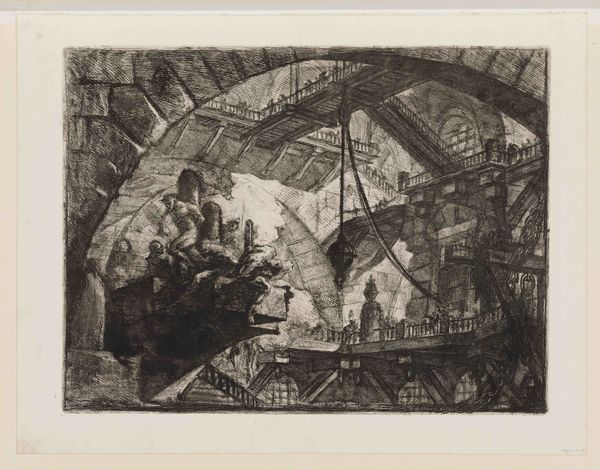
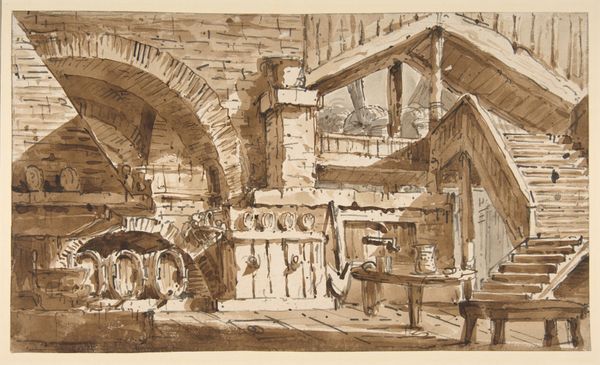
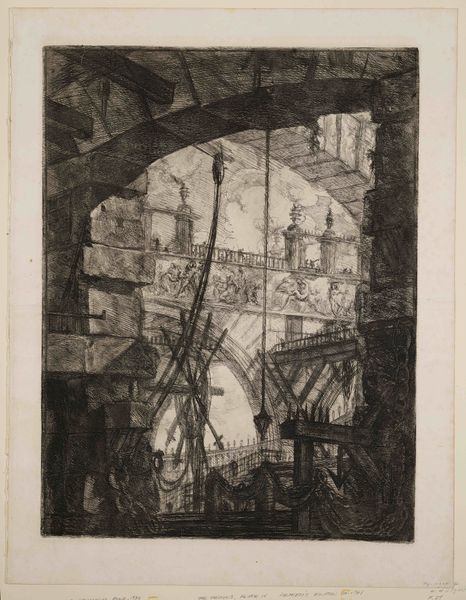
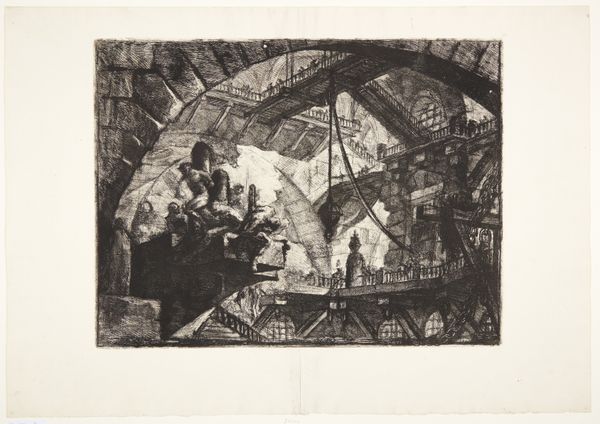
Stage Set Design of an Ancient Roman Ruin being Converted into a Barn 1783 - 1840
0:00
0:00


drawing, mixed-media, tempera, print, architecture
#
architectural sketch
#
drawing
#
mixed-media
#
tempera
# print
#
landscape
#
romanticism
#
history-painting
#
architecture
Dimensions: sheet: 8 1/16 x 11 9/16 in. (20.5 x 29.4 cm)
Copyright: Public Domain
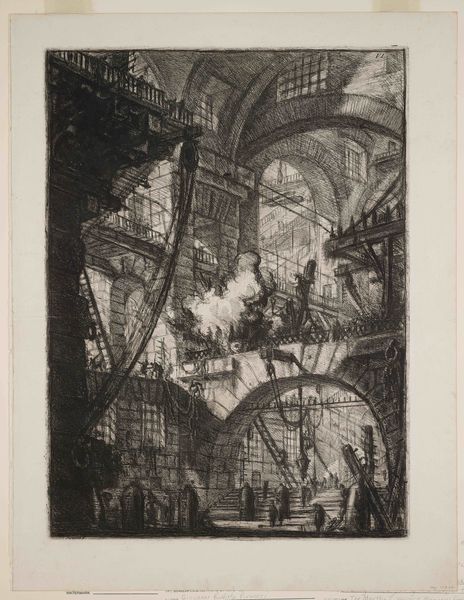
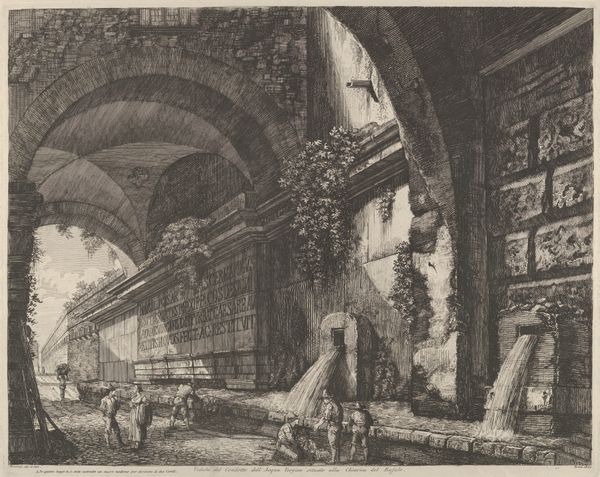
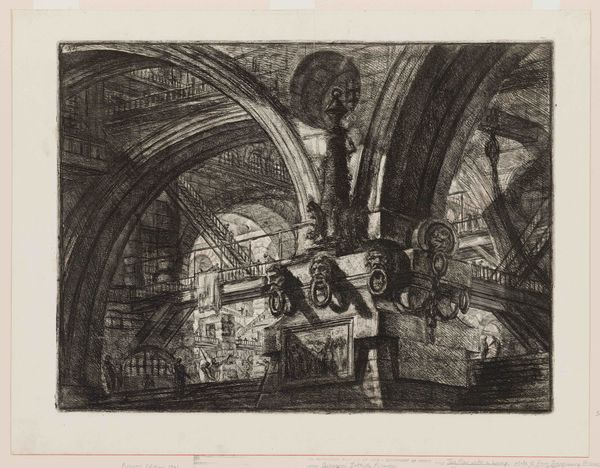
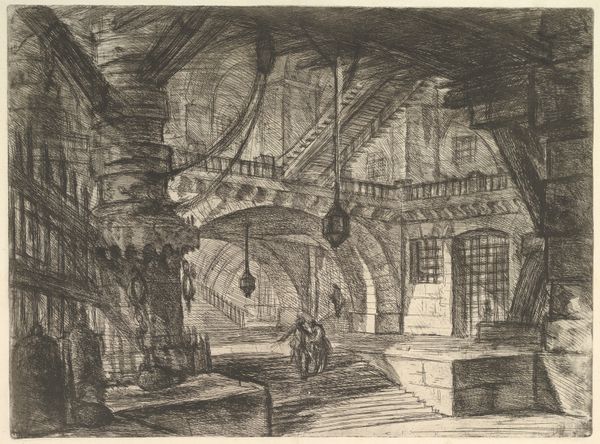
Curator: This mixed-media drawing and print, completed by Johann Heinrich Ramberg between 1783 and 1840, presents us with a fascinating, if peculiar, juxtaposition. The piece is titled "Stage Set Design of an Ancient Roman Ruin being Converted into a Barn." Editor: Intriguing. My immediate reaction is to the sheer density of lines and shapes; it gives a feeling of chaotic beauty, if such a thing exists. The building seems to sigh under the weight of history and, frankly, decay. Curator: That’s a fitting observation. Ramberg's composition here engages with concepts of ruination and reclamation. By overlaying the image of a decaying Roman ruin with the activity of turning it into a barn, the work invokes reflections on the cyclical nature of history. The fall of empires giving way to agrarian functionality speaks volumes. Consider how the vestiges of past power—arches, grand entrances—are re-purposed to meet basic needs. It reminds one of colonial appropriation. Editor: Yes, but notice too how carefully he uses light. See how it emphasizes the ruinous quality while subtly framing the human figures? There’s a definite visual rhythm at play here. The vertical lines of the dilapidated architecture contrast sharply with the figures busying themselves. It really enhances that feeling of an existing structure being absorbed, re-oriented into something new. Curator: Precisely, and it invites critical inquiry into the nature of cultural inheritance. Are these ruins treasures to be preserved, or mere resources ripe for exploitation and modification to serve contemporary society? Who decides, and on whose terms? It even foreshadows urban development that would come later. Editor: I concur. But structurally, look at the converging lines guiding our sight to a sort of vanishing point deep within the archway; that compositional decision strengthens our understanding that the Roman era is, symbolically, further behind us. Curator: Ultimately, Ramberg leaves us questioning what remains—what purpose is left—when grand ideals crumble and only practical demands persist? It resonates powerfully with concerns that still echo today within discourses of class, labor, and cultural memory. Editor: It all coalesces into a complex reflection on change. Thanks for pointing out nuances that enriched my perspective!
Comments
No comments
Be the first to comment and join the conversation on the ultimate creative platform.
 Collect
 React
React Comment
More like this