About this artwork
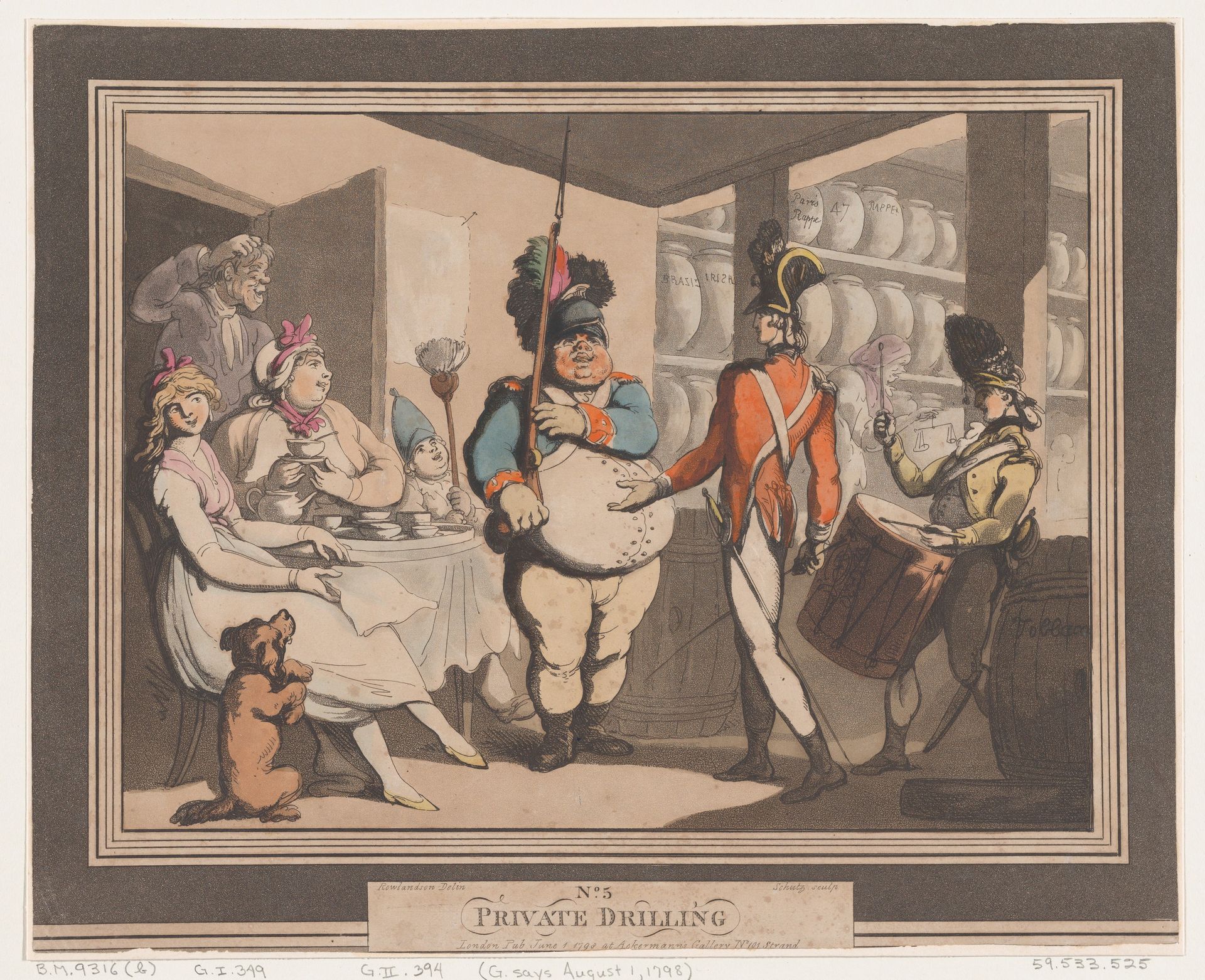
Heinrich Joseph Schütz created "Private Drilling, No. 5", a print which presents us with a sharply divided composition, the left side domestic and the right militaristic, with the two meeting somewhat uneasily in the middle. The round table and rounded figures of the tea drinkers contrast vividly with the rigid, vertical lines of the soldiers and stacked containers. This division uses semiotic codes to question the values of society. On one side, the figures drink tea in a comfortable domestic setting. The use of pale colors and curvilinear forms emphasizes their softness and presumed innocence. Conversely, the soldiers are depicted with bold lines and a strong, angular presence. The artist uses the formal elements of shape and line to suggest a critique of militarism. Schütz destabilizes these categories by placing them within the same frame, asking us to examine the relationship between private comfort and public duty. The print becomes not just a visual scene but a philosophical question posed through form. This piece reminds us that art is always in dialogue with the viewer, inviting ongoing analysis and diverse interpretations.
Private Drilling, No 5
1798

Heinrich Joseph Schütz
1800 - 1825
The Metropolitan Museum of Art
Metropolitan Museum of Art, New York, NYArtwork details
- Medium
- drawing, print
- Dimensions
- Sheet: 9 1/2 × 11 3/4 in. (24.1 × 29.9 cm)
- Location
- Metropolitan Museum of Art, New York, NY
- Copyright
- Public Domain
Tags
Comments
Share your thoughts
About this artwork
Heinrich Joseph Schütz created "Private Drilling, No. 5", a print which presents us with a sharply divided composition, the left side domestic and the right militaristic, with the two meeting somewhat uneasily in the middle. The round table and rounded figures of the tea drinkers contrast vividly with the rigid, vertical lines of the soldiers and stacked containers. This division uses semiotic codes to question the values of society. On one side, the figures drink tea in a comfortable domestic setting. The use of pale colors and curvilinear forms emphasizes their softness and presumed innocence. Conversely, the soldiers are depicted with bold lines and a strong, angular presence. The artist uses the formal elements of shape and line to suggest a critique of militarism. Schütz destabilizes these categories by placing them within the same frame, asking us to examine the relationship between private comfort and public duty. The print becomes not just a visual scene but a philosophical question posed through form. This piece reminds us that art is always in dialogue with the viewer, inviting ongoing analysis and diverse interpretations.
Comments
Share your thoughts