drawing, print, engraving
#
portrait
#
drawing
#
dutch-golden-age
# print
#
old engraving style
#
19th century
#
genre-painting
#
history-painting
#
engraving
Dimensions: height 114 mm, width 75 mm
Copyright: Rijks Museum: Open Domain
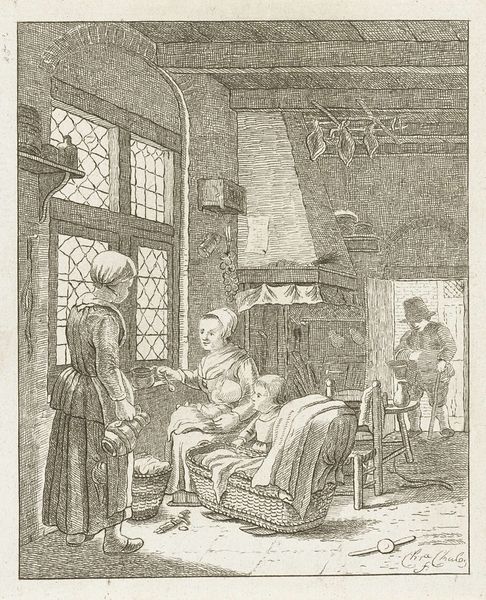
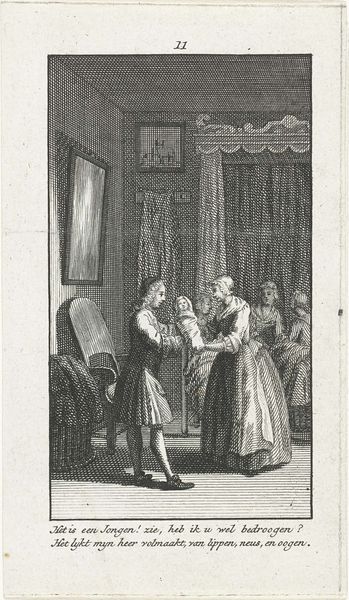
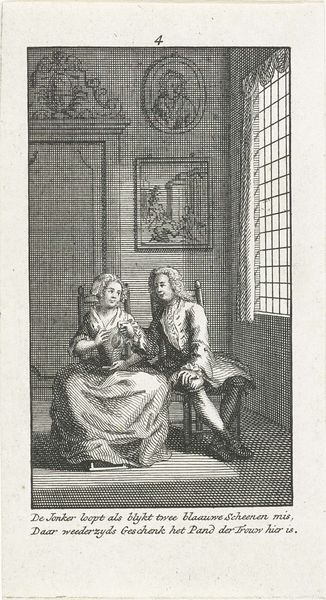
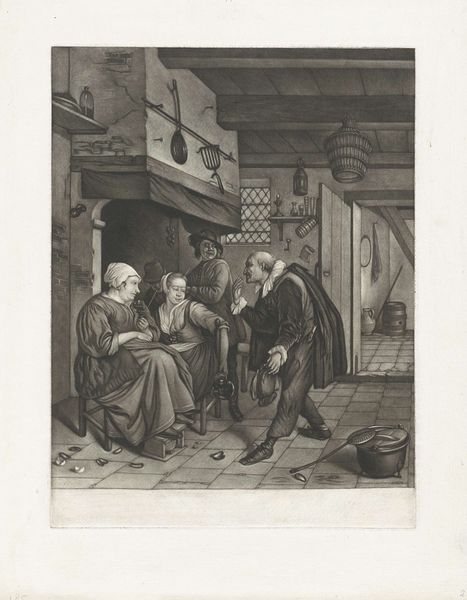
Curator: There's a somberness hanging over this engraving. Editor: Yes, it feels very still and intimate. We are looking at "Twee vrouwen bij een wieg en een man in een deuropening" by Philippus Velijn, created in 1832. It's currently held at the Rijksmuseum. Curator: The composition strikes me. The light focuses our attention on the women and the infant, while the man in the doorway is kept slightly in shadow. What might this tell us about gender and societal roles? Editor: Precisely! That placement definitely suggests something about power dynamics and domestic space. The man is present, but not really participating in the immediate, female-centered world around the cradle. Consider, also, how childbearing has been historically essentialized, particularly in Dutch Golden Age society to establish lineages and cultural capital, reinforcing gender roles and power structures. Curator: You raise an interesting point. Also note the intricate detail. Velijn renders texture so beautifully—the lace collars, the fabrics. All serve to highlight status but also speak of a certain vulnerability, of being enmeshed within societal expectations, no matter what the gender is. The child also seems symbolic, given their whiteness. What does that mean, metaphorically? What does it represent in that historic time and even now? Editor: White babies have long held particular social capital in European history, signifying continuity and heritage, and by consequence, reinforcing existing racial power imbalances in both implicit and explicit ways. The baby as a symbol becomes charged when we view through lenses of intersectionality in race, class, and gender. Curator: This work speaks volumes. Despite its simplicity, there's such complexity embedded in its iconography, encouraging us to reflect not just on the scene, but also our position relative to its subject. Editor: Absolutely, by positioning artworks such as this within relevant historical and socio-political discourse, we're able to engage in more profound and relevant conversations about societal forces.
Comments
No comments
Be the first to comment and join the conversation on the ultimate creative platform.
 Collect
 React
React Comment
More like this