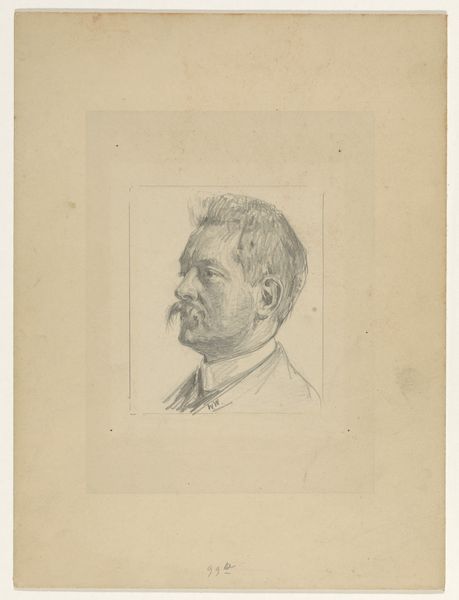
drawing, pencil
#
portrait
#
pencil drawn
#
drawing
#
pencil sketch
#
charcoal drawing
#
pencil drawing
#
pencil
#
portrait drawing
#
post-impressionism
Dimensions: height 98 mm, width 89 mm
Copyright: Rijks Museum: Open Domain
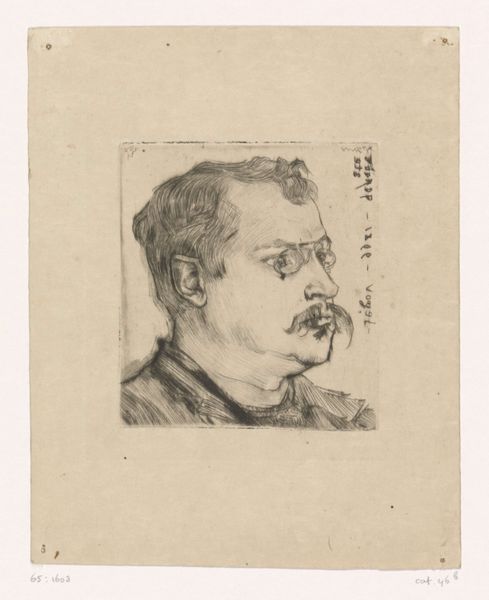
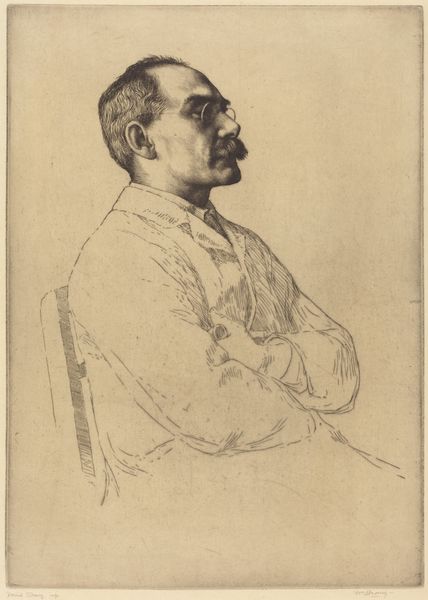
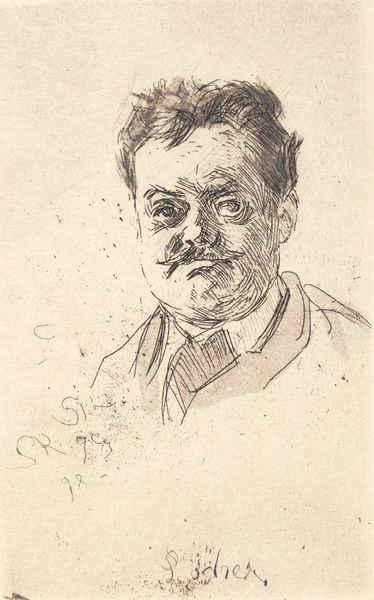
Editor: Here we have Jan Toorop's "Portret van Hugo Vogel" from 1899, a delicate pencil drawing. There's a stillness and almost scholarly mood to it. What strikes you about this piece? Curator: Beyond the skillful execution, I see a snapshot of a very particular moment in fin-de-siècle Europe. Think about the rise of intellectualism and burgeoning artistic communities. Toorop, embedded within the Symbolist movement, captures not just Vogel's likeness but hints at his social role, his engagement with the ideas of the era. Do you notice how the sharp, almost clinical lines around the monocle contrast with the softer rendering of his face? Editor: Yes, it’s like Toorop is highlighting his intellect, setting it apart. Is it a critique, maybe? Curator: Perhaps. Or perhaps it's an observation on how identity was performed and perceived at the time, especially for men in intellectual circles. The monocle becomes a signifier, a marker of a specific social position, hinting at class, education, and a certain world view. Who do you think had access and the privilege of being seen this way at that moment in history? Editor: Likely a very small and exclusive group. So it’s not just a portrait of an individual, but also a statement on society and representation. Curator: Precisely. The drawing becomes a lens through which we can examine power dynamics and the construction of identity in 19th-century Europe, right? What appears as a mere drawing opens up deeper questions of who gets to be seen, and how. Editor: That’s really changed my perception of it. I’m seeing a lot more depth in what I initially perceived as just a simple drawing. Thanks. Curator: My pleasure. It is important that we remember representation doesn't exist in a bubble and often reflect larger cultural dynamics at play.
Comments
No comments
Be the first to comment and join the conversation on the ultimate creative platform.
 Collect
 React
React Comment
More like this