About this artwork
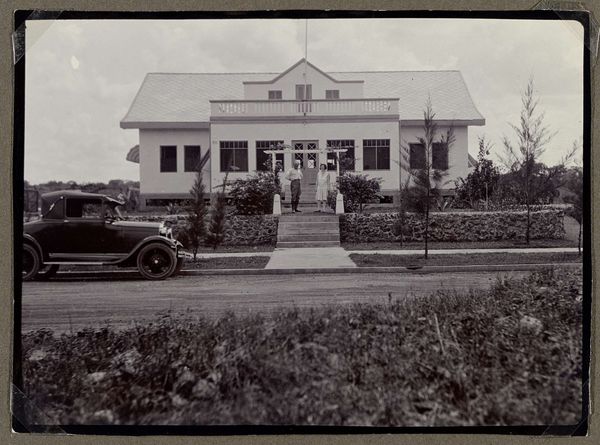
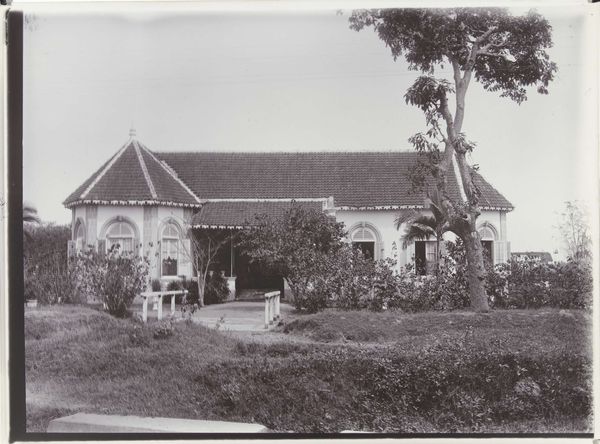
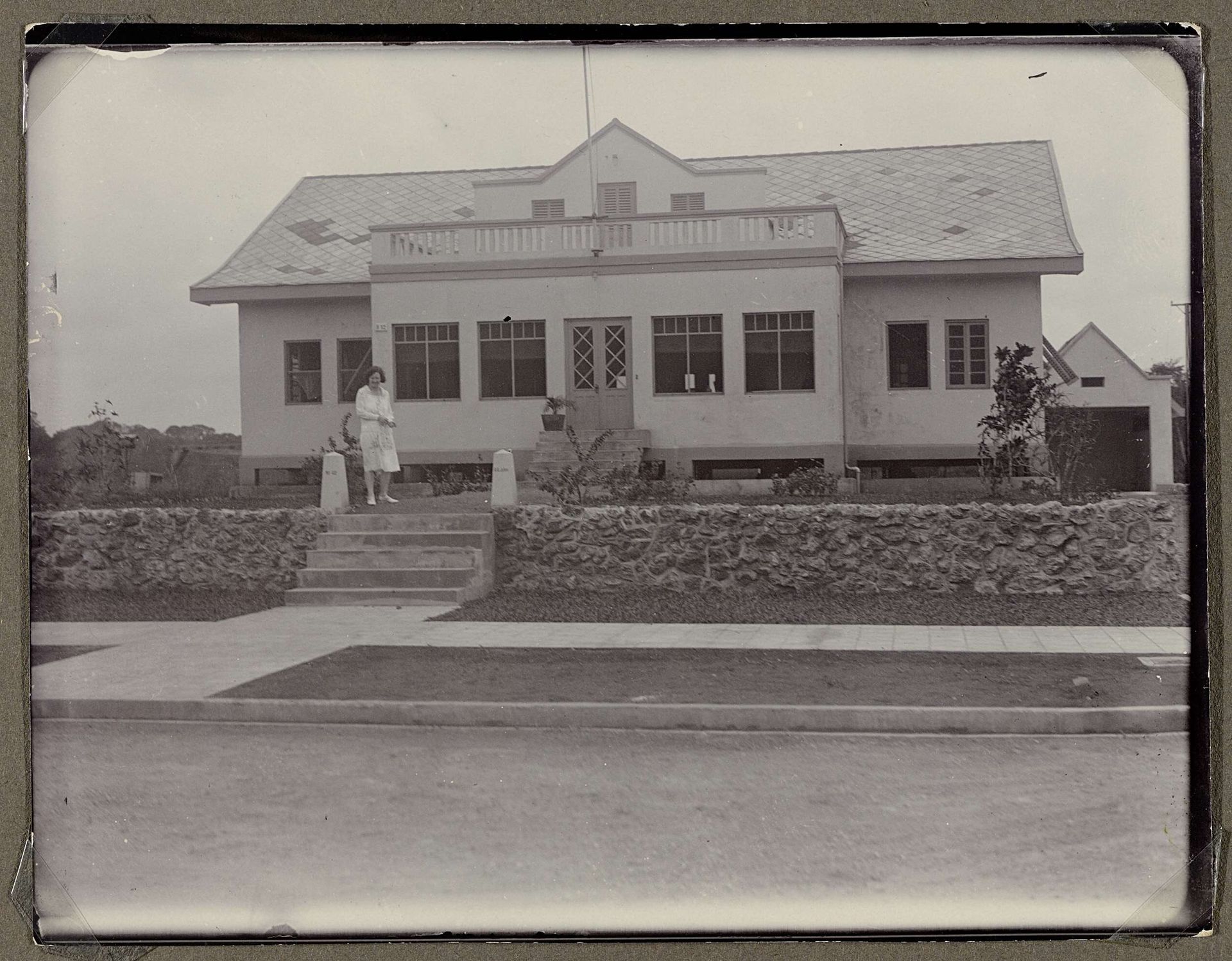
Curator: Looking at this vintage photograph, I'm struck by how effectively it captures a sense of both domesticity and the vast, unknown landscapes of the Dutch colony. What do you notice? Editor: Immediately, I sense a feeling of starkness, almost alienation, despite the presence of the house. It's the contrasting textures – the rough stonework, the smooth façade, the woman's slight figure that really stand out to me, what is her story here? Curator: This photograph is entitled "Edith Jetten voor het huis te Moengo," placing it in the period of 1925 to 1927. Editor: It reminds me a little of early modernist architectural photography. So, tell me more about the socio-political implications behind constructing such houses in Moengo, what was it all about? Curator: The photograph gives us an insight into the lives of Dutch individuals living in the then colony of Suriname. The modern house design and its presence in a tropical region evokes colonial aspirations, doesn't it? The geometric forms signify more than shelter, but are icons of Dutch governance and control. Editor: I agree completely; however, consider the composition: Edith herself seems almost spectral, diminutive even against this rigid background. Is she there to humanize the colonial presence, or does her image invite a deeper examination of women’s roles within colonialism's strict power dynamics? The image doesn't say it, but makes us want to ask it ourselves. Curator: Perhaps it speaks to both! Consider the deliberate act of photographing this scene; it underscores a narrative, embedding Edith, her house, and by extension, the Dutch colonial project into this specific landscape and our cultural memory. Editor: Yes, and what about the psychological effect of projecting a European ideal of “home” onto such a different place. Curator: Precisely! Through the window grids, or even the stone statues on the yard...these aren't arbitrary choices but rather symbolic reminders of heritage, identity, and ownership asserted within the colonial context. Editor: Looking at the social stratification and the building, what do you make of this photographic record as an example of early cultural Modernism? Curator: Modernism frequently sought to challenge existing structures, including societal ones, though even the best intentioned visions can still be vehicles for larger power structures. Now I find myself thinking about the visual legacy it has on today. Editor: It's remarkable how much depth a seemingly straightforward photograph can offer. I'll certainly leave today thinking more carefully about how visual histories shape colonial identities.

Artwork details
- Medium
- photography
- Dimensions
- height 91 mm, width 117 mm
- Copyright
- Rijks Museum: Open Domain
Tags
portrait
sculpture
landscape
photography
cityscape
modernism
statue
Comments
No comments
About this artwork
Curator: Looking at this vintage photograph, I'm struck by how effectively it captures a sense of both domesticity and the vast, unknown landscapes of the Dutch colony. What do you notice? Editor: Immediately, I sense a feeling of starkness, almost alienation, despite the presence of the house. It's the contrasting textures – the rough stonework, the smooth façade, the woman's slight figure that really stand out to me, what is her story here? Curator: This photograph is entitled "Edith Jetten voor het huis te Moengo," placing it in the period of 1925 to 1927. Editor: It reminds me a little of early modernist architectural photography. So, tell me more about the socio-political implications behind constructing such houses in Moengo, what was it all about? Curator: The photograph gives us an insight into the lives of Dutch individuals living in the then colony of Suriname. The modern house design and its presence in a tropical region evokes colonial aspirations, doesn't it? The geometric forms signify more than shelter, but are icons of Dutch governance and control. Editor: I agree completely; however, consider the composition: Edith herself seems almost spectral, diminutive even against this rigid background. Is she there to humanize the colonial presence, or does her image invite a deeper examination of women’s roles within colonialism's strict power dynamics? The image doesn't say it, but makes us want to ask it ourselves. Curator: Perhaps it speaks to both! Consider the deliberate act of photographing this scene; it underscores a narrative, embedding Edith, her house, and by extension, the Dutch colonial project into this specific landscape and our cultural memory. Editor: Yes, and what about the psychological effect of projecting a European ideal of “home” onto such a different place. Curator: Precisely! Through the window grids, or even the stone statues on the yard...these aren't arbitrary choices but rather symbolic reminders of heritage, identity, and ownership asserted within the colonial context. Editor: Looking at the social stratification and the building, what do you make of this photographic record as an example of early cultural Modernism? Curator: Modernism frequently sought to challenge existing structures, including societal ones, though even the best intentioned visions can still be vehicles for larger power structures. Now I find myself thinking about the visual legacy it has on today. Editor: It's remarkable how much depth a seemingly straightforward photograph can offer. I'll certainly leave today thinking more carefully about how visual histories shape colonial identities.
Comments
No comments