About this artwork
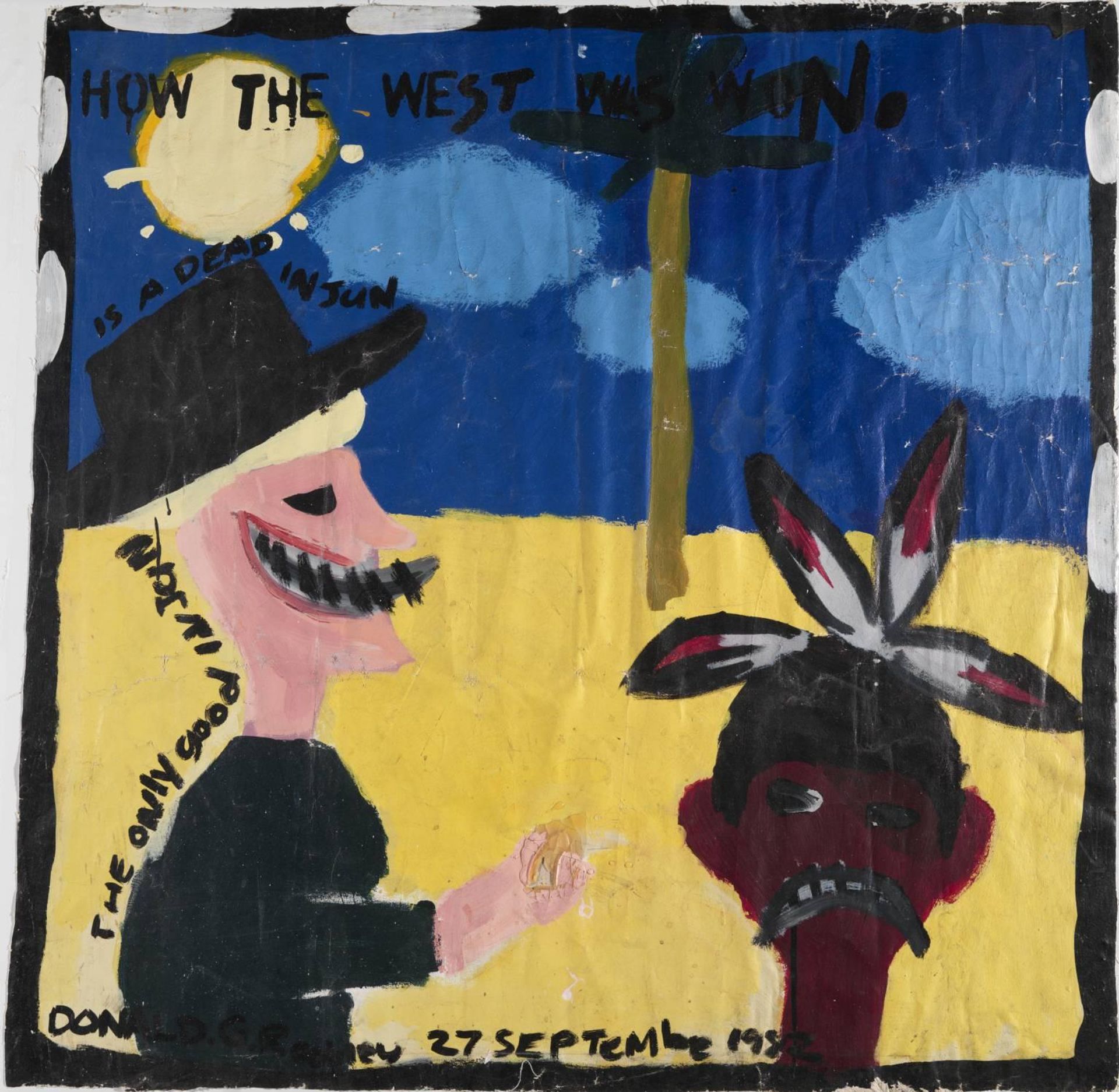
Curator: Donald Rodney's "How the West was Won," created in 1988, presents a stark commentary on colonial narratives. The bold brushstrokes and somewhat crude figuration immediately give it a sense of urgency and unease. Editor: There's a rawness to it, isn’t there? The visible texture of the paint on what appears to be found material almost cheapens the historical grand narrative suggested by the title. Curator: Exactly. Rodney often employed deliberately crude aesthetics to disrupt the assumed authority of historical representation. The painting's materials reflect a certain disposability, mirroring the displacement and dehumanization enacted during westward expansion. Editor: It’s interesting how the cowboy figure is rendered, a grinning caricature almost, set against the somber image of the Native American. The juxtaposition feels loaded, highlighting power imbalances through the manipulation of form and material. Curator: Absolutely. Rodney challenges the romanticized, heroic version of the Wild West, revealing instead the brutal reality of cultural erasure and systemic violence. It’s not just a painting, but an act of cultural disruption. Editor: Seeing the work in this light really amplifies its impact. It becomes less about a literal depiction and more about deconstructing the very idea of a triumphant "West."

Artwork details
- Dimensions
- support: 1200 x 1215 mm
- Location
- Tate Collections
- Copyright
- © The estate of Donald Rodney | CC-BY-NC-ND 4.0 DEED, Photo: Tate
Comments

http://www.tate.org.uk/art/artworks/rodney-how-the-west-was-won-t12768
Rodney made this work when he was still a student and it is one of his first political works. Referencing the 1962 Hollywood film of the same title, he has challenged the traditional American portrayal of ‘good’ and ‘evil’ in the colonisation of the American West. Whereas the film depicted the colonisation as a brave and exciting struggle, Rodney’s painting suggests a less heroic and more crudely violent narrative. The phrase painted around the figure on the left ‘The only good Indian is a dead Indian’ is a saying attributed to the United States Army General Philip Sheridan in 1869. Gallery label, September 2016
About this artwork
Curator: Donald Rodney's "How the West was Won," created in 1988, presents a stark commentary on colonial narratives. The bold brushstrokes and somewhat crude figuration immediately give it a sense of urgency and unease. Editor: There's a rawness to it, isn’t there? The visible texture of the paint on what appears to be found material almost cheapens the historical grand narrative suggested by the title. Curator: Exactly. Rodney often employed deliberately crude aesthetics to disrupt the assumed authority of historical representation. The painting's materials reflect a certain disposability, mirroring the displacement and dehumanization enacted during westward expansion. Editor: It’s interesting how the cowboy figure is rendered, a grinning caricature almost, set against the somber image of the Native American. The juxtaposition feels loaded, highlighting power imbalances through the manipulation of form and material. Curator: Absolutely. Rodney challenges the romanticized, heroic version of the Wild West, revealing instead the brutal reality of cultural erasure and systemic violence. It’s not just a painting, but an act of cultural disruption. Editor: Seeing the work in this light really amplifies its impact. It becomes less about a literal depiction and more about deconstructing the very idea of a triumphant "West."
Comments
http://www.tate.org.uk/art/artworks/rodney-how-the-west-was-won-t12768
Rodney made this work when he was still a student and it is one of his first political works. Referencing the 1962 Hollywood film of the same title, he has challenged the traditional American portrayal of ‘good’ and ‘evil’ in the colonisation of the American West. Whereas the film depicted the colonisation as a brave and exciting struggle, Rodney’s painting suggests a less heroic and more crudely violent narrative. The phrase painted around the figure on the left ‘The only good Indian is a dead Indian’ is a saying attributed to the United States Army General Philip Sheridan in 1869. Gallery label, September 2016