Dimensions: support: 772 x 187 mm
Copyright: CC-BY-NC-ND 4.0 DEED, Photo: Tate
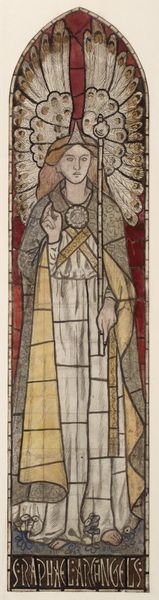
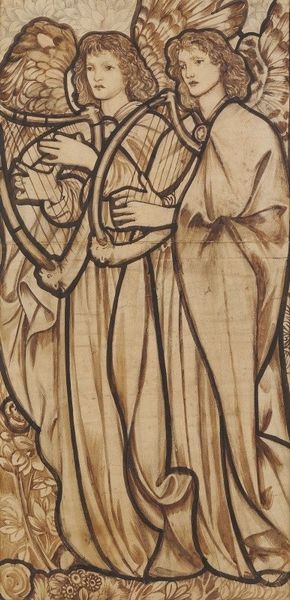
Curator: Here we have William Morris’s "The Archangel Gabriel," currently residing in the Tate Collections. Its dimensions are approximately 772 by 187 millimeters. Editor: It’s strikingly ethereal, almost like a whispered vision, with its pale palette and vertical composition directing the gaze upward. Curator: Indeed. Consider Morris's engagement with the Arts and Crafts movement; his intent was to revitalize medieval aesthetics, to elevate the craft and integrate art into everyday life. Editor: And isn't it fascinating how the stained-glass effect, with its distinct lead lines, compartmentalizes the figure, almost fragmenting Gabriel's divine presence? I wonder how the audience reacted to it. Curator: Well, we know the Arts and Crafts movement aimed for social reform, and Morris himself used art as a tool to critique industrialization. Editor: Ultimately, this image evokes a sense of both reverence and human vulnerability. Curator: It’s quite a synthesis of stylistic choices and societal aspirations, really.
Comments

tate 12 months ago
⋮
http://www.tate.org.uk/art/artworks/morris-the-archangel-gabriel-a00820


Join the conversation
Join millions of artists and users on Artera today and experience the ultimate creative platform.
tate 12 months ago
⋮
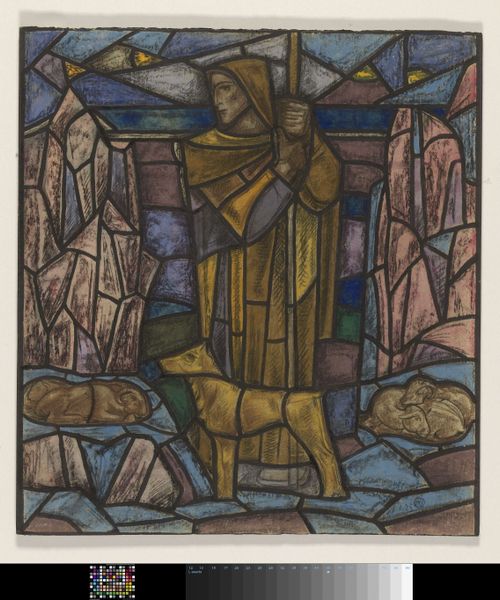
In 1855 Morris and Burne-Jones toured northern France. Morris was enthralled by the architecture and stained-glass windows of the medieval cathedrals and returned to England determined to be an architect. He spent most of 1856 in the London office of George Edmund Street, a Gothic Revival architect, but quickly abandoned this career. Stained-glass, perhaps the medium most evocative of the medieval period, was one of the mainstays of Morris, Marshall, Faulkner & Co. The designs shown here are the same as those Morris provided for St Michael and All Angels church, Brighton. Burne-Jones and Madox Brown also contributed to this decorative scheme. Gallery label, August 2004
 Collect
More like this