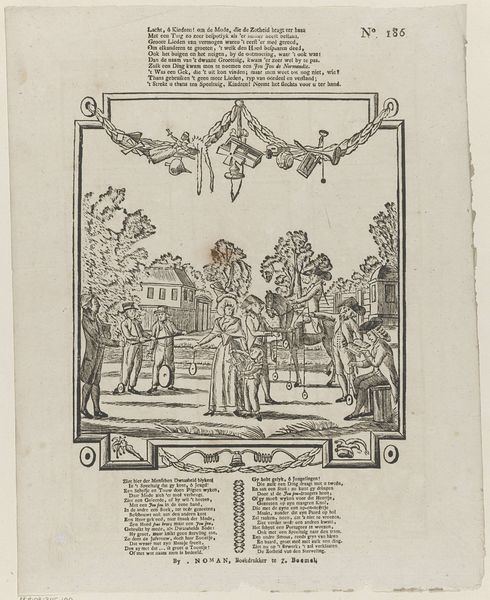
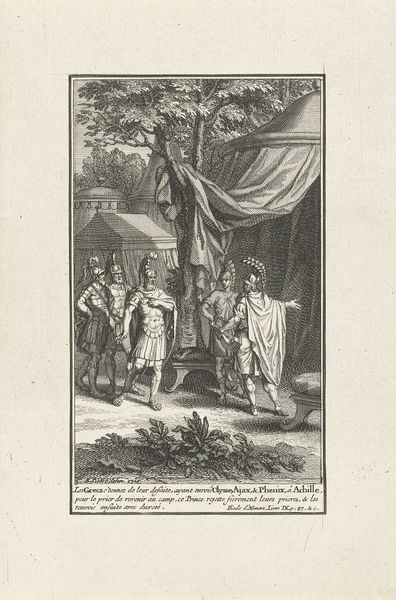
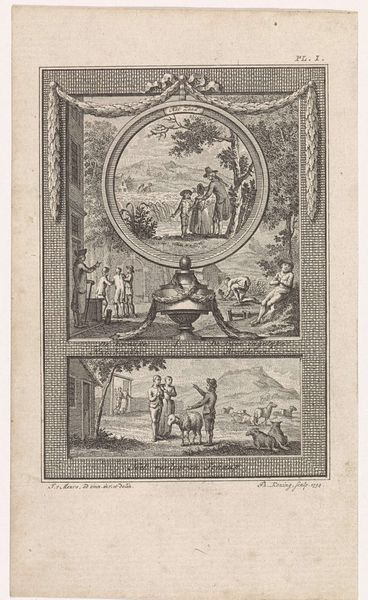
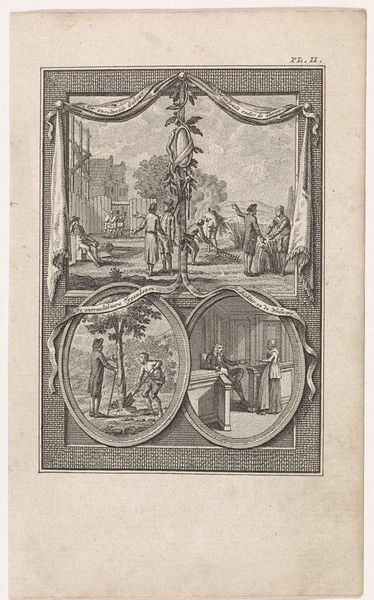
Komt nu vrijers en vrijsters met hoopen / Om Leander en Silvia te kopen / 1765 - 1767
0:00
0:00

weduwehendrikvanderputte
Rijksmuseum
Dimensions: height 425 mm, width 303 mm
Copyright: Rijks Museum: Open Domain
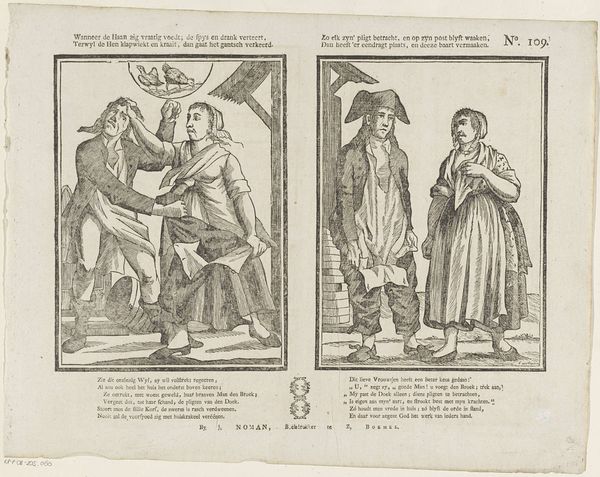
Curator: This engaging print, created between 1765 and 1767, is called "Komt nu vrijers en vrijsters met hoopen / Om Leander en Silvia te koopen /". It’s currently held in the collection of the Rijksmuseum and was crafted by the weduwe Hendrik van der Putte. Editor: Oh, this piece has such an innocent and playful spirit! It reminds me of the carefree drawings I'd make as a child, albeit with considerably more skilled linework and detail than I ever managed! There's an almost cartoon-like quality about the characters; that stiffness, the exaggerated collars, everything outlined, you know. Curator: Indeed. The formal, almost symmetrical arrangement of the figures, tree, and floating putti guides our eyes—doesn't it?—creating a balanced composition that’s common in baroque works, especially prints. I see that as a strategic move of the artist, guiding the viewers in a time of limited imagery. Editor: But look closer. See the dogs at the tree's base? And the village receding into the distance. There's a whimsical narrative tucked in there, defying that structural formality. Like life interrupting order—perhaps love and commerce were at odds even back then! The print seems like it is almost encouraging everyone to hurry, young or old, and get the two main figures—Leander and Silvia—into each other's arms, you know, by helping each other 'to buy them', as the translated title says. Curator: What catches my eye is the detail achieved through the engraving. It uses the density and direction of the lines in the image and suggests form and light. These prints really did operate on the level of semiotics; line means light, absence means dark. It created depth in the relatively static and stark artwork. Editor: True, it's incredible. But ultimately, the appeal for me lies in how accessible this piece feels. There’s an everyman sensibility—dogs barking, lovers bartering. Curator: A good observation! Indeed it provides insight on Baroque aesthetic principles in this genre-painting by mixing common love, wealth, youth, and landscape. Editor: It's also intriguing that it leaves so much open for interpretation. We are offered pieces of an exchange, leaving the viewer the agency to decide the why or how. It provides great context in very few brushstrokes. Curator: Agreed. It showcases art’s capacity to document, inspire, and mirror us across time. Editor: This print then seems to give everyone in the gallery pause to just ponder the relationship between people's affection, their resources, and... cute dogs!
Comments
No comments
Be the first to comment and join the conversation on the ultimate creative platform.
 Collect
 React
React Comment
More like this