About this artwork
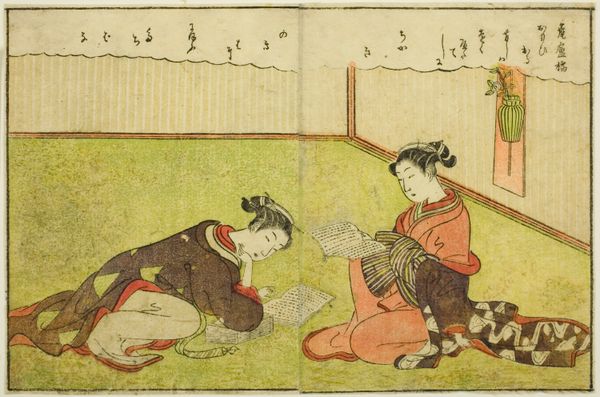
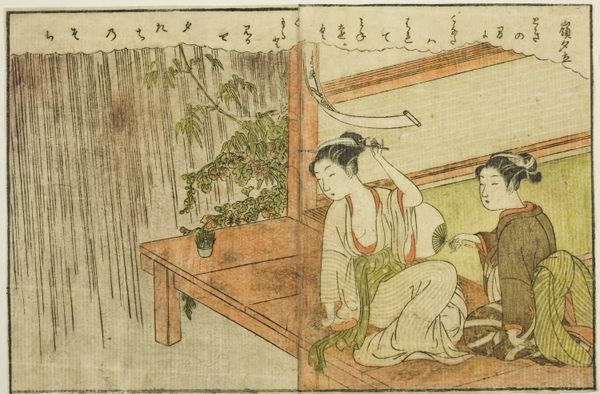
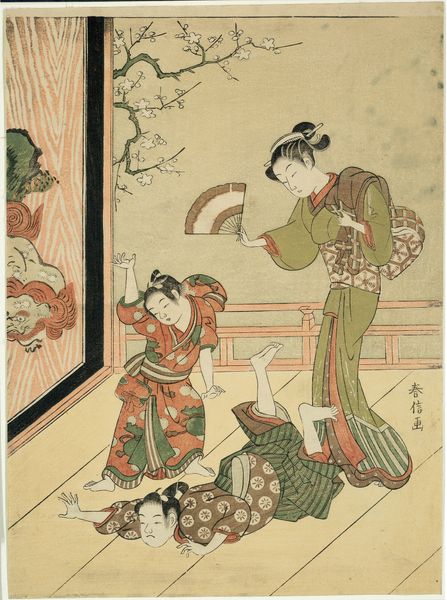
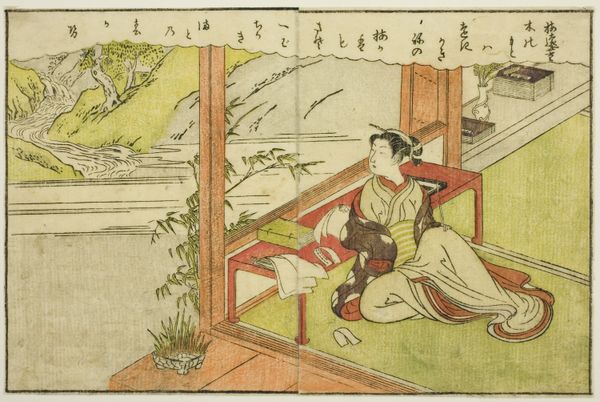
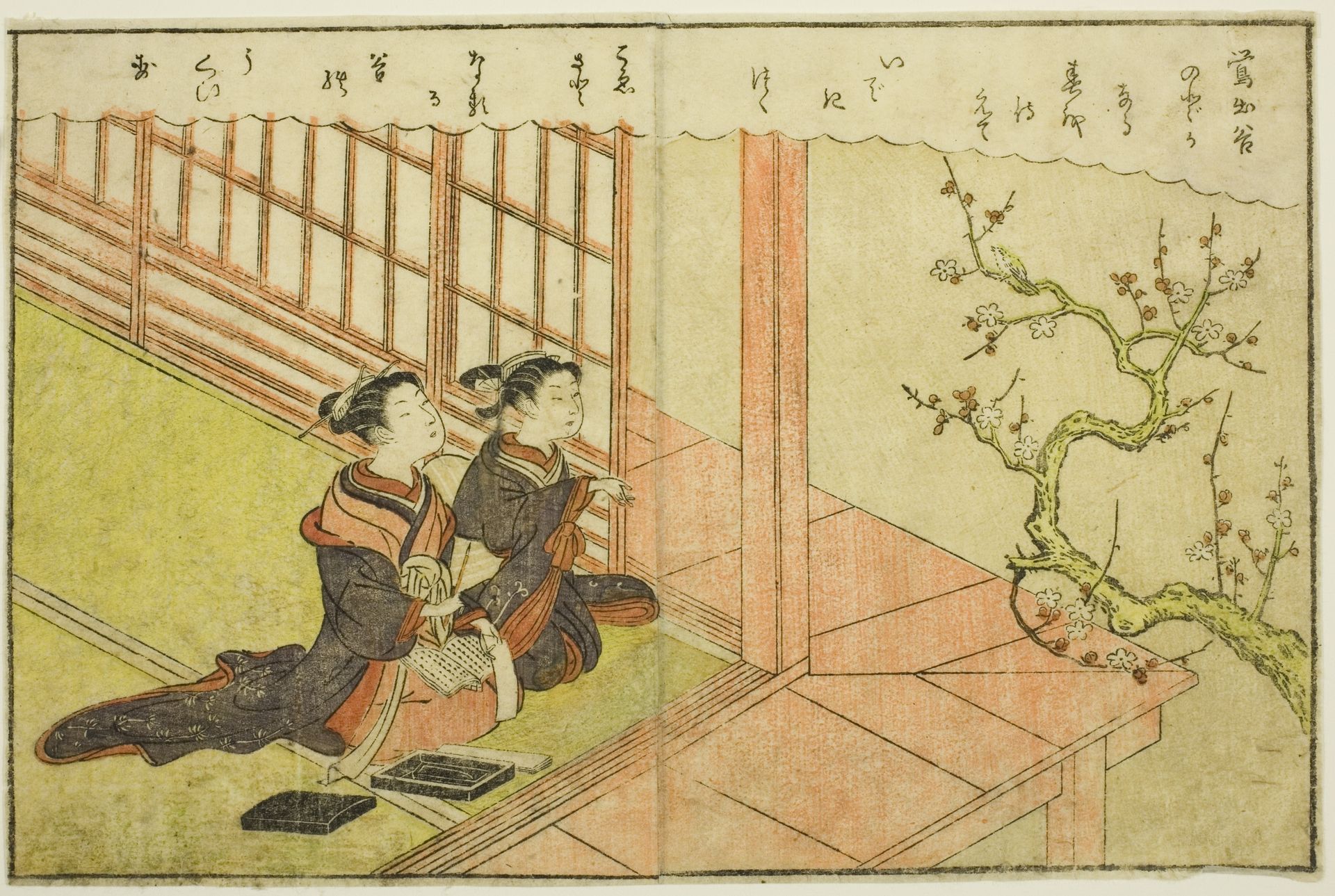
Editor: This woodblock print, a double-page illustration from Suzuki Harunobu's "Picture Book of Spring Brocades," dates back to 1771. I’m really drawn to the gentle, almost dreamlike quality of the scene, but I find it curious as a ‘landscape’ since the human element dominates. What stands out to you when you look at this piece? Curator: It's true, isn't it? Landscape often serves merely as a backdrop to human activity. To me, it whispers of enclosed spaces, of quiet observation and reflection, as if we’re glimpsing a stolen moment. The two women inside are in dialogue with something, someone out there that remains beyond our gaze. Notice the paper walls; those vertical strips create these parallel, superimposed screens... It creates a layered composition that draws your eyes toward that blossoming plum tree. Doesn’t that, in itself, feel symbolic, promising and eternal, as if a subtle hope pervades? What does spring signify to you in the piece? Editor: It really hits home that nature, represented by the blossoms, seems separate yet so vital. It definitely has a kind of hopeful feeling, this almost yearning in them as they reach toward spring! Curator: Indeed! Perhaps they see in those delicate blooms a reflection of their own aspirations, a silent dialogue between the human spirit and the promise of renewal. And look at their clothing, how meticulously rendered. What a perfect glimpse of fleeting beauty, made eternal through ink and wood. Editor: It's fascinating how much meaning can be packed into such a seemingly simple scene. I will keep a closer watch of those details when I look at artworks! Thanks for your insight. Curator: My pleasure! It's through these shared observations that art truly comes alive, isn't it? Always look beyond what you think is visible.
Double-page Illustration from Vol. 1 of "Picture Book of Spring Brocades (Ehon haru no nishiki)"
1771


Artwork details
- Dimensions
- 17.9 × 27 cm (7 1/16 × 10 5/8 in.)
- Location
- The Art Institute of Chicago
- Copyright
- Public Domain
Comments
Share your thoughts
About this artwork
Editor: This woodblock print, a double-page illustration from Suzuki Harunobu's "Picture Book of Spring Brocades," dates back to 1771. I’m really drawn to the gentle, almost dreamlike quality of the scene, but I find it curious as a ‘landscape’ since the human element dominates. What stands out to you when you look at this piece? Curator: It's true, isn't it? Landscape often serves merely as a backdrop to human activity. To me, it whispers of enclosed spaces, of quiet observation and reflection, as if we’re glimpsing a stolen moment. The two women inside are in dialogue with something, someone out there that remains beyond our gaze. Notice the paper walls; those vertical strips create these parallel, superimposed screens... It creates a layered composition that draws your eyes toward that blossoming plum tree. Doesn’t that, in itself, feel symbolic, promising and eternal, as if a subtle hope pervades? What does spring signify to you in the piece? Editor: It really hits home that nature, represented by the blossoms, seems separate yet so vital. It definitely has a kind of hopeful feeling, this almost yearning in them as they reach toward spring! Curator: Indeed! Perhaps they see in those delicate blooms a reflection of their own aspirations, a silent dialogue between the human spirit and the promise of renewal. And look at their clothing, how meticulously rendered. What a perfect glimpse of fleeting beauty, made eternal through ink and wood. Editor: It's fascinating how much meaning can be packed into such a seemingly simple scene. I will keep a closer watch of those details when I look at artworks! Thanks for your insight. Curator: My pleasure! It's through these shared observations that art truly comes alive, isn't it? Always look beyond what you think is visible.
Comments
Share your thoughts