About this artwork
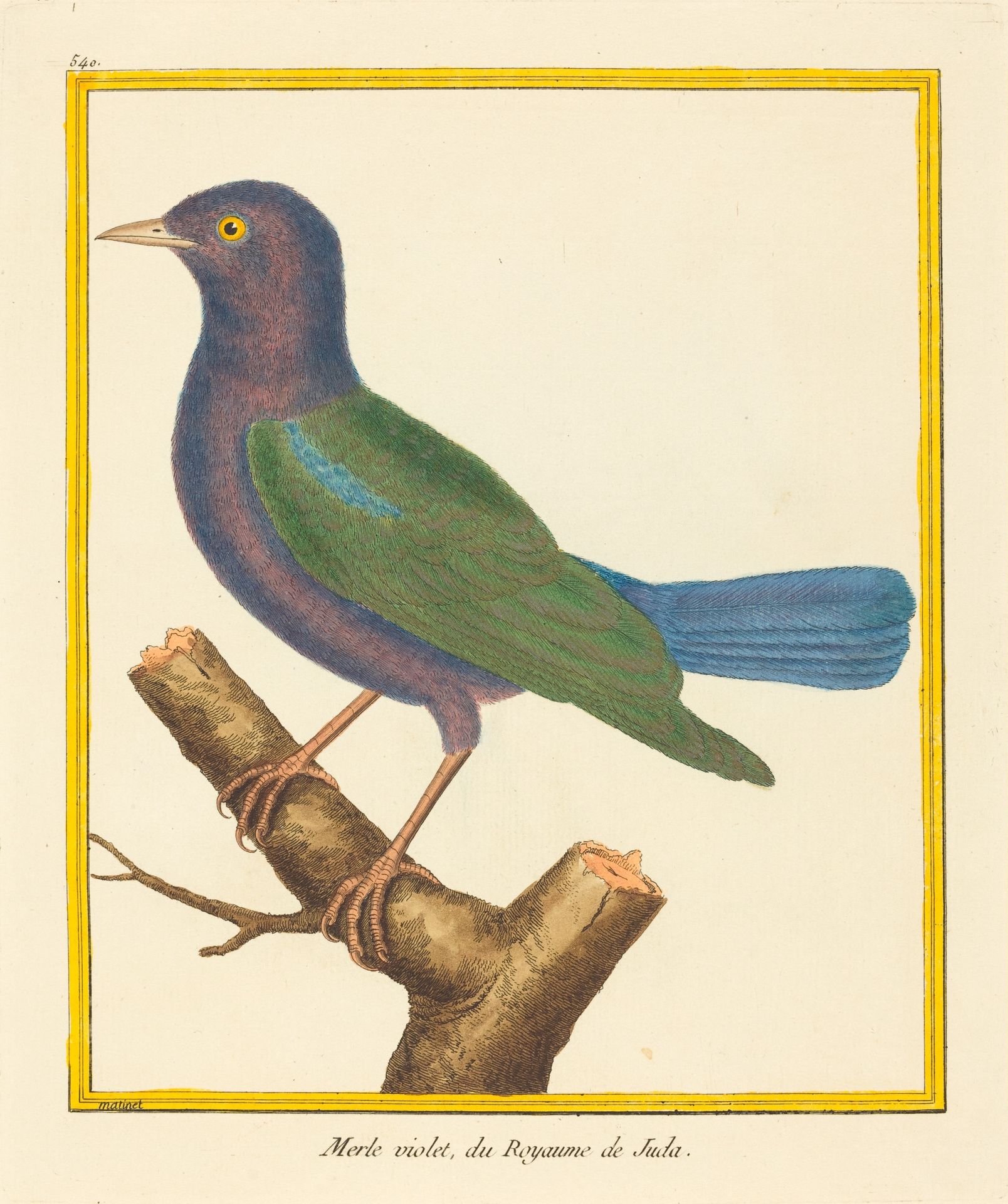
Editor: This is a print entitled "Merle Violet, du Royaume de Juda," by an artist known as Matinet. It looks like it's rendered with etching and watercolor. What I find most striking is the way the bird is depicted, almost as a caricature, yet the botanical details are quite precise. How do you interpret this work? Curator: Well, looking at it historically, these kinds of prints were popular during a time of intense scientific exploration and colonization. The detailed rendering, as you pointed out, serves a purpose. They weren’t just artistic endeavors; they were attempts to document and classify the natural world, to lay claim to knowledge about these newly "discovered" species. Editor: So it’s more than just a pretty bird picture. Curator: Precisely! Think about the title: "Merle Violet, du Royaume de Juda." "Royaume de Juda"—the Kingdom of Judah. It links the exotic, newly cataloged natural world with historical and often biblically-referenced geography, lending an air of authority, but also perhaps inadvertently hinting at appropriation. Where was this meant to be viewed? Editor: Probably in a book or a collection owned by a wealthy patron, maybe? Curator: Exactly. These images circulated within specific social and intellectual circles, reinforcing power structures and contributing to the era’s imperialistic gaze. And look at the strong yellow border; does it look like a frame or a cage? Editor: It does feel a bit like a cage now that you mention it. It definitely changes my perception of the artwork, from a decorative piece to something with complex social implications. Curator: And that is the beauty of art history. It shows us how art is so enmeshed within society.


Artwork details
- Medium
- drawing, print, etching, watercolor
- Copyright
- National Gallery of Art: CC0 1.0
Tags
Comments
Share your thoughts
About this artwork
Editor: This is a print entitled "Merle Violet, du Royaume de Juda," by an artist known as Matinet. It looks like it's rendered with etching and watercolor. What I find most striking is the way the bird is depicted, almost as a caricature, yet the botanical details are quite precise. How do you interpret this work? Curator: Well, looking at it historically, these kinds of prints were popular during a time of intense scientific exploration and colonization. The detailed rendering, as you pointed out, serves a purpose. They weren’t just artistic endeavors; they were attempts to document and classify the natural world, to lay claim to knowledge about these newly "discovered" species. Editor: So it’s more than just a pretty bird picture. Curator: Precisely! Think about the title: "Merle Violet, du Royaume de Juda." "Royaume de Juda"—the Kingdom of Judah. It links the exotic, newly cataloged natural world with historical and often biblically-referenced geography, lending an air of authority, but also perhaps inadvertently hinting at appropriation. Where was this meant to be viewed? Editor: Probably in a book or a collection owned by a wealthy patron, maybe? Curator: Exactly. These images circulated within specific social and intellectual circles, reinforcing power structures and contributing to the era’s imperialistic gaze. And look at the strong yellow border; does it look like a frame or a cage? Editor: It does feel a bit like a cage now that you mention it. It definitely changes my perception of the artwork, from a decorative piece to something with complex social implications. Curator: And that is the beauty of art history. It shows us how art is so enmeshed within society.
Comments
Share your thoughts