About this artwork
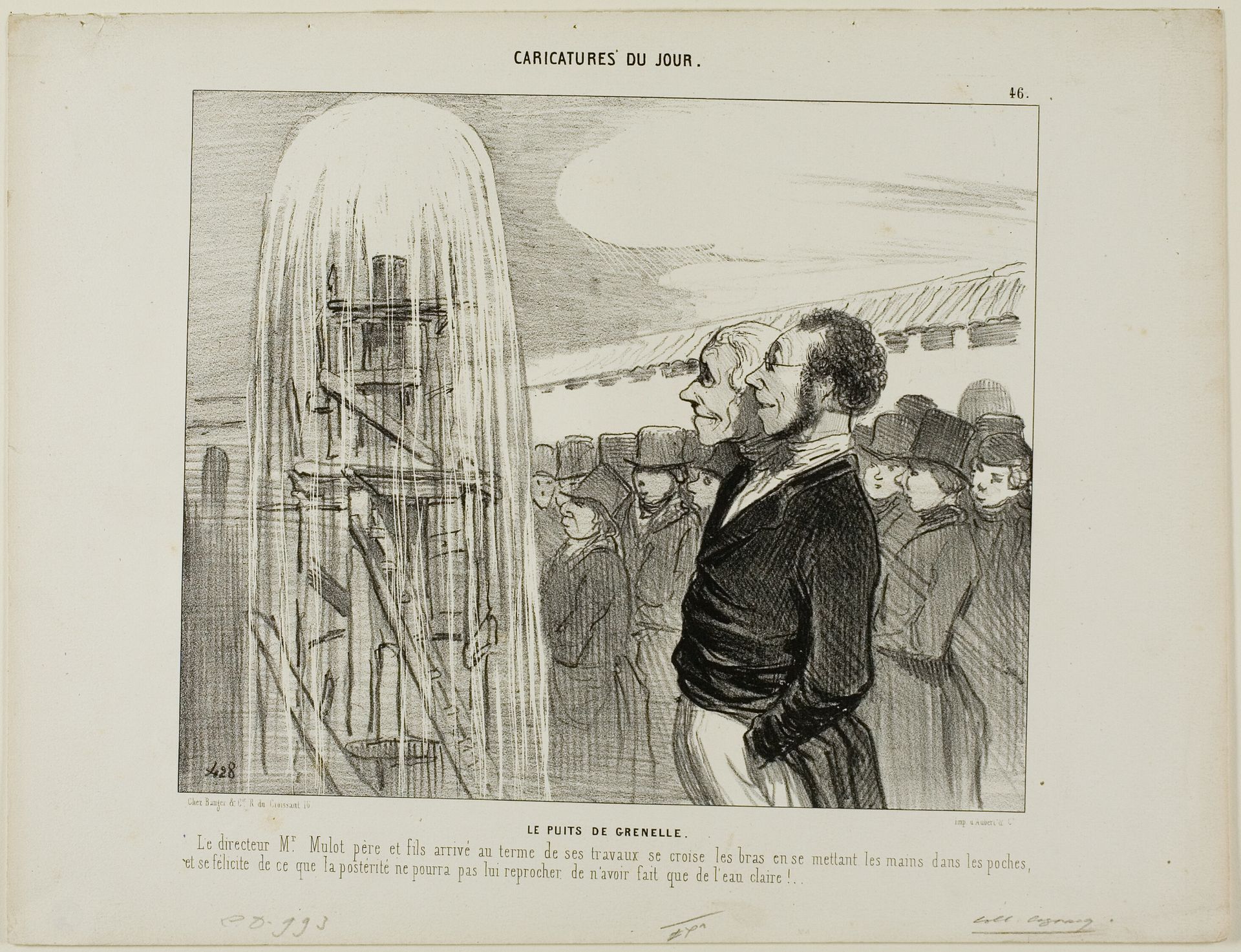
Editor: This lithograph by Honoré Daumier, titled "The Grenelle Wells," from 1842, depicts two figures observing the wells. I find it fascinating how Daumier captures a sense of public pride or perhaps even self-importance. How would you interpret this work? Curator: Well, understanding the historical context is key here. Daumier often used his art as social commentary. The Grenelle Wells were a significant engineering project for providing clean water to Paris. Look at the central figures—likely Mr. Mulot and his son, key figures in the project. How do you interpret their posture and placement within the scene? Editor: They seem very pleased with themselves, standing tall while those behind them look on, almost like spectators. I sense an element of satire there. Curator: Precisely! Daumier critiques the self-congratulatory nature of the elite involved in these public projects. He is commenting on the role of civic improvements as sources of personal and class-based prestige. Consider the title, part of "Caricatures Du Jour"; Daumier's prints were made for mass consumption, and directly spoke to political and social themes of the time. What impact do you think this kind of satirical portrayal had on the public’s perception of these figures and the well project? Editor: It probably fostered skepticism and questioned the motives of those in power, while still acknowledging the project's achievement of providing fresh water. Curator: Exactly. Art like this can shape public opinion and hold institutions accountable. It made me appreciate the role of satire in visual commentary in shaping social discourse. Editor: This has opened my eyes to how art can be intertwined with power dynamics. Thanks for your perspective.
The Grenelle Wells. The director Mr. Mulot and his son finally reaching the end of their work, crossing their arms and putting their hands into their pockets and congratulating themselves that posterity will not be able to reproach them of not having produced clean water, plate 46 from Caricatures Du Jour
1842


Artwork details
- Medium
- drawing, lithograph, print, paper
- Dimensions
- 204 × 244 mm (image); 269 × 351 mm (sheet)
- Location
- The Art Institute of Chicago
- Copyright
- Public Domain
Tags
Comments
Share your thoughts
About this artwork
Editor: This lithograph by Honoré Daumier, titled "The Grenelle Wells," from 1842, depicts two figures observing the wells. I find it fascinating how Daumier captures a sense of public pride or perhaps even self-importance. How would you interpret this work? Curator: Well, understanding the historical context is key here. Daumier often used his art as social commentary. The Grenelle Wells were a significant engineering project for providing clean water to Paris. Look at the central figures—likely Mr. Mulot and his son, key figures in the project. How do you interpret their posture and placement within the scene? Editor: They seem very pleased with themselves, standing tall while those behind them look on, almost like spectators. I sense an element of satire there. Curator: Precisely! Daumier critiques the self-congratulatory nature of the elite involved in these public projects. He is commenting on the role of civic improvements as sources of personal and class-based prestige. Consider the title, part of "Caricatures Du Jour"; Daumier's prints were made for mass consumption, and directly spoke to political and social themes of the time. What impact do you think this kind of satirical portrayal had on the public’s perception of these figures and the well project? Editor: It probably fostered skepticism and questioned the motives of those in power, while still acknowledging the project's achievement of providing fresh water. Curator: Exactly. Art like this can shape public opinion and hold institutions accountable. It made me appreciate the role of satire in visual commentary in shaping social discourse. Editor: This has opened my eyes to how art can be intertwined with power dynamics. Thanks for your perspective.
Comments
Share your thoughts