About this artwork
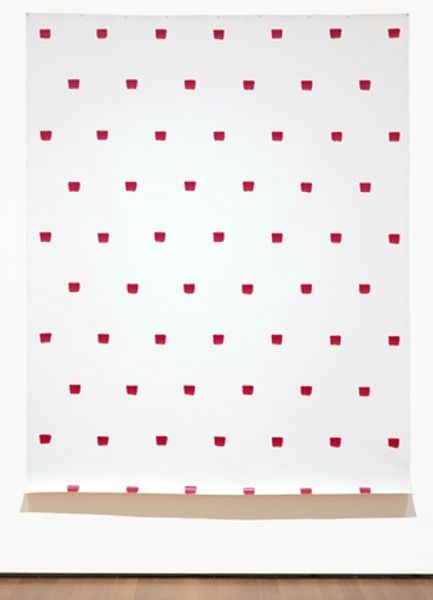
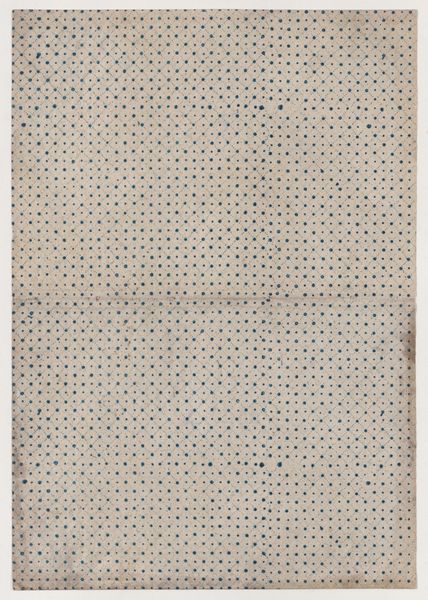
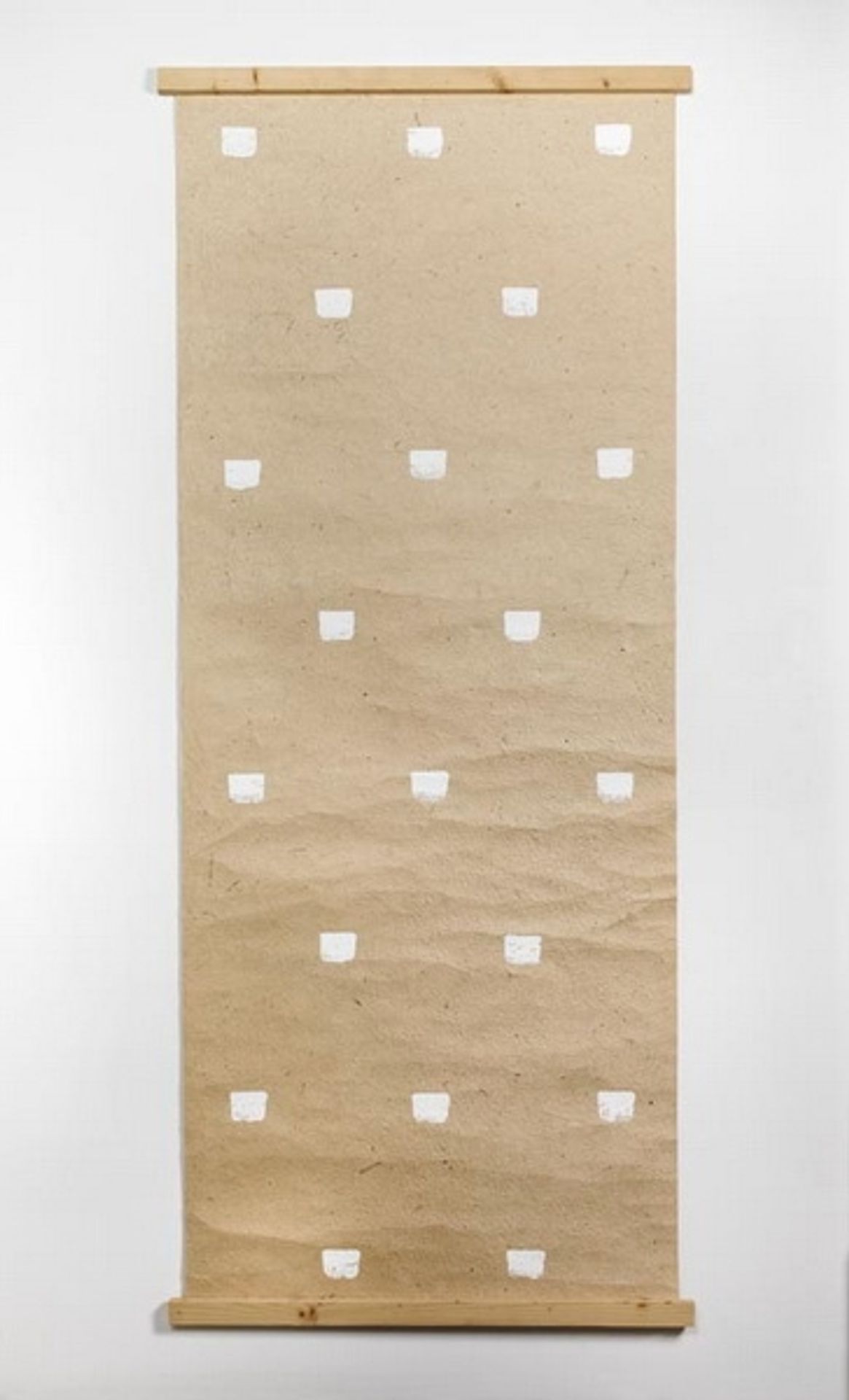
Editor: We’re looking at Niele Toroni’s "Imprints of a No. 50 Paintbrush Repeated at Regular Intervals of 30 cm.," created in 1992. It’s a mixed media piece; I see acrylic on paper and wood. It feels...minimalist, I suppose. All those white dabs marching down the brown paper. How do you interpret this work? Curator: The essence resides in its compositional elements. The systematic repetition and measured intervals speak to a profound exploration of form and space. Notice how the imprints, though uniform, possess subtle variations in pressure and paint application, creating a delicate interplay of texture. How do these minute deviations affect your perception of the work’s overall structure? Editor: I guess it makes it feel… less mechanical? Almost handmade, despite the grid. So, the pattern is important, but so is the variation? Curator: Precisely. The grid provides a framework, a set of rules, but the slight imperfections disrupt the monotony and invite closer scrutiny. The selection of a neutral, unassuming color palette also serves to emphasize the intrinsic qualities of the paint itself. What significance might we find in this particular method of mark-making, repeated across the surface? Editor: Maybe it’s about breaking down painting to its most basic act? Just a simple mark, repeated? Curator: It's an exercise in reduction, a stripping away of narrative or expression. We're left with the pure materiality of paint and paper, the fundamental elements of art. It prompts a consideration of how meaning is constructed through these essential visual components. Do you feel your initial impression has evolved? Editor: Definitely. I see it now not as just a simple pattern, but as a thoughtful exploration of material and process. Curator: And the act of seeing itself. This work exemplifies how even the most minimal gestures can hold layers of conceptual depth.

Artwork details
- Medium
- stencil, acrylic-paint, paper
- Copyright
- Niele Toroni,Fair Use
Tags
Comments
Share your thoughts
About this artwork
Editor: We’re looking at Niele Toroni’s "Imprints of a No. 50 Paintbrush Repeated at Regular Intervals of 30 cm.," created in 1992. It’s a mixed media piece; I see acrylic on paper and wood. It feels...minimalist, I suppose. All those white dabs marching down the brown paper. How do you interpret this work? Curator: The essence resides in its compositional elements. The systematic repetition and measured intervals speak to a profound exploration of form and space. Notice how the imprints, though uniform, possess subtle variations in pressure and paint application, creating a delicate interplay of texture. How do these minute deviations affect your perception of the work’s overall structure? Editor: I guess it makes it feel… less mechanical? Almost handmade, despite the grid. So, the pattern is important, but so is the variation? Curator: Precisely. The grid provides a framework, a set of rules, but the slight imperfections disrupt the monotony and invite closer scrutiny. The selection of a neutral, unassuming color palette also serves to emphasize the intrinsic qualities of the paint itself. What significance might we find in this particular method of mark-making, repeated across the surface? Editor: Maybe it’s about breaking down painting to its most basic act? Just a simple mark, repeated? Curator: It's an exercise in reduction, a stripping away of narrative or expression. We're left with the pure materiality of paint and paper, the fundamental elements of art. It prompts a consideration of how meaning is constructed through these essential visual components. Do you feel your initial impression has evolved? Editor: Definitely. I see it now not as just a simple pattern, but as a thoughtful exploration of material and process. Curator: And the act of seeing itself. This work exemplifies how even the most minimal gestures can hold layers of conceptual depth.
Comments
Share your thoughts