

1921
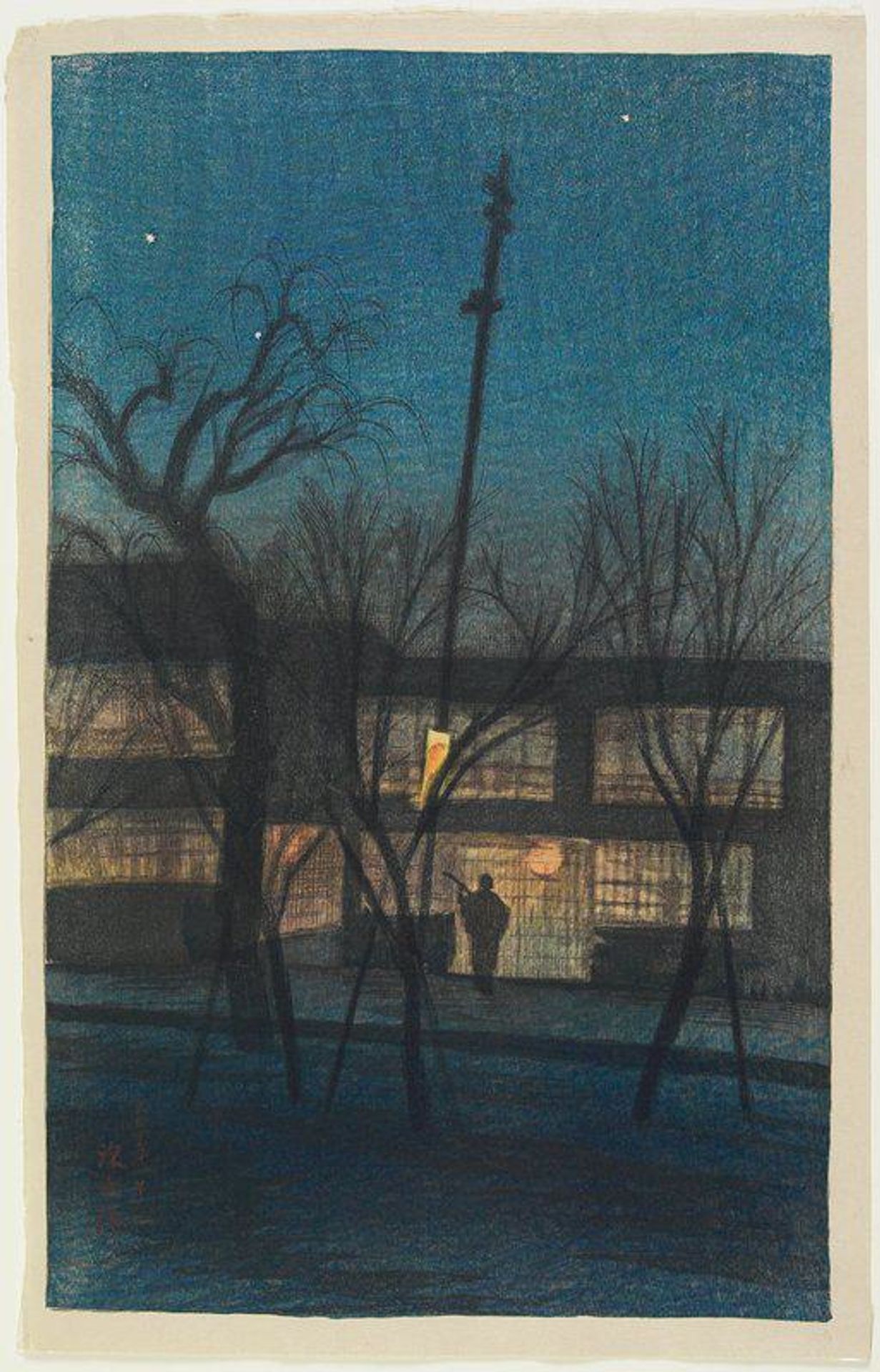
Ikenohata at Night


Listen to curator's interpretation
Curatorial notes
Editor: Ito Shinsui’s "Ikenohata at Night", created in 1921. It looks like a woodblock print depicting a street scene under a dark blue sky. There's a sense of quiet solitude, even loneliness, evoked by the lone figure standing in the doorway. What do you see in this piece? Curator: It's fascinating how Shinsui uses the cityscape, here Ikenohata, as a backdrop for contemplation. Night, as a symbol, often represents introspection, the subconscious, and the hidden aspects of life. Notice how the glowing windows contrast with the dark trees. Do they evoke any emotional connection for you? Editor: The light definitely draws my eye and offers a sense of warmth and, as you say, introspection. But the starkness of the trees, how bare they seem, counters that warmth somewhat. It's a bit melancholy. Curator: Exactly. These visual symbols aren't simply decorative. They function like cultural memory. Bare trees are powerful symbols in art, often signalling loss, the passage of time, or a state of vulnerability. The figure standing at the illuminated doorway; are they leaving, arriving, or simply pausing? What might the artist be saying about our place within an increasingly modern urban environment? Editor: That's a good question. I hadn’t thought about the modernity angle. Ukiyo-e traditionally depicted more historical scenes. Curator: Yes, Shinsui is part of the Shin-Hanga movement, reviving traditional ukiyo-e but with modern subjects and a touch of impressionism. He infuses this scene with the pulse of contemporary life while referencing an older artistic language. And this doorway; does it imply an entry or an exit? Editor: I guess that depends on the viewer's perspective! Thinking about the figure as perhaps moving away, it heightens the melancholic feeling I get from the print. I see so much more depth here now. Curator: Indeed. Art is as much about the questions it provokes as any definitive answers it offers.
