drawing, print, etching, woodcut, architecture
#
tree
#
drawing
# print
#
etching
#
landscape
#
woodcut
#
architecture
#
realism
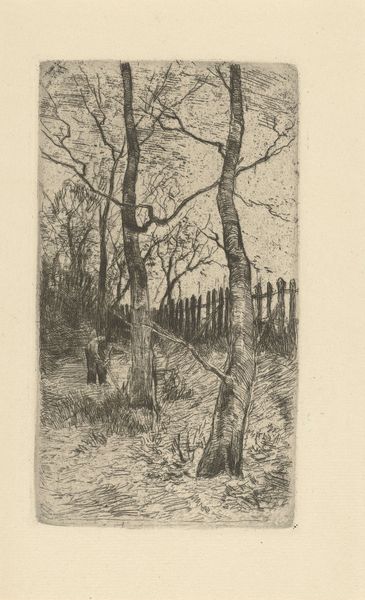
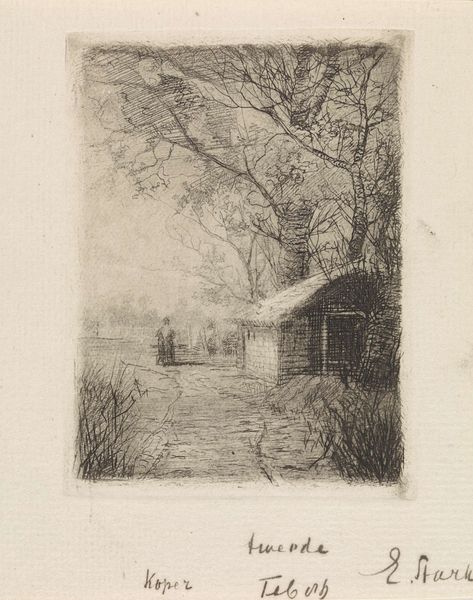
Dimensions: Plate: 6 3/8 × 3 3/4 in. (16.2 × 9.5 cm) Sheet: 19 7/16 × 15 5/8 in. (49.3 × 39.7 cm)
Copyright: Public Domain
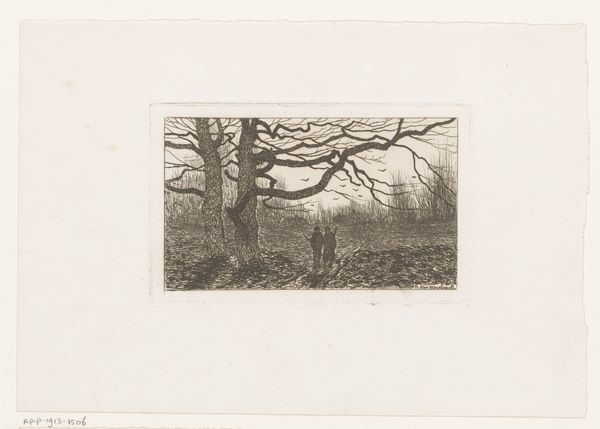
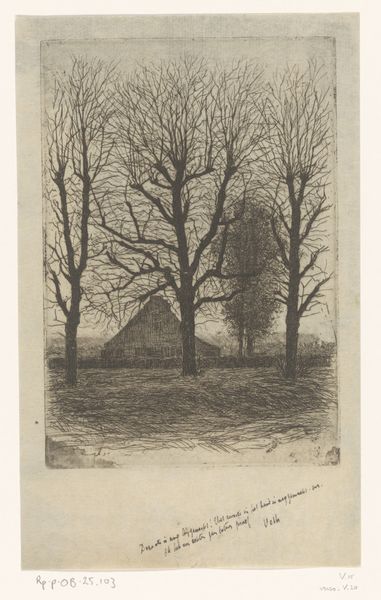
Editor: So, this is "Autumn (Höst)" by Albert Theodor Gellerstedt, created in 1889. It's an etching and woodcut. There’s a definite chill in the air looking at it; it’s muted, almost ghostly. The composition, with the skeletal trees against that house, gives me a kind of gothic fairytale vibe. What jumps out at you when you look at this piece? Curator: What grabs me? Oh, the hushed poetry of it all. It feels intensely personal, like Gellerstedt isn't just depicting autumn but a state of mind. I mean, look at those stark, bare trees— they're reaching up like questions. They almost look like my own thoughts on a bad day. What do you suppose that almost hidden house represents, nestled there behind the foliage? Does it beckon, or hide? Editor: That’s interesting, I hadn’t thought of them as questions. Maybe it's about home? The house is present but fading, just as autumn signifies the fading of the year... Curator: Perhaps! It speaks volumes about memory, loss... the poignant beauty of letting go. The etching itself is like a whispered secret, wouldn’t you say? I wonder what Gellerstedt felt he was letting go of as he made this...what were his summers like, that he's watching fade away into winter? Editor: Definitely a whisper, and definitely a work that bears repeated viewings. I see something new each time. Curator: Exactly! That's the enduring magic of art, isn't it? It's not just about what's on the surface, but what stirs within us as we look.
Comments
No comments
Be the first to comment and join the conversation on the ultimate creative platform.
 Collect
 React
React Comment
More like this