drawing, ink
#
drawing
#
narrative-art
#
baroque
#
figuration
#
ink
#
history-painting
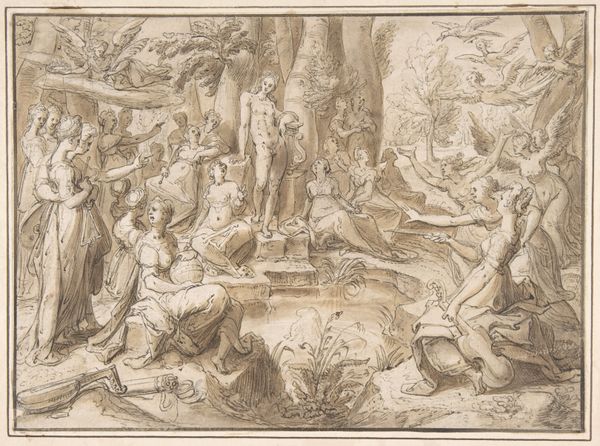
Dimensions: 316 mm (height) x 440 mm (width) (bladmaal), 244 mm (height) x 369 mm (width) (billedmaal)
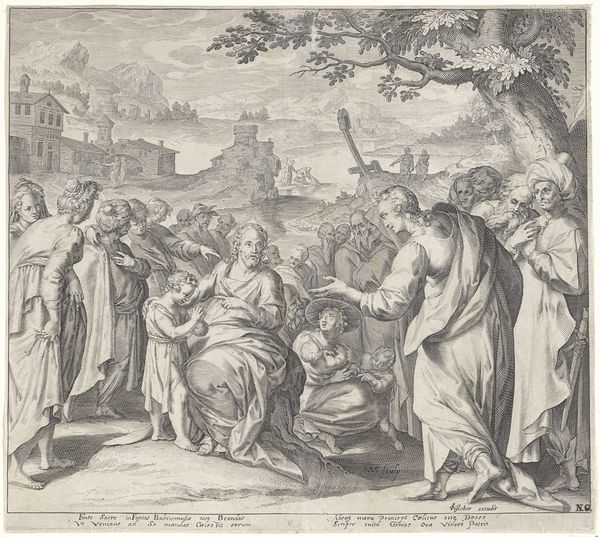
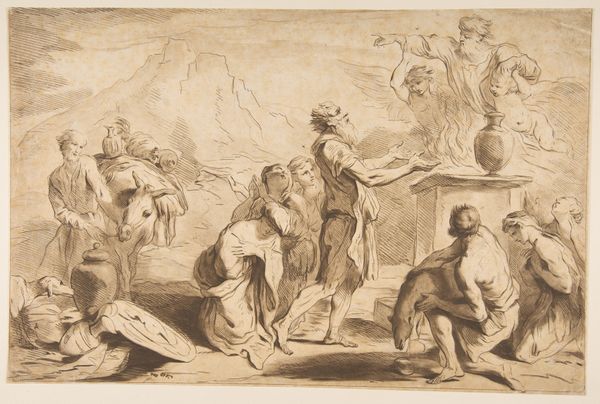
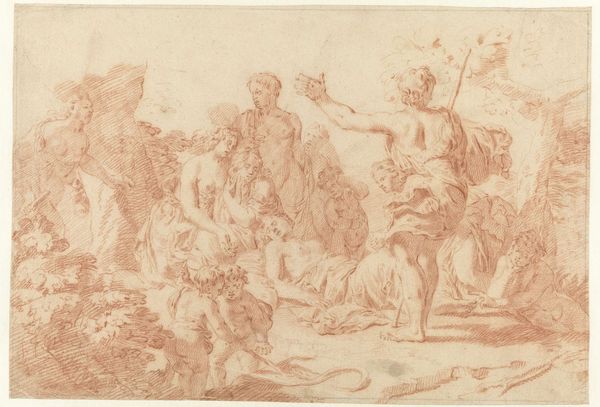
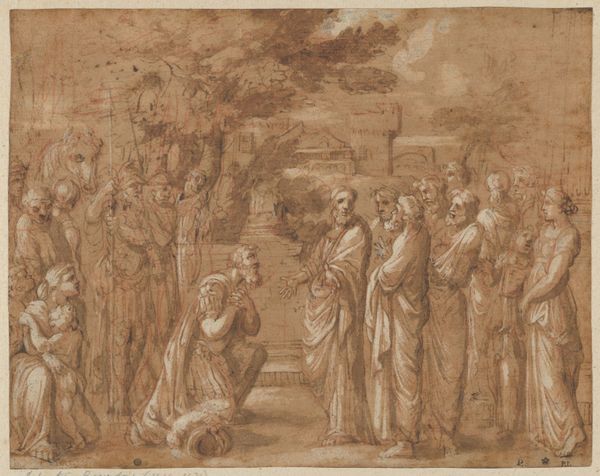
Editor: Abraham Bloemaert's ink drawing, "Poppo's Ordeal by Fire," created between 1637 and 1639, has such a striking narrative quality. The way the figures are arranged really pulls you into the scene. What strikes you most about its historical context? Curator: It’s fascinating to view this piece as more than just a religious scene. Consider the Counter-Reformation: the Catholic Church was actively seeking to reassert its authority, and images like these, depicting miraculous events and the power of faith, served a very clear propagandistic purpose. Notice how Poppo's gesture draws attention and orchestrates our perception of the central fire? It reinforces faith in a very visible and performative way. Who do you think would have seen this drawing? Editor: Probably other artists, right? Or perhaps wealthy patrons? It seems too… detailed to be shown to a very large audience. Curator: Exactly. Drawings often served as studies for larger paintings or prints. Think of this as a form of visual rhetoric, developing ideas within Bloemaert's studio, maybe for a commission. How does understanding its potential audience shift your understanding of the image's message? Editor: Knowing it was potentially meant for the eyes of powerful figures within the Church adds another layer to it. It is no longer just a representation, it becomes an appeal for authority, and possibly for future commissions! That is really neat. Curator: Precisely! And thinking about its function reminds us that art isn’t created in a vacuum. Social, religious, and economic factors are always at play. Hopefully, next time you’re in front of artwork you will consider that relationship as a source of historical context. Editor: Absolutely! That offers me a greater appreciation for the ways an image might be used as an active component of that culture. I'll carry that with me. Thanks!
Comments
No comments
Be the first to comment and join the conversation on the ultimate creative platform.
 Collect
 React
React Comment
More like this