painting, plein-air, oil-paint, impasto
#
painting
#
plein-air
#
oil-paint
#
landscape
#
oil painting
#
impasto
#
genre-painting
#
academic-art
#
watercolor
#
realism
Dimensions: overall (bottom width of trapezoidal panel): 89.2 x 83.2 cm (35 1/8 x 32 3/4 in.) overall (top width of trapezoidal panel): 89.2 x 101.9 cm (35 1/8 x 40 1/8 in.)
Copyright: National Gallery of Art: CC0 1.0
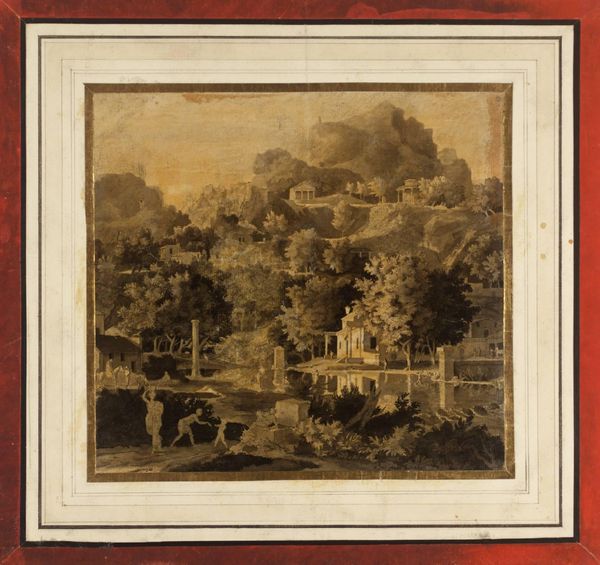
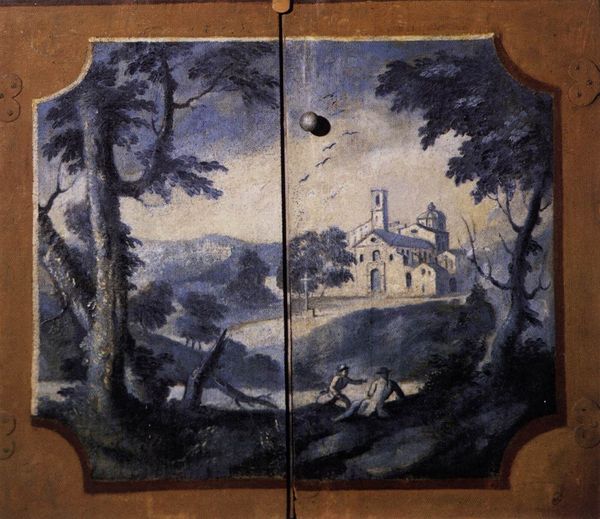
Curator: Looking at this intriguing piece, titled "Landscape with Churches," believed to be crafted sometime between 1890 and 1930 by Charles C.E. Lermond. Editor: It feels like a memory viewed through a child's picture book. The red curtains framing the pastoral scene lend an almost theatrical quality, doesn’t it? Curator: Exactly! That "staging" of the scene speaks volumes. Those drapes, painted onto the artwork itself, suggest a constructed reality. We aren't just looking at a landscape; we're viewing a curated perspective. Do you notice the distinct religious structures punctuating the horizon? Editor: Yes, the church steeples. And Lermond positions them carefully within the composition. One is nestled amid a cluster of what appear to be modest homes, while another is set further back, approached via a path seemingly guided by rows of trees. What about the overall aesthetic, doesn’t it harken back to those postcard scenes popularized for representing idealized tranquility? Curator: Indeed. The strategic deployment of such images, the churches representing not just faith, but also community stability, offered a potent vision of order. Lermond likely wanted to promote social cohesion through the symbolism embedded in these architectural figures. How society wants to present and perceive itself! Editor: Yet there is something slightly…unsettling, no? That avenue drawing you towards that distant church is so neatly ordered; perhaps it points to society seeking order? It reminds me a little of social engineering, those grand utopian plans that rarely work out as intended. Curator: Perhaps a reflection on faith itself? Consider the painting as an object carrying this complexity. The church isn't presented as an escape but rather is made a constructed element. In fact, all architecture becomes somewhat contrived and is no more special than the trees. This subverts what many seek out when viewing this painting, Editor: It makes you question whether it's an authentic, raw vision, or a deliberate projection, carefully designed to instill certain values, especially with those ever-present trees. An artwork can speak volumes through these deliberate "accidents" and "omissions." Curator: Ultimately, "Landscape with Churches" prompts us to consider art’s social functions, the image's political undertones, and the values these landscapes promoted—intentionally or otherwise. Editor: And, whether we can trust what's within that picture book landscape to be accurate. Thanks for offering such a compelling window.
Comments
No comments
Be the first to comment and join the conversation on the ultimate creative platform.
 Collect
 React
React Comment
More like this