About this artwork
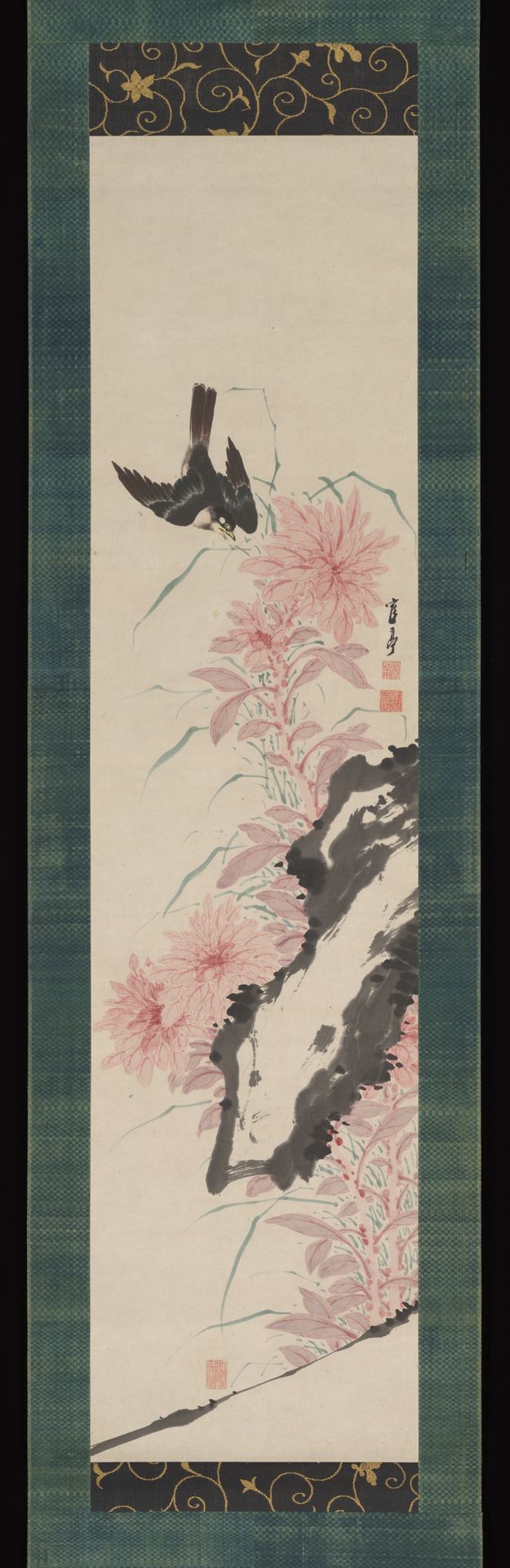
Kakutei painted "Amaranthus and Mynah Bird" using ink and color on silk, sometime in the mid-18th century, during Japan's Edo period. Kakutei, whose personal name was Yasumura Masanobu, was an artist from Osaka. The delicate scroll painting evokes the natural world, but also carries cultural meaning. The mynah bird, for example, is not native to Japan, but rather was imported from China and other parts of Asia. Its presence here speaks to the exchange of culture and goods that characterized Japan during this era. The amaranthus plant with its drooping flower heads, and the mynah bird, known for its dark plumage, might be a metaphor for aging and mortality, themes common in Edo period art and literature. The sensitive brushwork reminds us of the quiet and introspective dimensions of Japanese art. The painting invites us to contemplate the beauty of transient moments, while also reflecting on our own place within the larger cycles of nature and time.
Amaranthus and Mynah Bird
1722 - 1785


Artwork details
- Medium
- painting, ink
- Dimensions
- Image: 52 5/8 × 13 1/16 in. (133.7 × 33.2 cm) Overall with mounting: 79 1/2 × 18 in. (202 × 45.7 cm) Overall with knobs: 79 1/2 × 20 1/4 in. (201.9 × 51.4 cm)
- Location
- Metropolitan Museum of Art, New York, NY
- Copyright
- Public Domain
Tags
Comments
Share your thoughts
About this artwork
Kakutei painted "Amaranthus and Mynah Bird" using ink and color on silk, sometime in the mid-18th century, during Japan's Edo period. Kakutei, whose personal name was Yasumura Masanobu, was an artist from Osaka. The delicate scroll painting evokes the natural world, but also carries cultural meaning. The mynah bird, for example, is not native to Japan, but rather was imported from China and other parts of Asia. Its presence here speaks to the exchange of culture and goods that characterized Japan during this era. The amaranthus plant with its drooping flower heads, and the mynah bird, known for its dark plumage, might be a metaphor for aging and mortality, themes common in Edo period art and literature. The sensitive brushwork reminds us of the quiet and introspective dimensions of Japanese art. The painting invites us to contemplate the beauty of transient moments, while also reflecting on our own place within the larger cycles of nature and time.
Comments
Share your thoughts