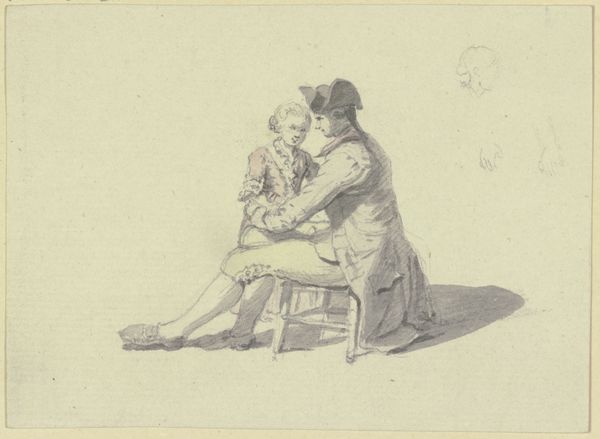
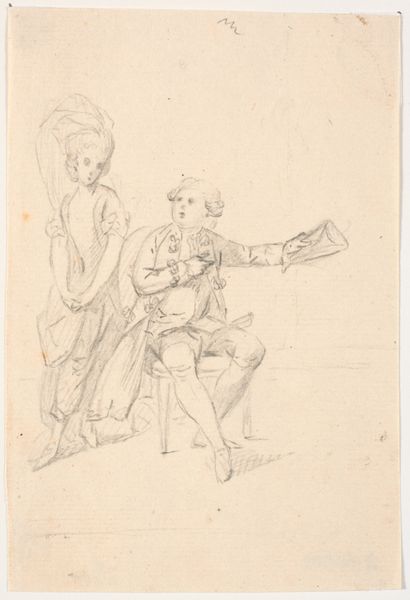
Auf einem Stuhl sitzender junger Mann, der von einem stehenden Mann frisiert wird c. 1770 - 1774
0:00
0:00


drawing, graphite
#
portrait
#
drawing
#
15_18th-century
#
graphite
#
genre-painting
Copyright: Public Domain
Curator: Welcome. Today, we are looking at a drawing by Georg Melchior Kraus, created sometime between 1770 and 1774, titled, *Auf einem Stuhl sitzender junger Mann, der von einem stehenden Mann frisiert wird*, or, *Young Man Sitting on a Chair Being Coiffed by a Standing Man*. Editor: Well, right off the bat, I am intrigued by the intimacy it suggests. The delicate graphite lines portray a mundane moment with striking sensitivity, but there's definitely something inherently unsettling about the dynamic between these two figures and their perceived social statuses. Curator: Yes, Kraus uses graphite with exquisite control. Observe how he models the forms, relying on subtle tonal gradations to convey light and volume. It’s a fine example of eighteenth-century draftsmanship, prioritizing clarity of line and anatomical precision. Editor: But isn't it interesting to consider this work as a mirror reflecting social hierarchies of the time? We see how personal grooming was not always a private affair but a performance interwoven with class dynamics. The man standing seems to be performing a duty for the seated man, subtly hinting at dependence and power. Curator: Certainly, there is an element of patronage visible. However, what interests me more is the way Kraus employs classical techniques within a genre scene. The composition, the rendering of fabric, all suggest academic training grounded in the principles of ideal form. The lines, while delicate, maintain a crispness, adhering to the conventions of Neoclassical art. Editor: I see that, and yet I can't shake the feeling that the drawing isn't merely about aesthetics. Think about how the seated figure has his back turned to us. He has an odd expression; perhaps the coiffure itself becomes a signifier of forced conformity and ritualistic behavior—not unlike current trends dictated by mainstream fashion. Is his gaze towards liberation or compliance? Curator: That reading introduces a fascinating layer to our understanding. Ultimately, Kraus has succeeded in capturing both the immediate observation of everyday life and a timeless elegance, making it a very intriguing artwork. Editor: Agreed, it makes me ponder not just the beauty of the line but the subtle narratives woven into its strokes, reminding us how art serves as both document and dialogue.
Comments
No comments
Be the first to comment and join the conversation on the ultimate creative platform.
 Collect
 React
React Comment
More like this